|
Sunday, March 30, 2008
On the most recent bloggingheads.tv you can watch Paul Bloom explaining why he thinks the propensity for theism is an innate bias of our species. Several years back Bloom wrote a piece for The Atlantic, Is God an Accident?, where he makes a similar case. But the general outline of Bloom's line of thinking is actually most powerfully argued in Scott Atran's In God's We Trust. The cognitive psychologists and anthropologists who work within this paradigm operate under some background assumptions in regards to our mental architecture. First, human cognitive states are strongly biased by innate tendencies which have a biological origin. Perception and language acquisition are easily explained by nativist treatments, but Atran and others have argued that more obscure biases such as folk biology also exist, while other domains such as theory of mind are broadly accepted within the scholarly community.
One can conceive of a model where on a lower structural level a set of biological parameters interact with exogenous inputs to generate a set of psychological biases. But the subsequent mental skills are not independent, and I suspect broadly distributed ones contingent upon environmental inputs such as language are among the least encapsulated from other cognitive domains. It seems rather clear that language aptitude is one of the components which can be used to explain the facility for mathematical abstraction, but it can not explain the totality of this skill. Cognitive anthropologists have also noted that preliterate peoples have extreme difficulties with comprehending the logic or rationale behind syllogistic reasoning (see Kluge: The Haphazard Construction of the Human Mind), suggesting that there are strong cultural preconditions to particular styles of thinking which may seem natural to us. Even though language, reading and writing all are learned, they are also facilities which we as humans have an innate aptitude for because of our neurobiology (language is obviously "more innate" insofar as it seems that our priming is so strong that it might emerge out of any conventional socialization processes, which literacy is historically and culturally contingent). Another working assumption of Bloom, Atran & co. is that a great deal of our cognition is implicit. Again, this is well accepted among the community of scholars. It stands to reason that our conscious mind lives under the illusion that it is all that there is, but a substantial body of work tells us that most of our conscious decisions are strongly influenced and primed by subconscious background parameters. Not only does this include priming an individual immediately prior to a psychological task, but it also includes the enormous swath of territory which falls under the category of intuitive thinking. A dense network of background connections and implicit inferences is often an outsized shadow of the visible chains of reflective rationality. Even in structurally transparent and deductive disciplines such as mathematics the dark-net of subconscious facts and assumptions loom large in the process of creativity. The fact that psychological biases have many different upstream neurobiological and environmental parameters, as well as the syngergistic nature of cognition which produces subsequent cognitive abilities (e.g., mathematics or painting which includes perspective), means that a hypothesis that posits a God Module is obviously going to be false. There are god modules such as the medulla oblongata, but only insofar as they are necessary for the proper functioning of a human in general. But it seems highly unlikely that there is one localized region of the brain which is specifically the causal element for belief in God (i.e., if said region is damaged atheism ensues, but most other cognitive function is left unscathed). This assumption doesn't derive simply from an a priori understanding of how the mind works; we can see it in how the phenotype of theism plays out. The pathological character of many aphasia sufferers is pretty obvious; in contrast the avowed attitude toward the God hypothesis is characterized by a rich range of opinion in terms of both plausibility and character. In other words, religion is more properly characterized as a quantitative trait which exhibits a wide range of continuous variation, subject to a norm of reaction. Do note that I said avowed attitude; when it comes to theism there are many ways to evaluate belief or lack thereof. Despite wide variations in verbal descriptions of the particular flavor of deity believers assent to, psychologists know that the implicit model of most humans in regards to supernatural agents is strongly constrained. This is one of the main reasons that many cognitive scientists believe that our mental architecture is rigged toward a belief in god; not only do the gods which individuals from widely disparate societies model in their mind's eye differ from the entities which they avow a conscious belief in, but those psychological constructs exhibit a very strong universal central tendency. In other words, the human model of a god, or supernatural agent if you will, seems to be predicated on the various elements of universal neurobiology. Unless strongly constrained by experimental or observational methodologies as in natural science, or a rigorous formalism as in mathematics, our species tends to reason extremely sloppily so that inferences unmoored from experience or unchanneled by formalism invariably explore an enormous sample space of possibilities starting from the same axioms. That humans tend to conceive of the same god-construct despite lack of communication or outside input suggests that the channeling is occurring on an innate level. Additionally, not only do theists no matter their affiliation agree upon an intuitive model of God, but so do atheists. Paul Bloom has noted that the offspring of secular parents are usually innate Creationists. Many of the ideas bracketed within "religion" are very natural and intuitive. In our gut we know them to be "true" without deep reflection or analysis. Atheism can not exist without theism because it is simply a negation of the latter. It is a conceit of many atheists that children are naturally unbelievers and that they are indoctrinated into a religious system of belief. This is correct; children are indoctrinated into a system of belief, but more specifically they are indoctrinated into a system, not a belief. That in almost all human societies a supernatural model of the world is numerically dominant strongly suggests that these sorts of belief do not necessarily need the institutional scaffolding of established churches or professional priesthoods. Rather, it seems that these features of religion are secondary and subsequent, and that they operate upon the preexistent assumptions of the population. Some atheists live under the delusion that the withering of organized religion will result in the collapse of belief in God or the supernatural; this is not so. Though the extremely high rates of theism in some societies may be an upper bound contingent upon social and historical conditions, in no society does it seem there exists an inverse dynamic where theism is extant at trivial levels. Note that even after 70 years of state sanctioned atheism Russians have now swung back to a default affiliation with their historical religious identity as Orthodox Christians. This is not to say that Russians are a religiously fervent people; rather, the high levels of atheism espoused during the Soviet era was a function of a skewing of the environmental inputs which shifted the median value of the trait distribution. With the norm relaxed the distribution has shifted back. The plausibility of theism doesn't need to be something we note only in terms of macrosocial metrics in regards to religious affiliation cross-culturally. As I imply above, theism is at root a psychological phenomena, and the bundle of biases and presuppositions which our biology confers upon us stack the deck in terms of weighting the plausibility of god concepts. This applies to atheists as well. We might not believe in god on the conscious level, but that does not mean that we are immune to the priming affect of agents, and likely supernatural agents as well. The folk wisdom about there being no atheists in foxholes is a reflection of this assumption. Now I'm not going to tell anyone who says they don't believe in god that deep down they really do believe in god; rather, I simply believe that many of the psychological characteristics which prime one for finding god plausible are present in those who consciously assert that they don't believe in gods. For example many atheists may feel unnerved in cemeteries despite a materialist world-view; the psychological response may be a result of social conditioning, but it is also possibly a cognitive reflex at an intersection of environmental inputs (think snake aversion as something similar). So far I have alluded to biology & psychology, but what about the higher-level social sciences? Paul Bloom and most cognitive scientists are focused on the first two disciplines, so they tend to strongly adhere to a model that religion is a byproduct of our cognitive architecture. An analogy might be the heat given off by the functioning of a car's engine; the heat is not a designed product of the various components of the engine, but it is an inevitable byproduct of the physical processes entailed by combustion. Similarly, theism may not be an adaptation to any exogenous selection pressure, but the intersection of various adaptive psychological characters such as agency detection, theory of mind and folk biology necessarily lead to the plausibility of supernatural agents within the minds of most humans. Because of Bloom's disciplinary focus he tends to not be very open toward a functionalist explanation for theism; that theism (or religion) is an adaptive trait which increases individual fitness. Insofar as explanations at a lower level of organization are preferable to those at a higher level, I think that Bloom's skepticism is warranted. But even cognitive anthropologists who tend to focus on the psychological dimensions of theism can't dismiss the social aspects of religion, and a substantial body of social science research implies that variation in religious belief might track other social variables. Instead of repeating the functionalist explanations elucidated by scientists such as David Sloan Wilson (see Darwin's Cathedral), I think it is easy to illustrate the relation of these various theories by using an analogy with narrative. Despite the attempts of authors who dabble in "experimental fiction" it seems pretty obvious that a great story has a dimension of temporal permanence derived from the timelessness of the primary themes and styles. The Epic of Gilgamesh speaks to us even after 4,000 years, and many of its motifs are still extant in the heroic fantasy genre. Despite the lack of qualitative originality in plot and the constraints upon the plausible range of the psychology of characters we continue to consume fiction because our brains are attracted to particular themes arranged in a familiar structure. One could contend that fiction is a waste of time, but it seems likely that the same mental ticks which draw us to compelling stories are useful in other areas of life. But narrative is not only a byproduct of our promiscuous mental functioning, it is an essential part of myth-making and religion. The cognitive anthropologist Pascal Boyer has reported on research which suggests that minimally counterintuitive stories are the ones which are most memorable and "sticky" over the long-term. In other words, experimental fiction is just too weird to really make a deep impact, you don't have any common basis for associative memory to operate. In contrast, exceedingly conventional and banal narratives just don't add anything new to the base of data. A boring story is a boring story. But a familiar scenario with just the right amount of spice adds enough twists and turns within the comprehensible base to make it memorable enough to catalog and retrieve later. This explains why most science fiction and fantasy tends to constrain the deviation from normality; you can't relate to a story where most of it is unfamiliar or disorienting. Of course narrative is an essential part of religion. Even "primitive" religions have a robust narrative base; tales of gods & heroes unfettered by abstruse theologies. The story of Jesus as depicted in the Gospels has a power to draw people in and inspire them toward belief & action. In contrast, despite the fact that Christians accept the divine provenance of Deuteronomy, very few believers have ever recounted to me how it inspires them or serves as the ground of their faith. Just as narrative emerges naturally as a byproduct of our overall psychological architecture, it also immediately slots into the overall cultural entity which we label "religion." I suspect the exact same model is applicable to gods; their plausibility precedes their integration into a religious framework and does not derive from direct adaptation. But the universal nature of religious frameworks as well as storytelling implies that these byproduct traits are almost always subject to co-option by cultural systems which are canalized toward a particular configuration. But what is driving that canalization? I suspect there is some functional selection going on. Like many social science generalizations I'm not sure I can be very general here. David Sloan Wilson has collected data which shows that religious fundamentalism is more noticeable in economically depressed regions. Which way does the causality run here? I suspect that it is generally in the direction of economic insecurity to religious fundamentalism. The sociologist of religion Rodney Stark has elucidated a rational choice inspired framework which posits that religious institutions are firms which offer products which satisfy a fragmented market of religious consumers. This model seems highly plausible for the United States, but there are doubts as to its validity in other cultures where religious switching is not as socially acceptable or viable. Similarly, many of Wilson's adaptive arguments for the functional significance of religion are quite likely more relevant in societies which lack the accoutrements of the welfare state so that religious institutions have few competitors or substitutes. In other words, generalizations about the functional significance of religious institutions may not hold across many environments. Nevertheless, though generalizations on higher levels of organization are less impressive when compared to the relatively simplicity and universality of a biopsychological paradigm, I think it is necessary that we analyze the expression of religion outside the bounds of the human mind. After all, though religious ideas are fundamentally mental, they are embedded within a social matrix and have a geopolitical relevance in terms of how they shape human relations and action. We can, for instance, see that over the past few thousand years local tribal religions have ceded ground to the dominance of institutional religions which often have multiple products under the same brand name. The number of supernatural agents seems to be decreasing through a process of competition concurrent with the decrease in polities, languages and ethnic groups. But though institutional religions have gone through a process of consolidation this dynamic has limits; the fragmentation of Christianity during the Reformation or the schisms within the first centuries of Islam attest to this. Though religious institutions far exceed the scale of Dunbar's Number, a One-World-Religion seems as plausible as a One-World-Government. Psychologists have also attempted to move into broader domains of social science. Scott Atran has been at the forefront of attempting to synthesize the cognitivist viewpoint with an analysis of the nature of religious terrorism. Atran emphasizes the power of religious narratives & rituals in cementing group cohesion. The functionalist interpretation on this is pretty obvious; this is a case where heat from one process is quickly being utilized to generate energy through another. To some extent analysis of religious is like the species problem; we should measure the definition against the utility it provides in a particular context. Species define the joints around which nature is carved, and religion is a label for a cluster of integrated characters which we humans imbue with ontological significance. Both species and religion are important to understand, and can serve as frameworks for robust research programs, but a final definition will never be attained so long as scholars in disparate fields have distinct ends. A diversity of ends does not imply that these ends are contradictory, rather, when you have a many dimensional character it is necessary to observe from a variety of angles to obtain the clearest picture. Addendum: I want to add something: theism & religion are very robust phenomena. This is why adaptationist explanations are so compelling. That's why an analogy to misunderstandings due to intuitive physics (e.g., flat earth, variance of acceleration in proportion to mass of an objection) is informative, but only to some extent. Overactive agency detection feeds into something which is far more than the sum of their parts, the falsifiable manifestations of religion such as Young Earth Creationism can resist disconfirmation because of their association with psychological tendencies such as group conformity enforced by common rituals & beliefs. To say religion is a spandrel or exaptation understates its interaction with other aspects of human culture so as to make it inevitable and resistant to suppression. Related: The nature of religion and Breaking the Spell, Modes of religion, Who Dan Dennett think he be foolin'?, An evolutionary anthropology of religion, , God lives, deal with it!, , Belief & belief in belief, Logical consistency is irreligious, God & moralityAre people naturally religious? Yes.... , The round-eyed Buddha, Nerds are nuts, Atheism, Heresy and Hesychasm, The God Delusion - Amongst the unbelievers , Innate atheism & variation across societies, "Hard-wired" for God, Buddhism, a religion or not?, Why do people believe in God?, Is religion an adaptation?, Theological incorrectness - when people behave how they shouldn't....sort of , The gods of the cognitive scientists Labels: Cognitive Science, Evolutionary Psychology, Religion
Thursday, March 27, 2008
As a supplement to my post on Sewall Wright's method of Path Analysis, here is an article on the subject which I just found. I don't agree with all the authors' comments, but the historical background and references are useful.
Monday, March 24, 2008
Via Over Coming Bias, The science of religion - Where angels no longer fear to tread:
It is an ambitious shopping list. Fortunately, other researchers have blazed a trail. Patrick McNamara, for example, is the head of the Evolutionary Neurobehaviour Laboratory at Boston University's School of Medicine. He works with people who suffer from Parkinson's disease. This illness is caused by low levels of a messenger molecule called dopamine in certain parts of the brain. In a preliminary study, Dr McNamara discovered that those with Parkinson's had lower levels of religiosity than healthy individuals, and that the difference seemed to correlate with the disease's severity. He therefore suspects a link with dopamine levels and is now conducting a follow-up involving some patients who are taking dopamine-boosting medicine and some of whom are not. Any bets on what's causing this? I suspect low dopamine individuals are less likely to be socially conforming, so the effect on religiosity might be weaker in a society where religion is less important than the United States. But nice to see some neurochemical work on this. In the future perhaps neuroscientists will be able to advise parents on the optimal mixture of the "soup" in their offsprings' brains to increase the chances of religiosity, or decrease it? (Randall Parker has been talking about this for years) But probably the most interesting reported research in the piece has to do with group selection & functionalism: To test whether religion might have emerged as a way of improving group co-operation while reducing the need to keep an eye out for free-riders, Dr Sosis drew on a catalogue of 19th-century American communes published in 1988 by Yaacov Oved of Tel Aviv University. Dr Sosis picked 200 of these for his analysis; 88 were religious and 112 were secular. Dr Oved's data include the span of each commune's existence and Dr Sosis found that communes whose ideology was secular were up to four times as likely as religious ones to dissolve in any given year. These sorts of data are relatively persuave to me about the functional power of religious institutions and social dynamics. Of course, apparent deviations from the trendline will be important to examine too. This is the closest thing to a website I could find for the Explaining Religion Project. Labels: Religion
Friday, March 21, 2008
Over at my other blog I flogged Jamie Kirchick somewhat for what seemed to me a pretty obvious misrepresentation of basic facts. You might think these "gotchas" are picayune, but I don't think they are at all. Do you remember back in 2002 when Colin Powell misspoke about the "Sunni majority" of Iraq? These are not easy slip ups to make if you have a good model in your head for the situation on the ground in far off lands, rather, they indicate a thin network of contingent data. Scratching below the surface of the CIA Factbook is important. Knowing that 40% of Yemenis are Shia is an important fact, but knowing that most of these 40% are Zaidis, stereotypically the "most Sunni" of the modern Shia adds more nuance. Many of the rest are Ismaili, who are the "least Sunni." The smallest of the Shia groups are Twelver Shias. This is the largest of the Shia sects, and probably the most typical one in terms of compromising between Ismaili distinctiveness and Zaidi banality. It is the group dominant in Iran, the Gulf and Lebanon. Does this matter? If you think geopolitically in terms of the Shia Crescent, it does. Does thinking geo-politically matter? I'll leave that up to you.
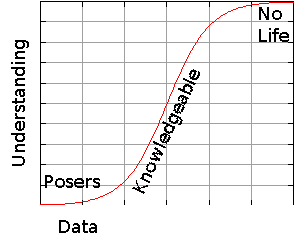 When we're talking about science there's a lot of precise and fixed background information we're working with. Not only are there facts, there are strong theoretical frameworks which give you "free information" and that you can use in your heuristics. Unfortunately there aren't that many robust theoretical frameworks on the scale of area studies. Facts matter because they're the only guides you have in making proximate decisions. Conclusions will differ between people because of different interests and alternative normative frames, but an agreemant on known background facts is essential for elevating the level of discussion above that of two blind people discussing the merits of Monet vs. Picasso (no offense to the blind readers of this weblog!). I don't really mind differences of conclusion based on varied norms or self-interest; but the casual pig-ignorance of very smart people on topics which they feel qualified to offer an opinion on irritates me because mitigation of a dearth of facts is relatively easy if you have the marginal time. My own experience is that the denser the network of facts the easier retention becomes. At a particular density threshold I suspect there is an increase of the marginal value of the fact in terms of discerning patterns and trends, though diminishing returns kicks in once we've attained all the perceptual power the human mind can expect. When we're talking about science there's a lot of precise and fixed background information we're working with. Not only are there facts, there are strong theoretical frameworks which give you "free information" and that you can use in your heuristics. Unfortunately there aren't that many robust theoretical frameworks on the scale of area studies. Facts matter because they're the only guides you have in making proximate decisions. Conclusions will differ between people because of different interests and alternative normative frames, but an agreemant on known background facts is essential for elevating the level of discussion above that of two blind people discussing the merits of Monet vs. Picasso (no offense to the blind readers of this weblog!). I don't really mind differences of conclusion based on varied norms or self-interest; but the casual pig-ignorance of very smart people on topics which they feel qualified to offer an opinion on irritates me because mitigation of a dearth of facts is relatively easy if you have the marginal time. My own experience is that the denser the network of facts the easier retention becomes. At a particular density threshold I suspect there is an increase of the marginal value of the fact in terms of discerning patterns and trends, though diminishing returns kicks in once we've attained all the perceptual power the human mind can expect.Many times I've criticized people for using a very weak analogy, or relying on fallacious background facts. These are critiques of process, and I can tell people get frustrated by this, they want to get to the conclusions and argue over the ends instead of the means. I think this is totally wrong-headed; imagine if someone wanted to discuss particle physics without taking the prerequisite mathematical & science courses (you encounter such retards regularly actually). Personally I would much rather listen to a well argued case or position at variance with my own than a weak case which buttressed a personally held opinion (my favorite form of masturbation is sexual). It is ultimately a game where we need to look beyond individual battles, and focus on the war. The long forever war to understand the world around us predicated on good faith and particular principles which keep the ecology relatively clean. For an appropriate equilibrium to be maintained cheaters must be punished lest they invade the ecosystem. Labels: Razib Guru
New PLOS paper, Geographic Patterns of Genome Admixture in Latin American Mestizos. Nothing new, but pushing the ball forward....
 A = autosomal X = X chromosomal
Thursday, March 20, 2008
If you are a male, and someone says your mother is a slut, how do you respond? I think most non-autistic individuals, even if they are reflexive pussies as many civilized American men raised in urban areas and suburbs tend to be, will feel an urge to react violently. I think we can agree that someone calling your mother a slut does not have obvious material consequences; it isn't inimical to your economic interests, especially if the exchange occurs in a bar and your interlocutor and yourself are drunk. I won't rehash evolutionary psychological arguments for why there's a tendency for most males to react viscerally with rage when someone insults the sexual character of their mother; I simply want to use it to illustrate the power of words and concepts which have no material consequence, and might not even be rooted in fact. A stranger who throws this insult at you usually doesn't even believe in its accuracy, his usage of the phrase is calculated to offend and elicit a reaction. There are certain things which are sacred, certain lines you don't cross. Sometimes these are strongly biased by biological parameters (e.g., I suspect near-family incest taboos is one of these), and sometimes they are not. It is the latter case I was thinking about a few months ago when I read Rome & Jerusalem: A Clash of Ancient Civilizations and God's Rule - Government and Islam.
You see, the ancient Romans and Muslims did not have kings. Kings were tyrants, and the early Roman and Islamic polities rejected such tyranny on principle. So of course, instead of kings, the Roman Empire was headed by an emperor, while the Muslims had caliphs.1 Get it? When Augustus defeated Mark Antony and Cleopatra the official narrative was that the doughty republican traditions of Rome had bested once more the oriental despotism of the Hellenistic world, with their Greek kings and queens. Similarly, the righteous Abbasids overthrew the despotic Arab Kingdom, the Umayyads. In its place they established a genuine Islamic state which was guided by the traditions of the community as opposed to profane naked autocracy. Right.... As you can see here, the extent of the self-deception and semantic delusion is really humorous. Now, it is true that the early emperors of Rome tended to keep up the illusion that they were simply stewards of the Roman Republic with some verisimilitude.2 Augustus' shtick was that his was a restorationist project; he was no dictator or king, just the First Citizen. Similarly, the early Abbasids were ostensibly bringing the vision of the Islamic community to its true fulfillment (especially the Shia party), whereas the Umayyads had been worldly Arab tribalists more in keeping with the values of the jahiliya. But the reality is that Augustus' Rome was as republican as Constantinople in 1453 was the capital of the Roman Empire. Similarly, the Abbasids resurrected the values of the primitive ummah by way of formulating a more ideologically coherent oriental despotism than the barracks state of the Umayyads. Despite their more effective propaganda the Abbasid caliphs integrated pre-Islamic Sassanid motifs into their court far more than the Umayyads ever had. But this sort of pro forma packaging mattered a great deal. Muslim soldiers were enraged and shocked when the conqueror of Spain allowed his Visigothic wife to convince him to don a crown and so indicate kingship; they accused him of becoming a Christian. This despite their own fealty to an Umayyad regime which was excoriated later in history by mainstream Muslims as a semi-pagan autocracy! These sorts of issues tie in to events and dynamics we see in the modern world. Muslims, for example, wish to criminalize blasphemous criticism of their prophet, desecration of their holy bookm and disrespect of their religion generally. Obviously they're met with skepticism from non-Muslims, but a number of them analogize their position to that of Europeans who ban Holocaust Denial. Dismissing the details of the analogy and my personal rejection of these Holocaust Denial laws, it is important to state that I think it trivializes the extermination of millions of human men, women and children on an industrial scale to compare this to an insult to an idea, or the desecration of a configuration of ink, paper and binding which results in a Koran. My own perspective is pretty obviously conditioned by the fact that I accept that human beings were tortured and killed en masse 60-70 years ago, while I don't think that the Muslim religion is anything more than a belief system rooted in made up stuff. The only damage is done to feelings, not a One True God. That being said, a billion people have invested a lot of psychological import into these beliefs and they just go insane when you insult those beliefs. Billions of others can empathize on some level because they have other beliefs which are cognate in the broad outlines. In the West, what I like to think of as the civilized world, there has emerged a consensus that constrains, and almost devalues, sacred lines and the right to take offense. Feelings rooted in immaterial beliefs still matter; if one makes a religious objection to a public norm one is accorded more credibility than if one makes an areligious objection (e.g., prisoners who need a special diet due to religious restrictions vs. those who really hate the taste of the cuisine). But to a large extent the power of religion to defend itself from blasphemy through the arm of state power has been abolished, even if there are blasphemy laws on the books in many jurisdictions. The transgressive assertions of men such as Denis Diderot in the 18th century broke down those barriers, and the reality of religious pluralism in the United States meant that reciprocal blasphemies between Protestants and Catholics occurred which did not elicit the intervention of the state as in the past lest it enflame the conflict furthermore. In any case, the attempt by Muslims to resurrect in the West the enforcement of pietas by governmental fiat has changed my own opinion as an atheist about the value of religious pluralism. Because I believe that religious sentiment and feeling is normal, and will be dominant in our species barring a reprogramming of the software, I think that one religious tradition is probably easier to manage in terms of negotiating the terms of relating state, religion and the role of the ontologically blasphemous irreligious minority within a society (by ontologically I mean that by the very nature of my atheism & apostasy I offend against Islam, for example). Since the militant secular party is by definition a negative one, objecting to the prescribed social pieties, it is much simpler when one has to face-off with a unified front and one dimensionality of supernaturalism. With the rise of a polycentric supernatural marketplace the act of negation multiplies in complexity as the permutations of absurdity increase ever upward. Diversity has costs, the common norms are essential so that even transgression of those norms can be regularized and tolerated reasonably. Addendum: I want to add that I was in rural Bangladesh during the Rushdie Affair. I was called on to translate some photocopies of English pamphlets which in hindsight totally misrepresented the The Satanic Verses (long story short, they made it sound like Muhammad's wives were starring in a novelization of EuroGangBang #69, and it was kind of awkward for me since I didn't know the appropriate words in Bengali for a lot of the stuff). But it was notable that many of the young Muslim men were enraged about something that they barely even comprehended in its accurate details. Feelings.... 1 - Minor note before David Ross points this out, but the term imperator did not come to be regularly used by the emperors until the Flavians. Before that they had been only the princips. 2 - The transition from First Citizens of the Julio-Claudian period to the autocrats (of the Byzantine Empire was a gradual one. The Flavians in the late 1st century reiterated the hereditary principle and banished any delusion that a senatorial resurrection was in the offing. Septimius Severus in the early 3rd century crystallized the idea that the law was an expression of imperial will as opposed to senatorial consensus. Diocletian in the early 4th century introduced the proto-medieval regalia which typified Byzantine autocrats, an oriental court and diademed crown. Labels: History
Tuesday, March 18, 2008
It's hard to have a recessive lethal hang around for a long time without some kind of heterozygote advantage: selection reduces its frequency. If the population is even moderately large, more than a few thousand, changes in allele frequency over time are very predictable: deterministic.
That also means that one can calculate past frequencies, as long as as these assumptions hold (i.e. as long as there was no tight bottleneck & selection coefficients were the same). Going forward in time , the frequency of a recessive lethal with no het advantage declines more and more slowly, since the ratio of homozygotes to heterozygotes declines as the allele frequency declines. But if you go backward in time, the frequency grows, and it grows more and more rapidly as you go further and further back in time. This doesn't continue indefinitely: the frequency can't go above 100%. Project the frequency of such a recessive lethal back in time and you hit a singularity. Today, lethal cystic fibrosis alleles have a frequency of 2% in northern Europeans. Unless I'm wrong, it takes 50 generations for a recessive lethal to go from almost 100% to 2%, and another 50 to go from 2% to 1%, assuming no reproductive compensation. 'Reproductive compensation' means that parents have another kid when one dies young and thus end up with the same number of children raised to adulthood. This effect weakens, but does not eliminate, selection against lethal recessives. With full reproductive compensation, it takes 80 generations for a recessive lethal to go from 99.5% to 2%, and another 75 to go from 2% to 1%. If the frequency of lethal CF alleles is 2% today, there must have either been a selective advantage in heterogygotes over most the of the past two thousand years, or the population of northern Europe must have crashed down to a few hundred or less sometime during that period. There was no such crash, which would have been worse than a nuclear war. Indeed, there was no bottleneck of any kind in that time period: we know this from the historical record. Events like the Black Death do not a bottleneck make: you need to get the population down into the low thousands or less. The Black Death left tens of millions. So lethal CF mutants had some kind of selective advantage, or were closely linked to some allele that did.
I was talking the other day with a friend about why economists think they're so smart to the point of ignoring easily accessible data from other fields. Will points me to this Greg Clark review of a new book from the field of economic sociology, Adam Smith in Beijing. Clark doesn't think much of the reasoning, and my own first reaction was shock at what seemed to be a childishly naive argument worthy of a simpleton if the summary is accurate. Whatever the merits of the book, the arrogance of economists made a lot more sense if these were their adjacent fields whose scholarship they were aware of. Especially considering the relatively large number of economists who switched from physics or mathematics. Here are average GRE scores by intended major for graduate school.
Monday, March 17, 2008
 Pursuing a hunch inspired by a post on breast size and getting married by Irina, I managed to hunt down a study that shows the characteristics of the Boobman, Assman, and Legman. First though, I could not find any studies that investigated what non-obvious correlates there may be of breast size, rump size, or leg length. So I can't back up Irina's observation that larger breasts, as opposed to say a rounder butt, make a woman more likely to get married. Pursuing a hunch inspired by a post on breast size and getting married by Irina, I managed to hunt down a study that shows the characteristics of the Boobman, Assman, and Legman. First though, I could not find any studies that investigated what non-obvious correlates there may be of breast size, rump size, or leg length. So I can't back up Irina's observation that larger breasts, as opposed to say a rounder butt, make a woman more likely to get married.The idea is not ridiculous: females vary in their reproductive strategies, some specializing in shorter-term and some in longer-term relationships, for example. And like many strategic choices, there is likely a trade-off: to wit, between investing a finite amount of body fat more in the upper or more in the lower region. Larger breasts could reflect pleiotropic effects of genes that also contribute to being more focused on stability and the long-term in mate choice. Or perhaps men who are more of the "good dad" type have a bias toward larger breasts, so that these are a response to the preferences of guys who will stick around. Moving on to what I do have data for, let's see what Wiggins et al. (1968) have to say about what men with different physical tastes are like. They asked 95 male college students which silhouette drawings they preferred, and these independently varied the size of the breasts, butt, and legs: each appeared in a "normal" size, somewhat large, large, somewhat small, and small. They completed personality questionnaires and provided demographic background info. Men who preferred the "large" figure -- large breasts, large butt, and large legs -- were characterized by "a need for achievement." Those who preferred the "standard" figure -- normal size for all parts -- were characterized by "a tendency to be disorganized in personal habits." And as for the small figure -- small size for all parts -- Those who preferred the small figure tend to persevere in their work. They are not cynical about authority and reported coming from an upper-class background. Although the small figure was generally disliked by the present group of subjects (Table 1), it very well may be a preferred type among members of the upper class (Moore, Stunkard, & Srole, 1962) as suggested by the present data. I don't think there's any deep evolutionary strategy going on with upper-class people preferring petite females. It could just be a fashion statement. Men who like large breasts: Also characterizing large-breast preference was a tendency to date frequently, to have masculine interests, and to read sports magazines. Further, large-breast preference was related to a need for heterosexual contact and for exhibitionism (saying witty things and being the center of attention). In social relations, men who preferred the large breasts tend to be non-nurturant and independent. This latter result gives support to Scodel's (1957) finding of a lack of fantasy dependence among college men who preferred large-breasted figures. In the present study, preference for large breasts was positively correlated with smoking and negatively correlated with endurance (perseverance in work habits). Sounds like the Boobman is a gregarious "guy's guy." Men who prefer boobs that are friendly and unpretentious:
Men who prefer large buttocks (that is, men who are not homosexuals):
Sounds like the Type A businessman or political leader. (I would say "alpha-male," but that wouldn't be very self-abasing, would it?) Quoth bodybuilder, badass actor, and governator of California Arnold Schwarzenegger (watch from 1:35 - 2:25 in this clip): "I can absolutely understand why Brazil is devoted to my favorite body part - the ass." Men who like small buttocks: Unlike those who preferred large buttocks, those who preferred small buttocks tend not to be self-abasing. They tend to persevere in the completion of their work and do not feel the need to be the center of attention. As a group they tend not to be education majors and their reading interests do not include sports magazines. Men who like large legs: The most substantial correlate of large-leg preference is an abstinence from alcoholic beverages as indicated by the negative correlation with both drinking and amount of drinking. Those who preferred large legs are nonaggressive and self-abasing (guilty, self-blaming). They tend to be psychologically minded (intraceptive) and are characterized by a slow personal tempo. . . Subjects who preferred large legs indicated that they are not business majors and that they would choose their mother over their father if they had to make a choice. The personality pattern suggested by these correlates is one of inhibition and restraint in social situations. Men who like small legs: [P]reference for small legs is characterized by a strong need for social participation. Those who preferred small legs are characterized by needs for nurturance, affiliation, and exhibitionism. That is, they are helpful to others, feel a need for social participation, and like to be the center of attention in social situations. They are also socially dependent and tend not to stick at a task until completed. So, men who like the "large" figure (the one who's tall and has t&a) are the more ambitious ones, the Boobman sounds like a social guy's guy, and the Assman sounds like a Type A businessman. It's possible to interpret this pattern as showing that the Boobman is more likely to settle down with one woman, while the Assman would be the polygynous executive type. Admittedly, the data aren't very clear; they certainly don't contain any direct information about willingness to marry, thoughts on monogamy, and so on. It has been 40 years since this study was done, but in my search I could not find any follow-up studies -- you have to admit that it's not exactly a major research concern. If any readers know of similar studies, or especially of studies on the non-obvious correlates of female breast, butt, and leg size, please say so in the comments. * I believe "not psychologically minded" in this case means they tend to think of people in simple stereotypes rather than using complex and varied concepts. Terms like "psychologically minded" and "intraceptive" are fossilized jargon from 40 years ago, and it's not totally clear what is meant. Reference: Wiggins, J.S., J. Wiggins, & J.C. Conger (1968). Correlates of heterosexual somatic preference. J Pers Soc Psych, 10(1): 82-90. Labels: babes and hunks, Personality
Sunday, March 16, 2008
Finnish Parliament debates proposal for "love vacations":
A proposal by MP Tommy Tabermann (SDP) to grant all employees a paid 7-day "love vacation" once a year led to an exceptionally colourful debate in Parliament on Thursday evening. Tommy Tabermann is a poet, but I don't think he's working on a follow up to the Kalevala. Labels: Finn baiting
Saturday, March 15, 2008
During the height of the Roman Empire there was a NW-SE (of course mostly west to east) gradient in per capita income. This is well known. One of the reasons given for the collapse of the Western Empire in the 5h century in contrast to the persistence of the Eastern Empire is that the provinces of the latter were wealthier and so could afford initiatives such as bribing barbarian tribes to move on toward the west. In Contours of the World Economy 1-2030 AD Angus Maddison confirms this (table below the fold). Additionally, in Peter Heather's The Fall of the Roman Empire the argument is also made that expansion beyond the Rhine did not occur mostly because of the poverty of the lands; the lack of tax base meaning that the conquest wouldn't have been self-supporting. So as you go north there is an inversion of the east-west wealth gradient. The main exception to this clinal geographic distribution of wealth is Italy, for obvious reasons. But there are a few other data which Maddison alludes to which interest me in relation to per capita income. He confirms that Germans were larger and more physically robust because they had more meat and milk in their diet (better sources of protein). Maddison also notes that Roman culinary science which reflected the needs and interests of the elites had a strong focus on condiments and sauces because even imported foods tended to go bad. I know that the Dutch became wealthy in the early modern period in part by exporting salted herring, but these data seem to imply that the Roman trade in food was mostly in grain. Unless curred or salted it seems that vegetables and meats wouldn't make it. If there had been magic preservatives perhaps those in the wealthier provinces would have purchased milk & meat to shore up their nutritional intake? But decomposition constrained the possibilities for trade across long distances in such perishable food stuffs.
I bring this up because in Farewell to Alms Greg Clark used the distribution of lactose tolerance to imply that northern Europe had always been very wealthy, since after all milk was produced from cows which indicated a relatively high standard of living where land could be given over to husbandry. Now, Clark is obviously a smart guy, smart enough that Brad DeLong seems to have creamed himself with praise over his book, but that sort of assertion seemed really dumb and reinforces the perception that economists don't know jack. After all, we have a good idea of the distribution of lactose tolerance and the nature of its evolution, and it seems that ecological constraints and possibly path dependence is very critical in conditioning whether this trait will emerge. In fact, as I note above scholars of the Roman period assume that the lands of Germany were relatively sparsely populated and poor if material data are any evidence (Hitler was irritated with Himmler for funding archaeological digs in Germany and Scandinavia because he felt it just made the ancestors look primitive). Gaul was wealthier and more densely populated. That serves to explain why it remained occupied after being gutted for the glory of Julius Caesar, while the campaigns of Germanicus served mainly to buttress the popularity of his insane son the emperor Gaius (Caligula). Reading economic history I notice all sorts of glosses and oversimplifications when it comes to cultural details. I don't mind that too much; I don't read Maddison's work for his analysis or even his often tenuous causal claims, but rather for his copious data sets. Nevertheless, when it comes to something like inferring economic conditions from biological data one can work out objections from the armchair without reading historical works. The extrapolation does though require taking non-economic dynamics and conditions seriously, which Clark presumably does. Note: The estimates below are for 14 AD.   Labels: History
A long time ago I said I was planning a series of posts on the work of Sewall Wright. I am finally getting round to it.
I originally planned to write notes on the following topics: 1. The measurement of kinship. 2. Inbreeding and the decline of genetic variance. 3. Population size and migration. 4. The adaptive landscape. 5. The shifting balance theory of evolution. I still hope to cover these topics, but I will begin with a few notes on Wright's method of Path Analysis..... Path Analysis is Wright's main contribution to statistical theory. It is one of several methods of multivariate analysis developed between 1900 and 1930, after the basic theory of multivariate correlation and regression had been established by Karl Pearson and others in the 1890s. Other types of multivariate analysis include Factor Analysis, pioneered by the psychologist Charles Spearman in 1904; Principal Component Analysis, developed by H. Hotelling in the 1920s but foreshadowed by Karl Pearson in 1901; and Analysis of Variance, due mainly to R. A. Fisher from 1918 onwards. A bibliography of Wright's main work on Path Analysis is available here. The three most useful items are: 1. Correlation and causation (1921) 2. The theory of path coefficients: reply to Niles's criticism (1922) 3. The method of path coefficients (1934) Items 1 and 3 are available as pdf downloads linked to the online bibliography. Item 2 is not, but it is available here. As I mentioned in a previous post, a page is missing from the pdf file of item 1, but fortunately the most important part of the missing page (the definition of path coefficients) is quoted verbatim in item 2. The distinctive feature of Wright's path analysis is that it introduces questions of causation into the treatment of correlation and regression between variables. Every statistics textbook makes a ritual statement that 'correlation does not imply causation', but in practice there very often is a causal relationship between correlated variables. Path Analysis provides a systematic means of investigating such relationships. As Wright several times emphasised, it does not provide a method of discovering or proving causal relationships, but if these are known or hypothesised to exist on other grounds, Path Analysis can (in principle) help quantify their relative importance. The following comments are in no way intended as a substitute for reading Wright's own studies, which are essential. I am only aiming to provide supplementary explanations on points which Wright deals with very briefly, and sometimes obscurely. In particular, I want to clarify the relationship between Path Analysis and multivariate correlation and regression. Wright's own attitude on this seems to have changed over time. It seems that initially he was dissatisfied with what he thought of as paradoxes in the existing methods, and wanted to provide a substantially different approach. But in the course of his work he discovered that his own system was more closely related to conventional multiple regression than he had realised, and increasingly he emphasised this relationship. In Path Analysis the investigator first devises a model, shown in a path diagram, representing the assumed direction of causal relationships among a number of variables. There will be one or more dependent variables, and one or more independent variables which are assumed to influence the former. Some variables may be intermediate links in a chain of causation. The independent variables may be either correlated or uncorrelated with each other. Each segment of a path in the diagram is assigned a path coefficient which quantitatively measures the strength of the causal influence along that segment. The fundamental problems in understanding Path Analysis are: what exactly are these path coefficients? And how are they to be quantified? I will return to these questions shortly. Assuming for the moment that all the path coefficients are known, the correlations between the variables can be derived from the path coefficients by a few simple rules. Briefly, the correlation between any two variables is the sum of the products of the path coefficients along each distinct path (or chain of paths) joining the two variables. For this purpose a correlation between two independent variables can be counted as a path between them. The relative importance of the causal influence of an independent variable on any given dependent variable can be measured by the square of the path coefficient between them, which Wright calls a 'coefficient of determination' (possibly the first use of this term). The rules for operating with path coefficients are explained by Wright reasonably clearly in 'Correlation and causation' and later papers. [Note 1] The real difficulty is to understand the nature of the path coefficients themselves. Wright's verbal explanation is that 'the direct influence along a given path can be measured by the standard deviation remaining in the effect after all other possible paths of influence are eliminated, while variation of the causes back of the given path is kept as great as ever, regardless of their relations to the other variables which have been made constant.' This is defined as 'the standard deviation due to' the independent variable in question. The path coefficient itself is then defined as the ratio of this standard deviation to the total standard deviation of the dependent variable. This definition is not ideally clear, especially for cases where the independent variables are correlated with each other. Various objections were made in a critique of Wright's theory by Henry Niles. In his 'Reply to Niles' Wright admits that 'the operations suggested by the verbal definitions could not be literally carried out in extreme cases, and the definition is therefore imperfect'. Wright points out, however, that the path coefficient can always be calculated by the methods described in his 1921 paper. In the later paper on 'The method of path coefficients' Wright offers a variant on his original definition which is perhaps a little clearer: 'Each [path coefficient] obviously measures the fraction of the standard deviation of the dependent variable (with the appropriate sign) for which the designated factor is directly responsible, in the sense of the fraction which would be found if this factor varies to the same extent as in the observed data while all others .... are constant'. The problem with both formulations, as Wright was aware, is that in the case of correlated independent variables they seem to require a counterfactual assumption. If all variables other than the dependent and independent variables of interest are held constant, but one or more of those other variables are correlated with both of the variables of interest, then both of the latter variables will have their variability reduced. By insisting that the causative variable of interest retains its full variability, Wright is therefore assuming a counterfactual condition. In order to keep the variability of the causative variable unchanged, Wright says 'the definition of [the standard deviation in X due to M] implies that not only is [the other independent variable] made constant but that there is such a readjustment among the more remote causes .... that [the standard deviation of M] is unchanged ('Correlation and Causation', p.566). What Wright meant by 'readjustment' is unclear to me and, so far as I know, Wright never attempted to explain it. The causal relationships are what they are, and any 'readjustment' sounds like an artificial if not improper procedure. Rather than make further efforts to decipher Wright's formulations, I think it will be more useful to approach the problem from first principles, drawing on the general theory of correlation and regression as set out in my Notes on Correlation, Parts 1, 2, and 3. I hope to show that Wright's path coefficients can in fact be derived in a way which avoids the problems of his verbal formulations. I will assume linearity of all relationships. (Wright also in general assumes linearity, but does briefly consider the effects of departures from linearity.) It is presupposed, of course, that items represented by one variable are associated in some way with the items represented by the other variables, e.g. that the height of fathers is associated with the height of sons. The general idea behind Wright's definition is that variation in one (independent) variable has an effect in producing variation in another (dependent) variable. Since we are assuming linearity, the size of the effect should be simply proportional to the size of the cause. This naturally suggests a connection with statistical regression. The regression of one variable on another measures the average size of the deviation in the dependent variable as a proportion of the associated deviation in the independent variable. In the case of a causal influence, it is therefore reasonable to say that a certain amount of variation in one variable is caused by or 'due to' its regression on the other. The effects caused in this way will have a calculable standard deviation, which can be taken as a measure of the total size of the causal influence. Case 1 Let us begin with the simplest possible case. Suppose there is one dependent variable, X, and one independent variable, Y. I assume, as usual, that the variables are measured as deviations from their means, in appropriate units (not necessarily the same for both variables). Let the regression coefficient of X on Y be designated bxy. We are assuming that each unit of variation in the items of Y has a simple proportional effect on the corresponding items in X. The proportion must then be equal to bxy, since this is a measure of the proportional mean deviation in X associated with a given deviation in Y. For example, if bxy = .6, then for each deviation of 1 unit in Y there will on average be a deviation of .6 units in X. In general this need not be a causal relationship, but in the present case we are assuming that it is, and that the deviation in X is an effect 'due to' the deviation in Y. The total amount of variation in X that is due to variation in Y will of course depend on the total amount of variation in Y as well as on the regression coefficient. If we designate the standard deviation of Y as sy, the standard deviation in X that can be attributed to the causal influence of Y will be bxy.sy. [Note 2] If the total standard deviation of X is sx, the proportion of the standard deviation of X that is due to Y will therefore be bxy.sy/sx. But this equal to the correlation coefficient between X and Y. We therefore find that in this simple case the path coefficient between X and Y equals the correlation coefficient between them. Case 2 Turning to a slightly more complex case, let us suppose that Y influences X via an intermediate variable Z, and that Y is uncorrelated with any other variables in the system. Each unit deviation in Y will produce a deviation of bzy in Z, and in turn each unit deviation in Z will produce a deviation of bxz in X. The indirect influence of Y on X through Z will therefore be equal to the product bzy.bxz. Since by assumption there is no other path of influence of Y on X, the product byz.bzx will measure the total influence of each unit deviation of Y on Z. The standard deviation in X due to Y will be byz.bz.sy, which as a proportion of the total standard deviation in X is bzy.bxz.sy/sx. On a little examination it can be seen that this is equal to ryz.rxz, which we may call the compound path coefficient between X and Y. But by the arguments of the previous paragraph, the path coefficient between Z and X will be rxz and that between Y and Z will be ryz. The product of the path coefficients between Y and Z and Z and X is therefore ryz.rxz, which is the same as the compound path coefficient between X and Y. It may also be noted that if the sole influence of Y on X is via Z, the partial correlation coefficient between X and Y given Z should be zero, which implies rxy = ryz.rxz. The compound path coefficient between X and Y is therefore the same as rxy, the bivariate correlation between them. Case 3 The last conclusion can also be applied to the case of a single independent variable Z which affects two dependent variables X and Y. If Z is the only reason for correlation between X and Y, the partial correlation coefficient between X and Y given Z will be zero, which implies rxy = ryz.rxz. But ryz and rxz are also the path coefficients between Y and Z and Z and X, so the compound path coefficients between X and Y is the same as the correlation between them. Case 4 Suppose now that we have two dependent variables, X and Y, and two independent variables, A and B, which are uncorrelated with each other. This gives us two 'paths' between X and Y. Each of these paths can be considered as an example of case 3, so that they will each give an estimate for the correlation between X and Y. The problem is, how can the two estimates be combined? Since A and B are uncorrelated, a plausible guess is that the two estimates should simply be added together. This can be proved more rigorously using the formulae for partial correlation, as is done by Wright ('Correlation and Causation', p.565). The argument can easily be extended to cases with more than two independent variables. The result is that if all the independent variables are uncorrelated with each other, the correlation between two variables is equal to the sum of the products of the correlations along all paths connecting the two variables. Case 5 We have so far assumed that the independent variables are all uncorrelated with each other. Things get more complicated when two or more of the independent variables are correlated (including the case where two 'intermediate' variables lead back to the same independent variable, and are therefore correlated with each other). If we have dependent variables X and Y, and correlated independent variables A and C, the total correlations between X (or Y) and A will be partly attributable to A's correlation with C. [I am avoiding using B to designate variables, as I use it to designate partial regression coefficients.] If we simply added the correlations resulting from the paths X-A-Y and X-C-Y, as in case 4, the correlation between X and Y would be inflated by double-counting, and could well be greater than 1 or less than -1, which is impossible. These considerations suggest that the correlations between a dependent variable and the independent variables cannot in themselves give us the required path coefficients. But this does not tell us what the path coefficients should be, or even guarantee that any suitable measure for the purpose exists. Drawing on the theory of multiple regression and correlation, as developed in Notes Part 3, an alternative measure does suggest itself. It was pointed out there that the partial regression coefficient of X on Y, given Z, measures the independent contribution of Y to the best estimate of X, when Z is held constant. Surprisingly, the partial regression coefficient can serve a dual purpose. When multiplied by the full deviation of the relevant independent variable, it contributes to the best estimate of the value of the dependent variable as given by a multiple regression equation. When multiplied by the residual deviation of the relevant independent variable, after subtracting the estimate derived from the regression on the other independent variable, it gives the best estimate of the residual deviation of the dependent variable. It is not intuitively obvious that the same coefficient can serve these two different purposes, but it is demonstrably the case. Wright's concern about the restricted variability of the independent variable, and the need to 'readjust the more remote causes', therefore seems unnecessary. If we take the partial regression coefficient Bxa.c, (see Notes Part 3 for this notation) and multiply it by the full deviation value of A, this should itself be a suitable measure of the independent causal influence of A on X, taking account of C. The standard deviation of the effect of A on X will then be (Bxa.c)sa, which as a proportion of the total standard deviation in X will be (Bxa.c)sa/sx. But this is equivalent to the Beta weight of X on A, given C. (See Notes Part 3.) The suggested value for the path coefficient is therefore equal to the relevant Beta weight. If the variables are measured in units of their own standard deviations, as Wright recommends for most purposes, the partial regression coefficients and Beta weights will coincide. This is the same as Wright's result, but reached via the theory of multiple regression. By Wright's own account, he did not originally take this approach, and was surprised when late in his investigation of the problem he realised the close connection between path coefficients and multiple regression. (See 'Reply to Niles', p.242.) I would suggest that it would be better to explain Path Analysis from the outset as a 'causalised' version of multiple regression. The other main question in Path Analysis is how to quantify the path coefficients. If all the correlations between the variables in the system are known (or hypothesised), then the path coefficients can be calculated by using in reverse the rules which enable the correlations to be derived from the path coefficients. (This will sometimes require simultaneous equations, but there should be enough equations to determine the unknowns.) If there are gaps in the available information, these may often be filled by imposing the condition that the 'coefficients of determination' for each variable must, if the scheme of causation is complete, collectively account for the total variance of the variable. Wright also often makes use of the principle that the correlation of a variable with itself is 1. Overall, Wright's method of Path Analysis is a very impressive achievement. It is interesting to note that two of the major methods of multivariate analysis devised in the 20th century were the work of people who were only amateurs in statistics (the other example being Spearman's Factor Analysis). Despite the scale of Wright's achievement, Path Analysis never seems to have received the same general acceptance as Fisher's Analysis of Variance. For example, it is seldom covered in general textbooks on statistical methods. It seems to have had occasional phases of fashionability in particular fields, notably in sociology, without ever quite becoming part of standard statistical practice. (Incidentally, Wright himself criticised some of the uses it was put to in the social sciences, which can hardly have encouraged would-be practitioners of the method.) Probably one reason for its unpopularity is that Wright's method requires the use of diagrams. Perhaps more important in modern times, it resists reduction to off-the-shelf computerisation. It is impossible to do Path Analysis without a human brain. But it may also be wondered whether Path Analysis has quite justified Wright's hope that it would help clarify causal relationships. Wright himself used it mainly for the narrower purpose of calculating genetic relatedness, where the nature and direction of causal influences is unambiguous. This is seldom the case in other fields. (And even in this field his methods have largely been superseded by Malecot's concept of Identity by Descent, which uses diagrams which look like an application of Path Analysis but are conceptually quite different.) It seems also that Wright was originally motivated by a belief that the existing methods of multiple regression and correlation were inadequate or paradoxical, and needed to be supplemented. But in the process of working out his method, he discovered that it was more closely related to multiple regression than he had realised at the outset. The 'added value' of Path Analysis as compared with other methods may therefore not always justify the extra effort involved in mastering and applying the technique. Postscript: Since writing this I have found a useful explanation and evaluation of Path Analysis in an article by O. D. Duncan, 'Path Analysis: Sociological Examples', American Journal of Sociology, 72, 1966, 1-16. Another, more technical, account is given by K. C. Land in 'Principles of Path Analysis', Sociological Methodology, 1, 1969, 3-37. Both articles are available on JSTOR for those with access. Note 1: One relatively obscure point is Wright's discussion of the correlation of a variable with itself, which must equal 1. Although Wright discusses this case on several occasions, I do not think he ever gives a path diagram for it, or explains how it would be drawn. I think the best way of doing it would be to insert the self-correlated variable in the diagram twice, perhaps labelled X(1) and X(2). Note 2: For any given deviation value of Y, the associated deviation value of X will be bxy.Y. The total of the deviations due to Y will be S(bxy.Y), with the summation taken over all values of Y. Since SY is a sum of deviation values, S(bxy.Y) equals zero, but the sum of squares, S(bxy.Y)^2, will in general be non-zero. The standard deviation in X due to Y will be root-[S((bxy.Y)^2)/N]. But root-[S((bxy.Y)^2)/N] = bxy.[(root-SY^2)/N]. The expression in square brackets is the standard deviation of Y, so abbreviating this as sy we have shown that the standard deviation in X due to Y is equal to bxy.sy. Labels: Burbridge, Population genetics
Friday, March 14, 2008
Among ants, wasps and bees, any female larva may in principle become a queen, depending on the way in which it is fed (royal jelly, etc). It is usually assumed that all larvae have an equal chance of receiving this treatment. But I noticed this article in the UK Times this week, which suggests otherwise. In species of ant where queens mate with more than one male, the offspring of some males have a better chance than others of becoming queens. The preference has a genetic basis, but the detailed mechanism is unknown.
The original research, by Hughes and Boomsma, is in PNAS, but I have not been able to track it down. Update from Razib: Hat-tip to a reader, Genetic royal cheats in leaf-cutting ant societies.
Over at Genetic Future a nice selection of regular commentary on new findings in genomics (A nice compliment to our old friend Hsien-Hsien Lei's Eye on DNA).
Thursday, March 13, 2008
Below I discussed the issue of whether the Roman Empire's decline & fall was consequential. These sorts of discussions are loaded with presuppositions and impressions. Any one metric is not necessarily representative of other variables, and one must ask whether metrics are relevant in the first case. I think one important question to ask far upstream is this: does the rate of cultural change vary? In other words, does the first derivative of a cultural variable as a function of time deviate from zero? I think it does. For example, it seems that the period between 1950-1965 witnessed less change on average and in totality in the Zeitgeist than that between 1965-1970. In other words, someone in 1965 would recognize the general outlines of the society as less alien 15 years before than 5 years into the future.
With that assumption under the belt, the question we might ask about the Roman Empire is this: was there a discontinuity in the change so that one could say that the barbarian invasions were very significant? Or did the classical world of late antiquity slowly melt into the early medieval period. Most everyone can agree that production, material and intellectual, tended to decrease. But was the 6th century, for example, a period of particularly sharp decline in Italy? Traditional narrative history has a story to tell about the disruptive impact of the wars between the Goths and the East Roman Empire; that in the process of reconquering Italy Justinian destroyed it. But enough. I have a copy of Contours of the World Economy 1-2030 AD, which has a handy chapter on the economy of the Roman Empire. Below the fold I've reformatted some of the population data to put it out on the web.
A few thoughts? First, look at Greece. The Roman Empire wasn't so hot for it, but remember that prior to the conquest of this region it was a major center of Hellenistic civilization under the Macedonians. Italy's economic boom was in large part based on plunder, and Greece's no longer (in fact, Greece was one of the major sources of high value slaves for Italy). Also, the data points hide a lot in between. During the mid-200s the Roman Empire nearly collapsed, and by 300 it had been resurrected by a series of reforms under the emperor Diocletian. So the difference between the year 200 and 400 likely masks that there might have been a minimum point sometime late in the 200s. Finally, you can see some regional dynamics. The recovery of the late 3rd century was under the aegis of emperors derived from the Danubian provinces, so the relative robustness between 200-400 can be attributed to the likelihood that the military and cultural outlays enabled by increased taxation benefited these regions via redistribution. Labels: History
Wednesday, March 12, 2008
Just noticed that Carlos Bustamante's chapter from Statistical Methods in Molecular Evolution, Population Genetics of Molecular Evolution, is online (PDF). Enjoy.
Tuesday, March 11, 2008
Monday, March 10, 2008
A few days ago I posted on the effect of a unitary (at least notionally) Islamic state in the early 8th century which stretched from the Atlantic to the Indus. Though prior to the rise of the Umayyad Caliphate the whole region had been ruled by civilized states (defined by the accoutrements of high society such as cities, literacy and institutional religions) the relative fragmentation resulted in difficulties for the transfer of ideas and trade. For example, in 550 a merchant attempting to make the journey from the borders of the Chinese Empire to Alexandria would have had to traverse the lands of the Turks, a host of Iranian flavored states in Transoxiana, the Sassanid Empire, before finally reaching East Roman lands. By 700 once once they reached Transoxiana they would have been close to the borders of the Islamic state which ruled the city of Alexandria. This state was still very heterogeneous, ruled by a bureaucratic class who by and large perpetuated the traditions of the East Roman Empire or a local gentry which remained attached to the values of the Persian past, but there still existed an Arab Muslim elite which served as the nexus of power across disparate regions. Of course, this is not a sui generis case. After the fall of the Islamic Caliphate there was the Pax Mongolica, which fostered trade and exchange of ideas on a massive scale across Eurasia, and before it there was the Roman Empire.
Speaking of which, over the past generation or two there has been a great deal of debate over the nature of the Pax Romana, and whether its passing meant anything. It seems entirely plausible, for example, to assert that for the free peasantry the fall of Rome meant little, as they continued to eke out their existence on the margins of subsistence. The transition in the West Roman Empire was simply the shift of elites; from a Latin speaking one which prized literary cultivation and civilian values to a Germanic one which emphasized martial valor and a warrior ethos. There was no catastrophic break, rather antiquity faded into the medieval period seamlessly and qualitatively life went on. Some of Peter Brown's work reflects this sensibility, and shows that there was a shift of values, and measuring late antiquity by the standard of say the Second Sophistic is simply wrong-headed. In Europe After Rome Julia Smith makes the same case for cultural continuity drawing upon both documentation and archeology. I think to many readers these works will seem a touch Post-Modern and anti-Whiggish. In The Fall of Rome: And the End of Civilization and The Fall of the Roman Empire: A New History of Rome and the Barbarians you get a revisionism of the revisionism, an attempt to defend the older perception against an overreaction. The first book is unabashedly materialist, while the second reflects the position that the culture that produced Boethius was qualitatively different from that which looked to him as the interpreter of all the knowledge of the ancients. The barbarians were called such for a reason. How do we reconcile this? Bryan Ward-Perkins in The Fall of Rome: And the End of Civilization comes out and admits forthrightly that to some extent the differences are ones of values. For a medieval Christian the period of the "High Roman Empire" coincided with the persecution of the True Religion, so of course they did not perceive their own age as a dark one. Rather, though medieval folk did admit the glory of Rome (or what they knew of it) they would have also felt it important that many of those glories preceded the acceptance of Christ as Lord. Over the past 500 years the perception of the past has been strongly shaped by changes in norms. During the Renaissance the emphasis on the achievements of the classical world seem to have been in part a reaction against the intellectual monopoly of scholasticism which was a product of the High Middle Ages. Later on, during the Enlightenment and after the arguments were driven by an inversion of the values of the medieval period when Christianity was the measure of cultural attainment; 17th century China and 2nd century Rome were both examples of the genius of non-Christian & pre-Christian civilization, a rebuke to the claim that without Christ all was darkness. Some of these cultural trends are elucidated in Plato to NATO, a book length polemic by the classicist David Gress where he argues that the modern perception of the foundations of Western civilization are strongly conditioned by contemporary biases. Gress' states that the Germanic and Christian aspects of the Western tradition have been deemphasized so as to root all the genius of modern liberal democracy in its Athenian antecedent. This is the extreme end-product of the leapfrogging tendency which turns the Middle Ages into a detour from the natural course of events. In the interests of naming names Gress gives a lot of space to the influence of Will Durant. This is an exploration of a boundary condition, an extreme case during the mid to late 20th century in the United States, but it is illustrative of the general trend since the revival of classical learning in the West. Of course today we know that the Middle Ages was not a period of total stagnation. Even in material terms there were major advances. The horse collar, three-field crop rotation and windmills resulted in such inreased agricultural productivity in Northwestern Europe that by the period before the Black Death this region was far more densely populated than it had been during antiquity (see A Concise Economic History of the World). The demographic correction after the withdrawal of Roman Empire had not only been erased, it had been surpassed. 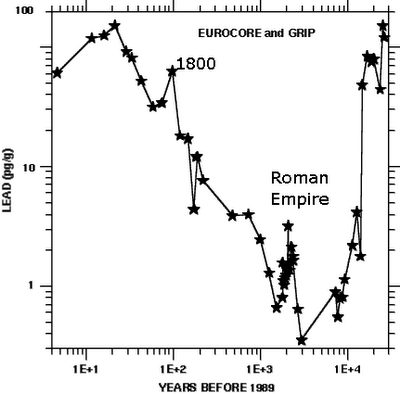 But at the end of the day, with the values that I bring to the table, figures like the one to the left make a deep impression on me. The Y axis represents the lead deposition in ice cores from Greeland. The X axis represents the last 30,000 years, scaled by powers of 10. I've added the label for the Roman Empire and 1800. A natural inference is that the anthropogenic production of lead because of smelting is what is producing the changes over time. Yes, the typical peasant always lived a miserable existence on the margins of the Malthusian trap until about 1800, but the scale of economic production and extent of specialization achieved during the Roman Empire took many centuries to recreate once it collapsed. But at the end of the day, with the values that I bring to the table, figures like the one to the left make a deep impression on me. The Y axis represents the lead deposition in ice cores from Greeland. The X axis represents the last 30,000 years, scaled by powers of 10. I've added the label for the Roman Empire and 1800. A natural inference is that the anthropogenic production of lead because of smelting is what is producing the changes over time. Yes, the typical peasant always lived a miserable existence on the margins of the Malthusian trap until about 1800, but the scale of economic production and extent of specialization achieved during the Roman Empire took many centuries to recreate once it collapsed.The data are what they are, now your interpret them is shaped by your norms. I'm obviously inclined to look to material considerations are the most important ones. The pollution in modern China is horrible, but it is an indicator as to its economic vitality. Conversely, many traditionalists may observe enviously the robustness of a religious ethos in the Middle East, but in terms economic growth there is far less activity (obviously the presence of petroleum contradicts this, but I think it's the exception that proves the rule). All the facts are to be admitted into evidence, but the verdicts are highly contingent upon the normative framework. Note: The Pax Romana coincided with the first flowering of Imperial China. Labels: History
About a year ago a paper came out, Low Levels of Genetic Divergence across Geographically and Linguistically Diverse Populations from India. The authors used Asian Indian groups from the United States, ergo, the caste/class representativeness is not is very typical. Additionally, there is a strong skew to Gujaratis since this group represents 1/2 of American Asian Indians. One could offer the reasonable opinion that the low amount of between population variance is simply a function of the fact that higher status groups across South Asia are not particularly differentiated from each other. I don't have a final opinion, but I would be moderately skeptical of this because I've seen enough work in the past suggesting that Brahmins, for example, are not particularly closely related to each across regions (and many of these regional Brahmin groups show strong evidence of gene flow with other local caste groups, though there usually there is some differentiation).
In any case, that's just a preface to the fact that a provisional paper has come out from the same group, Prevalence of common disease-associated variants in Asian Indians. If you're interested in the topic of the paper, all I have to say is that it seems that the major inference one might make is that more studies need to be done with Asian Indians because they likely have a whole lot of population-specific disease variants which aren't well known yet. Human biodiversity has some practical medical implications. But that's not what I want to focus on. In Table 4 they have some data on frequency of the minor frequency allele on SLC24A5, which in the case of South Asians is the ancestral variant. That is, the allele which is fixed in Africans and East Asians, and absent in Europeans, is the one shown in the table.
There's nothing that surprising here. I wouldn't take some of the frequencies as scripture; I suspect that some of these linguistic groups are not representative (the frequency for the Gujaratis I can believe since I've seen it elsewhere, while the northwestern groups are in line with the ones from the HGDP populations). It seems likely that a strong NW-SE cline on the variation of this gene exists just as it does on many genes in South Asia. There is data which shows that in Sri Lanka the frequency of the ancestral allele is 0.75 for Tamils, and 0.50 for Sinhalese. I wouldn't read too much into these data either; but I've seen results elsewhere which would imply that you shouldn't be surprised at seeing a ancestral allele frequency around ~0.25 for South Asians on SLC24A5. I know this is a provisional paper, and this might get yanked, but I want to point this out: The MAF [minor allele frequency] for the SLC24A5 g.13242G>A polymorphism [the ancestral allele] (0.114) in the Indian population is closer to that of Caucasian European populations (0.000-0.020) than to that of East Asians (0.979-0.989) and Africans (0.730-0.980)...This is surprising given that, as a whole, people of Indian origin have darker skin tone compared to Europeans. The East Asian and African populations share a similarly high frequency of the minor allele of the SLC24A5 g.13242G>A SNP, which in itself is surprising as East Asians are typically of much lighter skin than Africans. It is also interesting that the t-test suggested a greater similarity in MAF between Indians and those of populations in the Americas (Puerto Rican, Mexican, and Amerindian), who are of a similar skin tone.... No shit it's surprising. We know that SLC24A5 polymorphism can account for about 1/3 of the skin color variation in South Asians. It isn't as if it doesn't affect skin color in this population due to some modifier locus. The frequencies of SLC24A5 alleles in Latin American populations is just a proxy for European and non-European admixture; the non-European groups in Latin America are Amerindians and Africans, both of whom tend to carry the ancestral variant. In any case, contrary to the impressions of those of you who only know of South Asians from Bollywood, Indians are on average darker-skinned than Puerto Ricans or Mestizos. SLC24A5 has been under selection within the last 10,000 years. It explains 25-40% of the between group difference in complexion of Europeans and Africans (checked via an admixture study with African Americans). But there's no way I think that light skin was being selected in southern India within the last 10,000 years. Something else is going on.... Labels: human biodiversity
Born to Die: Disease and New World Conquest, 1492-1650 is a short and dense little book which summarizes the latest research on the litany of plagues which reduced the population of the New World by 1-2 orders of magnitude within the century after Columbus. 1491 is writerly enough so that the depressing aspect of the topic is at least presented in a manner which blunts the effect of scale of the death. Born to Die, as the title may indicate, makes little attempt at that sort of elegant exposition; just tables after tables of fatality numbers, quotations from eye witnesses to the death, and so on. With that all that said, there was one qualitatively new piece of information that I am now aware of: many people died of starvation, not the disease which had rendered them immobile. Here's what would happen: a disease which most Europeans were immune to because of childhood exposure, think measles, would strike a tribe all at once. Not only might the symptoms be far more grave because of a less robust immune response (many would die), but the whole village or population would manifest simultaneously. This is a problem, a certain number of hours are needed for activities such as grinding maize into corn meal. If only 1/10th of the population is at full strength there are simply too few hands doing too much for those who need to recuperate; basic activities necessary for survival on the margins of the Malthusian trap now go undone. Without corn meal starvation quickly follows, well before the path of the disease leads to either death or recuperation.
Labels: History
Sunday, March 09, 2008
Most of you probably know about the "species problem." The short of it is that even though the level of the species is probably the most justifiable one within the hierarchy of taxonomic systems (as opposed to say genus or order), it is not a cut & dried category. I tend to agree with evolgen that the nature of the species concept you use is going to be guided by instrumental concerns. If you are are focused upon taxonomy I have no doubt that the phylogenetic species concept is the bomb. On the other hand, if you are an evolutionary geneticist interested in speciation the details of the structure of the tree of life is less important. You would be more interested in how the branching occurs, in which case the biological species concept and its cousins are of more relevance. During the 18th and 19th century some taxonomists argued that their discipline had a claim to being the Queen of Sciences precisely because it was window into the mind and intentions of God's Creation. For these pre-evolutionary thinkers there was a religious and metaphysical significance in species; inappropriate classification would have distorted God's intent and obscured the grand beauty of his plan. Today we don't species aren't loaded with some metaphysical importance; our conception of the world does not hinge upon the battles between lumpers & splitters.
Which brings me to a lower taxonomical category; that of race. Or whatever you want to call it, you know what I mean! Obviously over the years on this weblog we've put the spotlight on specific issues such as Lewontin's Fallacy, which though seemingly abstruse can resolve confusions and misinformation being perpetuated in other domains. We've also pushed into more controversial territory like between group differences in behavioral tendencies & IQ, as well as less radioactive topics such as tissue matching problems across populations for transplantation. There's a lot of ground over the past 5+ years. But I believe there are 4 primary dimensions of variation, which though related (they aren't really orthogonal), get at different concerns. 1) First, there's the phylogenetic/total genome content angle. This is simply a form of Steve Sailer's race is an extended family argument. The tens of thousands of genes an individual has all exhibit their own distinct phylogenies; but they're not totally independent as a practical matter. We don't live in a perfectly panmictic world, population substructure is real. Just open up History and Geography of Human Genes; the classical autosomal markers exhibit correlations, which allow one to make assertions about population histories and relationships. 2) Second, there are the functional loci under selection. The story of lactase persistence in Europe & Asia is the best illustration of what I'm talking about here. From the North Sea to the Punjab a haplotype which likely arose around the Volga region has swept to high frequency within the last 10,000 years because of gene-culture coevolution. If you look at most other markers Middle Eastern populations will be closer to Europeans than peoples from the Punjab in northwest India (see the Fst values in History and Geography of Human Genes for example). But not on this locus. In fact, on this locus Danes are closer to Punjabis than they are to Sicilians, on average!1 Though most recently selected alleles will not break the cladograms you derive from neutral markers to ascertain phylogenetic relationships of populations, there will be plenty of peculiarities on the margins, and I have argued that these deviations are not trivial to our understanding of the history of the shape of human variation. Who can deny that the nature of genetic variation (or lack of) of indigenous New World groups was not of particular importance in relation to Old World people as a whole, as opposed to the undoubted phylogenetic reality that New World native peoples were a subset of East Asian Siberian populations. 3) This brings me to the dimension of salient phenotypic traits. No need for complex exposition of what I mean about this. Insofar as one looks at total genome content Melanesians are closer to the peoples of East Asia than they are to those of Africa. But if most people in the world were shown portraits of individuals from these three groups, and asked to generate an outgroup, I think most would assume that East Asians differed from the other two groups more than either did from each other. This is not to say that Melanesians and Africans look the same, or that Melanesians and Africans do not exhibit a great deal of within group variation in physical appearance, it is simply that the human brain strong affected by particular characteristics when generating classifications. Folk biology has a universal rationale, and is shaped by innate biases. Skin is our largest organ, and it is something that we as humans notice because there are strong adaptive reasons to scrutinize the skins of our conspecifics (fitness, disease, a rough & ready ascertainment of age). I agree with Steve Sailer that the monomanical focus on skin color which reigns in the American social discourse on race is a bit ridiculous, but I also think it is entirely expected and reasonable that skin color would loom large in any folk racial classification system. Many of the peoples which Europeans during the Age of Discovery encountered were referred to as "blacks." They were very different from each other, and Europeans recognized this. Today we know that all the non-African blacks are genetically closer to Europeans than they are to African blacks (who are characterized by a great deal of within group population substructure as well), but it is no surprise that a skin color terminology came to the fore. The West & Central Asian Muslims who ruled India during the medieval and early modern periods referred to themselves as white, and the natives as black. The Chinese would sometimes refer to the Khmer peoples as black as well, because that was a salient contrast. Of course other traits were recognized, and there is also a long tradition of Europeans suggesting that the peoples of South Asia were not truly black, but rather a very pigmented form of their own kind due to similarities of hair form and facial features. This sort of counter-argument was aided by the fact that a non-trivial proportion of South Asians even exhibit a brunette white complexion (usually along the northwest fringes). 4) This brings me to the last of the major ways in which we perceive human variation, and that is through the socially biased and constrained lens. Obviously this is affected by and contingent upon #3 to a great deal, but the boundary conditions are illustrative. In high school I was taking calculus with a friend whose mother was Scottish American and father was a Palestinian Arab. His name was an Arab one, but his physical appearance is by any definition "white." His skin is white, his hair is brown, his eyes hazel, and his features favored his Scottish as opposed to Levantine side (I had a 1/4 Lebanese friend who had a more recognizable Arab visage). Another friend, who was of vanilla Anglo origin as most of my classmates were, observed that we were the only two non-whites in the class, referring to myself and my aforementioned friend. Here's the irony: by any standard my Anglo friend was darker than my non-white friend, he had dark brown eyes, dark brown hair, and less of a pink pallor to his complexion. I recall kind of laughing at that assertion, and the teacher bitched me out about being disruptive and I laughed again. The point here is that the idea that taxonomical perceptions are colored by power hierarchies is not totally incorrect! In fact, it seems trivially obvious. I've been reading a fair amount on the Chinese & Japanese interaction with Western powers between 1500-1800. It is interesting that in the earlier commentaries on Asian peoples many Europeans observed that the Chinese and Japanese were white, unlike the peoples of South or Southeast Asia. After the last wave of Sinophilia receded after the mid-18th century there was a noted shift toward a perception of East Asians as being non-white. In other words, the whiteness of East Asian peoples (even if that whiteness was a different kind) inversely tracked the European sense of superiority to them. I think #1 and #4 are pretty easy to understand. Thinking of race as an extended family simply co-opts our native intuitions about genealogical relations. In other words, it's an extension of preexistent software. As far as #4 goes, there's enough pointers from the current academic dispensation that we can comprehend the nuances. The main point is to map the dynamics more accurately upon reality and not elide the complexities inherent within socially constructed categories which are only partly informed by folk biology. A tendency to pretend as if whites and non-whites are the only two relevant categories prevents the acknowledgment of the realities of how various groups relate to each other (e.g., the social science data which suggests most American non-white groups prefer whites to other minorities).2 Since #3 is derived pretty directly from folk biology and some gross social cues it isn't too difficult. It's the practical definition of human variation which people in the United States have in their head. #2 is a tricky one. I think it's really the most interesting one at this point, but I don't know how to really communicate it to people outside of a more technical framework. Alluding to selective sweeps and QTLs of large effect seems kind of important. #3 is actually a visible subset of this, and so I think when it comes to the general concept of how a functional locus may not reflect the evolutionary history of the whole genome that's a good place to start. LCT is also important, it's very well elucidated in all sorts of ways and so you can speak with confidence. Skin color is also a good case because people are generally aware of the trait and the general outline of inheritance patterns, and its putative adaptive significance. A lot of the work on recent human evolution is related to this dimension, so I think it's important for intelligent people to keep this angle in mind. The main issue is not to conflate the various facets of human variation. There are ideological reasons that people will privilege one or the other, but in terms of utility that depends on where you stand. I'm obviously pretty interested in questions and issues where #2, to some extent #1 and #3, are very operationally the relevant background definitions. #4 is not something I deny, but it's not particularly interesting to me, nor does it speak to the questions I'm focused on. #4 has come to the fore with the ubiquity of international trade and travel, along with a host of social and political movements. That's all real, and it's all significant, but it isn't really normally part of my brief. It intersects with my interests only a specific case of psychological issues, or an indicator of social dynamics. 1 - By this I simply mean that if you draw a random Sicilian, Dane and Punjabi, and are asked to predict which group will be the outgroup when it comes to the most recent common ancestor on the locus LCT, it would be the Sicilian. On most of the other loci, it would be the Punjabi. 2 - I recall listening to a radio show about tensions between South Asians and people of black African origin. Several white callers were shocked and outraged, and asserted that such tension and racial antogonism between non-white groups was by definition ludicrous and incoherent. Both groups were non-white, ergo, they had common interests by definition. There's a little bit of the sense that some whites view non-whites as objects which only operate within the bounds of some deterministic framework, as opposed to conscious agents who act in response to specific conditions and their own perceived self-interest. Labels: human biodiversity
Saturday, March 08, 2008
My history posts often leave me unsatisfied. I don't know much about the topics I'm blogging about, but most readers know even less, and a substantial subset are pretty self-satisfied with their ignorance (and some are just stupid, so they have weak analytic capacities anyhow). The science posts are easier since being wrong or right is scaffolded by some broad theoretical constraints; the history posts require a pretty large base of data which most of us (including me) don't really have, and it's really hard to extract inferences from theoretical presuppositions. A primary goal is to get pointers to more literature, or occasionally nuggets of data. Respectful questions are fine, but too often many readers seem to have a grasp of facts on the order of someone who would read A Coloring Book of the Middle Ages (I'm not being inaccurately insulting, I think it is a pretty good assessment of the level of knowledge some people have when they join comment threads on somewhat obscure topics and offer their "opinion"). So I'm going to try something new. Over the next week I will read The Prehistoric Origins of European Economic Integration (PDF); if you want to comment, you too will read this paper (it's about 60 pages). It's free and you don't need to go the library. At 60 pages it shouldn't entail more than a few hours of investment, max. I'll put up my post next weekend, and let's see if the comments are better since at least we'll all be ignorant about the same thing....
And please be aware, if a comment implies pretty strongly by its content that you haven't read the paper I'll just delete it. So help me avoid false positives! (Comments closed on this post)
I, Cringely has a nice column today analogizing the social network fad with that over CB radios in the 1970s. I tend to agree. History is bound to repeat; observers of the rise & fall of MUDs in the early-mid 90s noted that the same trend in the buzz around Second Life (a buzz which no longer is). This doesn't mean that these new technologies don't add value, but they affect a quantitative change, not qualitative one. I was mentioning to someone that I think IM is far more useful for work than it is for personal interaction. The reason is that work related IMs should focus on transmitting discrete pieces of data which result in a greater awareness of the flow of a particular project (e.g., "I'm way behind right now, don't plan on building today"). But when it comes to interpersonal relationships quantity comes at the cost of quality; Dunbar's number serves as a break on the scalability of social networking sites in terms of utility. At the end of the day we're still apes; our least apelike activities (like working in the tech sector and spending all day in front of a computer) are more amenable to being rendered more efficient by technological extensions...our more apelike ones, less so.
Friday, March 07, 2008
Last summer I read When Baghdad Ruled the Muslim World: The Rise And Fall of Islam's Greatest Dynasty, and this week I finished The Great Arab Conquests: How the Spread of Islam Changed the World We Live In, from the same author. In a strange twist the first book focuses on the Abbasid Caliphate, which flourished between 750-9501, while the second covers the period up to 750, the early Right Guided Caliphs and the Umayyads. I really don't see the logic in the order of publishing here, but no doubt there is some obscure reason why they came out in the sequence they did. Both books are a mix of social and narrative history, but The Great Arab Conquests tends to focus on the latter a great deal more than the former. The social context and dynamics are packed into the initial and last chapters, with most of the filling in the middle a litany of Arab names, battles, and obscure nations. On occasion the writing gets a little sloppy here and there, as if they were in a rush to get this book to press. If you know a fair amount about the history of the Islamic world the monotonous recitation of material you could find in Wikipedia might be a bit tiresome, but if you aren't as familiar with such details the book is a worthy introduction (though I do think the density of names, places and events might be veering into diminishing returns). My own interest in this period is driven by the fact that these early years of Islam have had a major impact on the rest of human history. Not only did it give rise to one of the major civilizational blocks of the modern world and finish off the long decline of late antiquity, but the early Arab polities served as the mediators of informational and economic exchange because of their geographical parameters.
Remember, in the few decades before 750 the whole region from what is today Uzbekistan to Spain was notionally under the aegis of one political entity. After 750 the Abbasids shifted their focus to the east and North Africa and Spain immediately went their own way, but even then the geographical range of the Muslim world-state was enormous. In the 14th century Ibn Battuta journeyed from West Africa to China, and his travels were aided by the Islamic international network which was in large part derived from the early formative period. But Battuta had to negotiate the frontiers of dozens of states within the Islamic world, up until 950 the Arab caliphs would have provided a more thoroughly integrated polity across which ideas and trade flowed freely. Not only was the Islamic world expansive, but the geometry of the political domain is of importance: it had contact with all the other major world civilizations very early on, and in many cases it was through Muslims that other societies learned of each other. I think this has resulted in one obvious dynamic: everyone has an opinion about Muslims and is in conflict with them because Muslims intersect with non-Muslims. In Central Asia the Muslims came into conflict with the Chinese. In the Eastern Mediterranean and along the Black Sea they came into conflict with the Orthodox. In Spain, Italy and France Muslims came into conflict with Latin Christians. In India Muslims came into conflict with Hindus. In Africa Muslims came into conflict with Christians in Ethiopia and Nubia, and pagans in the Niger river valley. Islam also later spread to Southeast Asia; Muslims came into conflict with the Spanish in the Philippines, converted the peoples of maritime Southeast Asia, and were major influences at the courts of the potentates who ruled in Thailand and Cambodia.2 In Power and Plenty the authors make the point that Islamic civilization was the only one in contact with all the others major regions at 1000 AD, and it served role as a conduit both across time (i.e., preserving some of the Greek works) and space. Paper was transmitted from China to the West via Islam, and Arabic numerals from India to the West. So how exactly did this world empire emerge in one generation from the deserts of Arabia? That's the main reason I read The Great Arab Conquests. Unfortunately, there weren't many new insights, though the author does touch upon the historiography and its problems for the 7th century. As many of you know there is a revisionist school of thought which contends that much of the early history of Islam was fabricated, the shape of what we know about early conquests more accurately reflects the self-perceptions of 8th century Muslims, at the height of empire, as opposed to the realities of the conquerors who defeated Byzantium and Persia. The Great Arab Conquests pulls back from this sort of extreme revisionism, and I think this is a good thing to do. Sometimes amazing secret-history narratives are very attractive, but they aren't necessarily right. The fact that Herodotus wasn't lying about the origins of the Etruscans makes me tend to think that the discounting of ancient annals and histories by modern scholars is an overreaction, just as the initial skepticism about the history depicted in the Hebrew Bible was.3 The Great Arab Conquests for example does not repeat the model of some scholars that the early Arabs were actually from the North Arabian lands, and that a Hijazi origin was a later myth. These historical details aside, the author basically presents a model where the Arabs pulled an "inside straight" when it came to timing. Most of you might know that the Byzantines and Persians were engaged in the "World War" of their age for a generation which ended a few years before the Muslim break-out; but there were some interesting details which I think need highlighting. At the maximum extent the Sassanid Empire in the early 7th century pushed all the way to the shores opposite Constantinople and into Egypt and Yemen. After the victories of Heraclius the Persians evacuated their new conquests. But an important point is that much of Syria had been under Byzantine rule for only a few years after one generation of Persian rule when the Arab conquests began if our chronologies are correct. I think this is a critical insight; obviously a modern nationalist sensibility is totally inappropriate to project back to the 7th century. The Syrian lands which the Arabs conquered were populated by Aramaic and Greek speakers of various Christian sects as loggerheads as well as a large number of Jews and numerous Christian Arabs on the margins. But even if loyalty to the Byzantine state is something that would be plausible, remember that for most residents a greater portion of their lives had likely been spent under Persian rule. Additionally, the large Jewish minority in these regions are attested to have been sympathetic to the Persians (there were Persian Jews associated with the Sassanid armies), and some of the early annals seem to indicate that they also welcomed the Arabs. The local non-Chalcedonian Christians were also generally unsympathetic toward their Byzantine overlords, while even loyalists seemed to see the recent events more as the hand of God temporarily punishing lax and heretical Christians more than a world-changing event that would alter the path of history. With 1,400 years of hindsight we can see that what happened in Syria in the 630s was of great significance. The Arab conquest resulted in the spread of their language from the Atlantic to the Tigris, and the long and slow decline of non-European Christianity. The individuals alive during the 630s could plausibly enter into a conversation with aged pagan philosophers who had retreated to Alexandria in their youth as well as the founders of early Islamic orthodoxy in their old age.4 But the patchy records from non-Muslims of the period suggests that proximate realities loomed much larger in the factors which affected their course of action, response and impressions. The anti-Imperial Monophysite faction which was driven from Alexandria before the Arab conquest has been depicted by some as welcoming the Muslims. This is probably an exaggeration, but it seems that the record does suggest that many Christians who were perceived as heretical by Constantinople saw recent events as simply the hand of God evening the scales of justice. Across much of Iran local rulers entered into truces with the Muslim invaders as the Sassanid royal family fled to the east. In parts of northern Iran Muslims could not enter without the expressed permission of the local non-Muslim potentate, who secured his rule through payment of tribute to the Caliph. In the 7th century Arab Muslims were a small rentier class of warriors overlain atop preexistent institutions and societies. Greek remained the bureaucratic language of the western half of the empire, while Persian dominated the east. Correspondence of non-Muslims during this period doesn't even address Islamic rule with great detail; each subculture was rather self-sufficient. John of Damascus, the last of the Church Fathers, was a minister of the Umayyad Caliph partly because the non-military aspects of the early Islamic Empire was rather simply an extension of previous dispensation. Which brings me the point about words like "Muslim" or "Islamic." How appropriate are they? In the 10th century they seem to be pretty appropriate; we know what they mean. With the introduction of paper there was apparently a boom in writing during the 9th century, which along with the emergence of a critical mass of Arab speaking Muslims within the Muslim Empire, means that our picture of 850 is far better than that of 750. I think this explains why The Great Arab Conquests feels more patchy than When Baghdad Ruled the Muslim World, which was built upon a much more fully fleshed out world because of the closeness and continuity of the documentary sources. The Umayyad interlude is to some extent a forgettable phase in the eyes of Muslims because of its reputed non-Islamic nature. When we say that someone was Christian in 2nd century Rome, I know what that means, but when we say someone was Muslim in 7th century Damascus, I think that the term itself is less clearly defined and implies far less. Like any religion, Islamic grew organically within a particular cultural context. But its particular circumstances were important in shaping the path of that development. To be short about it the early phase was one defined by the dominance of Arab ethnicity as opposed to Muslim religion. Christian Arab tribes were allowed to join the early Islamic armies with full rights, while non-Arab converts to Islam might remain second class citizens. There were also cases of intra-Islamic conflict where non-Arabs were executed and Arabs were imposed a monetary penalty as punishment for their rebellion. Racism and ethnic chauvinism have always been implicit features of the Islamic world (e.g., see descriptions of black Africans by Arab geographers), but during the first few decades it manifested in a very explicit manner. Not only were Arabs superior to non-Arabs, but particular lineages (e.g., the Quraysh) were superior to others (e.g., recruits from Yemen). During the Umayyad period Arabs lived as a military caste in their own cities, and despite the putative mercantile background of many of the early Muslims they were most definitely rentiers who extracted tax from the vast numbers of non-Muslims. Public nudity at the court of the Umayyads or the patronage of pagan-themed mosaics by powerful Muslims seems peculiar or heterodox only when we use our point of reference as that of the Abbasids, who reflect a far different cultural sensibility and likely an Islamic religiosity far closer to contemporary norms than that of the 7th century.5 So how did we get from there to here? In the year 600 Arabic was spoken only in Arabia as well as amongst communities in the Levant and Mesopotamia which were ethnically Arab. The dominant religion in North Africa, Egypt, Syria and Iraq was Christianity, in Iran it was Zoroastrianism, while Central Asia was a melting pot of Zoroastrian, Buddhist and shamanistic influences. In the year 1000 Arabic was the dominant language of high society from Morocco to the Tigris, and Islam was the dominant religion from the Atlantic to the borders of India. What happened? As noted above it seems that the initial conquests were a function of a coincidence of historical events; the Muslim Empire was not even the first Arab one, that of Zenobia's was. But the persistence, well, that's a different thing. If you are a Muslim you could posit the hand of God, but if not, I don't think there's a very good explanation at this point why the Arabs didn't go the way of the Mongols and get absorbed. One model is that Islam as it existed in 630 was a compelling force in keeping the Arabs distinct and giving the conquered folk an identity to assimilate to, but I think though there likely was some religious motive during the initial years it seems implausible that Islam was wholly formed out of the Arabian desert (many normal aspects of Islam today, such as a sharp Shia-Sunni divide or Sharia are attested to have emerged over the centuries). The circumstantial evidence strongly suggests that the outlines of the contemporary religion developed in situ within the Islamic Empire over a few decades, not de novo in the deserts of ARabia. By the 8th century the Christians of the Muslim of Empire were less sanguine about their new rulers. John of Damascus still referred to Muslims as a heretical sect of Christianity at this point, so a total crystallization that Islam was a new rival world religion had not developed (from the orthodox Christian perspective, whatever your orthodoxy happens to be, heresies come, and heresies go, and during the first century or so I think it is understandable why Christian intellectuals assumed that Islam was a passing fad to go the way of Arianism or Manicheanism). After all, the majority of the residents of the Islamic Empire were still Christians and Zoroastrians! It seems that Islam was a sect of the Arabs and their clients, the mawalis. For centuries prior to the rise of the Arab Empire Chalcedonians ruled over non-Chalcedonian populations in the Byzantine Empire, while in Persia Zoroastrianism had remained an ethnic religion and Mesopotamia was predominantly Christian and Jewish (Ctesiphon, the winter capital of the Sassanian Shahs did not have a fire temple, but it did have churches and synagogues). In The Rise of Western Christendom Peter Brown notes that the increase in conversions to Islam started occurring when Arabic replaced Greek & Aramaic as the dominant bureaucratic languages. Tensions between the Arab Muslims and their subjects are apparent in massive rebellions by Berbers and Copts early in the 8th century. During the second siege of Constantinople Coptic sailors crossed the lines and defected to the Byzantines; at this point the early 7th century resentments between Chalcedonians and non-Chalcedonians were distant memories. The Abassid revolt against the Umayyads is often depicted as that of mawalis against the Syrian Arab regime, but it seems likely that it also tapped into chafing of the Zoroastrian Iranian majority against Muslim rule. Iran remained predominantly non-Muslim into the 10th century, and in the last decades of the Umayyad Caliphate the Arab armies finally conquered the vassal non-Muslim states in the northern highlands. But at this point a critical threshold had been passed. Enough mawalis now existed which identified with the Arab Islamic regime that overthrowing the new order was now more difficult to do simply by pitting the demographic advantage of the dhimmis against their Muslim overlords. That advantage was fast disappearing, and in key sectors like the professional military the Muslim stranglehold was overwhelming. The quietism of Christians during the first centuries of conquest was due to the fact that little changed in their day to day lives (there is some evidence that their tax burden initially decreased), but by the 8th century they were now fast becoming a marginalized sector who could not reverse the direction of the reaction which was inducing cultural change. Finally, I want to include a deterministic observation. So far I've focused on the contingent events which framed the Arab conquest, and the inexplicable (from a non-Muslim perspective) robustness and evolution of the Arab sacred ideology into a world religion. But why did Iran remain non-Arab while Egypt did not? I think the explanation for the Arabicization of Fertile Crescent is pretty easy: this region was already Semitic speaking, and Aramaic and Arabic are relatively close. The switch from Aramaic to Arabic was like the switch from Akkadian and other assorted ancient Semitic dialects. But Egypt was dominated by Coptic, which is very different from Arabic. I think geography explains it, mediated through the circumstances of conquest. Remember, Egypt is pretty accessible along the axis of the Nile, and the Arab conquest was very rapid. In summary, the Arab armies defeated the Byzantines, and became the new head of the snake. In contrast, Iran was conquered piece-by-piece, and large expanses remained under non-Muslim rule for nearly a century after the initial nominal conquest. Some regions, such as Tabaristan, remained under the domination of Zoroastrian potentates until the 9th century, two centuries after conquest. There was no Coptic equivalent, unless you count the functionaries of the Christian church. Iranian high culture persisted I believe because the fragmented topography of the land made absolute and immediate rapid conquest impossible; in contrast, the Arabs managed to take Egypt as a whole without any mediators to the peasantry (the Coptic hierarchy would be horizontal alternatives in this model). By the time the Iranian elite was predominantly Muslim, Arab rule was collapsing, and with it any necessity for Arabicization. Ferdowsi is an exemplar of this non-Arab Iranian Islamic counter-culture which persisted because of the support given over the centuries of Arab domination by non-Muslim Iranian princes in the localities.6 I think this model explains to some extent the persistence of Berber dialects in the highlands of North Africa; the contrast with the Iranian example being that the Berber dialects were never independent vessels of high culture and so have been losing ground to Arabic until the present. Balancing inevitable fixed dynamics and path dependent contingent factors is difficult. Unfortunately an understanding of humanity requires knowledge of what comes before, and there's a whole lot of messy data to comprehend, and the subtleties of historiography to keep in mind. The the early centuries of Islam are fascinating, and critical to understanding human history as a whole because of Islamic civilization's relationship with the societies which came before, as well as the many with which it interacted. And of course, the Islamic Question is one which we are having to grapple with today. 1 - The caliphate lasted quite a bit longer than 950, but beyond that point they were puppets for the most part. 2 - Most people do not know, for example, that for a short time the Khmer monarchy was under Muslim influence. But the Therevada Buddhist character of Khmer society was robust and deep-rooted enough that this only resulted in the overthrow of the Muslim faction because of popular discontent. 3 - This is not to say that the Hebrew Bible, or Herodotus, are accurate histories. But, it is one think to look at a work skeptically, but another to dismiss it entirely as totally unreliable. 4 - After the closing of the Academy of Athens the pagan non-Christian intellectual tradition did not immediately go extinct. Some relocated to redoubts of paganism such as Haran in Syria, while others relocated to the cosmopolitan metropolis of Alexandria. There are reports of pagan teachers as late as 600, so it seems entirely likely that some survived to see the fall of the East Roman provinces to the Muslim armies, spanning the culture of the ancient classical West with Islam. 5 - The standard model is that the Abassids, centered on Baghdad, were more influenced by Iranian motifs and models while the Umayyads, centered on Damascus, were shaped by the Hellenic currents dominant in their locus of power. 6 - The lowlands of southwest Iran are Arabic speaking. I think geographic accessibility likely explains this, though this region seems to have been predominantly Christian, and so quite likely to have been Semitic, at conquest in any case. Labels: History
Thursday, March 06, 2008
So says a review (thanks evolgen). I've read most of Origins of Genome Architecture and Mike Lynch doesn't have a "two-handed economist" problem; but I think the style of presentation makes it clear that he's not being even-handed or fair & balanced.
I'm almost done with Power and Plenty: Trade, War, and the World Economy in the Second Millennium. So I found this press release of interest:
Throughout the 12th and 13th centuries - during the time of the Crusades --ceramic vessels reached Acre from: Mediterranean regions, the Levant, Europe, North Africa, and even China -- reveals new research, which examined trade of ceramic vessels, conducted at the University of Haifa. Not much. But China is far away. There is an unfortunate problem in economic history and archaeology of assuming that the lit area of a dark street has all the answers. Some aspects of human history are easier to quantitize than others, but ease of precise comprehension and communication does not imply totality of understanding. Which is why narrative history in a more classical sense is still important. But, an interest in one is not necessarily exclusive with an interest in the other, though in practical terms it often is (unfortunately). But in any case, I would though offer that 0.2% of a physical commodity imported from China in the Levant is orders of magnitude greater than the amount of trade between these regions 2,000 years before this period. I suspect that the world of 1,000 AD was far more of a small-world network than the world of 10,000 BC, and that is important to keep in mind for dynamics of all types. Labels: History
Hsien-Hsien Lei has a post up, deCODE CEO Predicts Downswing in Personal Genomics Market.
1) In 1998 search was a dead business model, a "hook" to create a portal. 10 years on how are things looking? 2) Sometimes businesses are run badly. The market opportunity which the business is attempting to capitalize upon does not mysteriously disappear when a particular business fails or falters. 3) Many technologies are oversold in the short term, but undervalued in the long term. What does "short" and "long" term mean in the context of personal genomics?
Tuesday, March 04, 2008
Apropos of pathogens and collectivism, Heritability of cooperative behavior in the trust game (Open Access):
Although laboratory experiments document cooperative behavior in humans, little is known about the extent to which individual differences in cooperativeness result from genetic and environmental variation. In this article, we report the results of two independently conceived and executed studies of monozygotic and dizygotic twins, one in Sweden and one in the United States. The results from these studies suggest that humans are endowed with genetic variation that influences the decision to invest, and to reciprocate investment, in the classic trust game. Based on these findings, we urge social scientists to take seriously the idea that differences in peer and parental socialization are not the only forces that influence variation in cooperative behavior. I'm not holding my breath.... Labels: Genetics 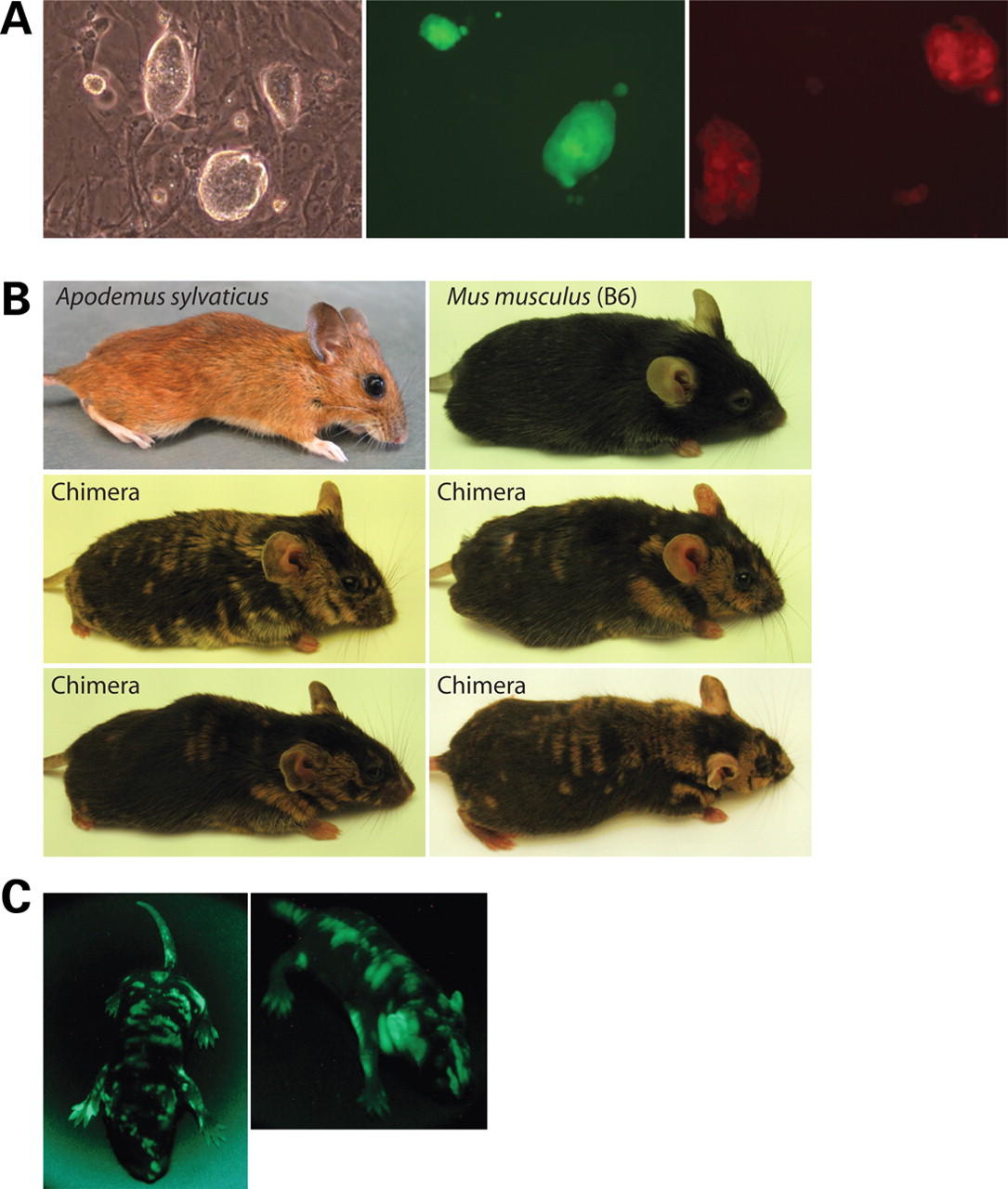 One of the most fascinating questions in biology is how a single cell becomes an entire organism--that is, how an amalgamation of largely genetically identical cells manages to act as a complex of vastly different tissues and organs. It's a simple question, but obviously not one with a simple answer, nor is there an experimental approach that immediately comes to mind for how to answer it. One of the most fascinating questions in biology is how a single cell becomes an entire organism--that is, how an amalgamation of largely genetically identical cells manages to act as a complex of vastly different tissues and organs. It's a simple question, but obviously not one with a simple answer, nor is there an experimental approach that immediately comes to mind for how to answer it. Clearly, if one is interested in, say, the development of the human brain, one approach would be to start with that initial fertilized egg, and follow it as it differentiates into the various neuronal cell types, knocking out different genes to see how development proceeds. It's also just as clear that's simply unethical in just about any culture on earth. For that reason, all studies of stem cells take place in vitro. But what if you were to grow a human brain in a mouse? This might bypass the ethical problems, yet give a fascinating glimpse into not only stem cell biology, but also the evolution of genetic pathways and morphology. A new paper from Bruce Lahn's group takes the first step towards that possibility. This is a proof-of-principle sort of study-- they take blastocysts from your average lab mouse, and inject stem cells from the wood mouse (these two species are highly diverged--the split time is probably something like 12 Mya). Perhaps surprisingly, these chimeras were viable, and the wood mouse ES cells were simply incorporated into all the organs of the adult. This seems to be the first step of a much larger research programme, and the authors hint at their next moves: Owing to various practical and ethical constraints, however, it is impossible to introduce ES cells of certain species into blastocysts of the same species.The implication is clear: this sort of approach could lead to a full in vivo analysis of the development of tissues from "certain" species where research is currently considered unethical. It's worth noting that this work was largely done in China; my guess is that will continue to be the case.
Brett Favre is retiring. Unless they were playing against the Steelers I always rooted for the Packers because of him. Why? Montana and Marino were better quarterbacks over their whole career, though I only followed football during the tail of their playing years, but it seemed like Favre's personality was more amenable to sympathy and identification. Yes, Montana was a 3rd round draft pick, but once he got on the playing field his fluid and cool grace made him seem effortless. Similarly, Marino's quick release was almost superhuman. Favre seemed to be overpreforming his raw talent base through sheer effort and force of persona; the fact that he played in freezing Green Bay probably added to, or even created, that perception. Montana played in San Francisco and Marion in Miami, where the weather probably dampens any perception of "gritty & gutty" playing-though-pain (OMG, drizzle in 45 degree weather!!!). Anyone know of multiple regression on NLF players? (this is a question aimed at Steve)
(note, I was aware of Favre during his college days, the marginal time of a teenager seems boundless and it allowed for the simultaneous immersion in both Saturday and Sunday sports watching)
Despite my long-standing interest in Celts and Anglo-Saxons, it took me a long time to get round to reading Stephen Oppenheimer's The origins of the British: a genetic detective story (2006). It is an alarmingly big book, and I had other stuff to do. When I finally read it, I found that appearances were deceptive. The book has a lot of diagrams and appendices, and the print (in the UK edition) is widely spaced, so the main text is not in reality all that long. I recommend it to anyone who is interested in the subject. This does not mean I agree with Oppenheimer's conclusions. I was going to give a summary of his claims, but I find that a webpage here by Geoffrey Sampson already contains an excellent summary, which I gratefully borrow:
Overall, Oppenheimer is making the following claims about British prehistory: Sampson also has some critical comments on Oppenheimer's claims. I will make a few comments of my own below the fold, but it is probably more useful to describe other recent work (mainly archaeological) on the transition from Roman Britain to Anglo-Saxon England .... So far as Oppenheimer's genetic claims are concerned, the most interesting is point 2 in Sampson's summary. Unlike some authors, Oppenheimer does find a marked genetic difference between England and the 'Celtic fringe'. Whereas this would conventionally be attributed to the impact of Anglo-Saxon and Danish migration in the early middle ages, Oppenheimer believes that it goes back much further, to the Neolithic or even the Mesolithic period. Broadly, he argues that the western parts of the British Isles were originally settled mainly by people from the Iberian peninsula, using the Atlantic sea routes, while the eastern parts (i.e. most of England) were largely settled from across the North Sea, roughly from what is now Belgium. The genetic differences resulting from these different origins have persisted, and have only been marginally affected by subsequent migrations. Now, I don't greatly care if my ancestors turn out to have been Belgian, so long as I don't have to put mayonnaise on my chips, but I am not yet convinced. In view of the importance and novelty of Oppenheimer's genetic claims, the evidence is presented surprisingly briefly. It does not appear to be based on any detailed peer-reviewed studies, but only on Oppenheimer's own unpublished analysis of haplotype data. Based on this, he considers that the 'English' haplotypes are more closely related to those of the Low Countries than to the 'Iberian' haplotypes which prevail in the 'Celtic fringe', but that the divergences from the Continental types must go back much further in time than the Anglo-Saxon migrations. For all I know, Oppenheimer may well be right, but I would be cautious about accepting his claims until they are corroborated by other experts. Oppenheimer is not himself a geneticist by training. Neither am I, but then I am not making highly technical genetic claims based on my own research. The boldest of Oppenheimer's claims is point 5 in Sampson's summary: that the inhabitants of eastern Britain already spoke a Germanic language long before the arrival of the Anglo-Saxons. This does have the advantage of avoiding the problem of explaining how a (supposedly) tiny number of Anglo-Saxons got the Britons to speak Old English. Otherwise, it has nothing to recommend it. There is no direct evidence that a Germanic language was spoken in Britain before the Anglo-Saxons (except for Germanic mercenaries in the Roman army), and there is a reasonable, if not overwhelming, amount of evidence from place names, etc, that a Celtic language was spoken. Most linguists also believe that Old English is far too closely related to the other Germanic languages to have diverged from them as long ago as Oppenheimer claims. Reading Oppenheimer's book has also encouraged me to catch up on recent historical and archaeological work on the Anglo-Saxon migration period. A selection of studies is in the references below. Since there are very few documents from the period, most of the evidence is archaeological. Unfortunately, archaeologists suffer from an occupational vice of over-interpreting their evidence. It used to be the fashion to attribute every shift of style in pots (and other material remains) to the migration of peoples. Since the 1950s the fashion has swung wildly to the other extreme, and there is a strong prejudice against recognising migration at all. The conclusions that archaeologists draw from the evidence therefore need to be taken with a handful or two of salt. So far as the archaeological facts are concerned, there seems to be a consensus that the Romano-British economy and society collapsed very completely and quickly soon after the withdrawal of the Roman army and administration early in the 5th century. Towns and villas fell into disuse, coins were no longer minted, and even pottery (that mainstay of archaeology) is very scarce. It is remarkably difficult to find any traces of the indigenous population. As Myres puts it (p.21) 'the sub-Roman Britons of the fifth and sixth centuries appear to have enjoyed - if that is the right word - a culture almost as completely devoid of durable material possessions as any culture can be.' Myres goes on to conclude that there must have been a drastic fall in population. This conclusion has not been so widely accepted. There is one strong piece of evidence against depopulation of rural areas: pollen analysis shows no widespread regeneration of woodland at the time. Across most of England the landscape would revert to woodland in a few decades if not regularly grazed or cultivated, so complete depopulation of large areas seems to be ruled out. (But I wonder how long regeneration of woodland could be prevented by grazing sheep and deer, without much human supervision?) There has been disagreement about the date of the first significant Germanic migration to Britain. The documentary sources (Gildas, etc.) indicate the mid-5th century for this, but some historians, up to and including Myres, have believed in significant Germanic settlements in the late Roman period. This belief rests largely on the existence of metalwork and pottery from this period which appears to have been manufactured in late Roman Britain but in Germanic styles (described by Myres as 'Romano-Saxon'). This has been interpreted as made by Romano-British craftsmen for Germanic settlers. But recent archaeologists have tended to reject this interpretation, arguing that the supposedly 'Germanic' style was just a widespread late-Roman fashion. If this reinterpretation is correct, then there is little evidence for significant Germanic settlement before the mid-5th century. But the tide of archaeological opinion may turn again. In reading the archaeological studies I was particularly looking for estimates of population numbers. Various estimates have been made for Roman Britain, but there is very little for the immediate post-Roman period. This is understandable in view of the shortage of evidence. It did however occur to me that it should be possible to form estimates of the relative numbers of Anglo-Saxon and indigenous people, based on the proportions of different types of burials. If all graves can be identified as 'Anglo-Saxon' or 'indigenous', then we can get such an estimate, admittedly subject to distortion by bias in preservation or discovery. Even if not all graves can be definitely identified, we might still get some reasonable outer limits for the estimate based on those that can be definitely identified. Little work of this kind seems to have been done, but I was pleased to find that a bold attempt has been made in a series of papers by the British-based German archaeologist Heinrich Harke. (The 'a' should have an umlaut, but this will not show properly in all browsers.) Unfortunately two of the key papers are in German, which is not my favourite language, but I hope I have deciphered the gist of them. 5th and 6th century graves are of two kinds: burials and cremation urns. Cremation urns are found mainly in eastern England, and have long been recognised as distinctively Anglo-Saxon. But the majority of graves are burials. The important feature of Harke's work is that he believes he can distinguish reliably, at least in many cases, between Anglo-Saxon and indigenous graves. The main basis for this is the presence or absence of weapons (swords, seaxes, spears and shields) in the graves. Throughout eastern and central England, even as far west as Shropshire, bodies were often buried with weapons. Harke argues that this is usually a good indicator of Anglo-Saxon ethnicity, his main points being: a) weapons are not found in late Roman or Celtic burials of the period, though they are common in Germanic areas on the Continent; b) the weapon burials are too common to be confined to people of very high status, so they are not just markers of a social elite; c) weapons are often found in what appear to be 'family graves', which suggest an inherited ethnic status; d) the skeletons in weapon graves are on average a few centimetres taller than those in weaponless graves, which is consistent with an ethnic difference between Germanic and British people. The difference cannot be explained by social status, because the taller skeletons are otherwise similar in nutritional history, as shown by growth interruptions, etc. Harke does not make what seems to me the important point that an invading military aristocracy, facing a risk of rebellion from an oppressed indigenous majority, does not usually let the subject people wander around with weapons! The impression we get from early documents such as the Laws of Ine is that the indigenous people were reduced to a servile status (wealh = Briton = slave), so the Britons in areas ruled by Anglo-Saxons would probably not have weapons. Or if they did have weapons, they would hardly waste them by burying them with the dead. Based on the assumption that weapon burial indicates Anglo-Saxon ethnicity, Harke attempts some quantitative estimates. He notes that some communities seem to be entirely Anglo-Saxon, including the women, while others were probably only Anglo-Saxon on the male side, others were ethnically mixed (as shown by mixed cemeteries), and others were enclaves of Britons. In southern and eastern England he estimates that the proportion of Anglo-Saxons ranged from a sixth to a quarter, while in northern England it was smaller, at 10 percent or less. Except perhaps in East Anglia (the stronghold of cremation urns) they were nowhere in a majority, but Harke argues that the Anglo-Saxon minority would be large enough, combined with its social and military supremacy, to give it a linguistic and cultural dominance. After the collapse of Roman civilisation, and in the absence of a Celtic alternative in most of England, the indigenous majority would be eager to throw in their lot with the new cultural elite and blend in as completely as possible. I find this a plausible and appealing scenario, which is consistent with the genetic evidence as interpreted by Weale et al., and which helps explain the otherwise perplexing absence of Celtic vocabulary in the English language. If the Britons were anxious to assimilate to the culturally dominant ethnic group, and 'pass' for Anglo-Saxon, they would avoid giving away their servile origins by using Celtic words. Harke's thesis will however no doubt be controversial. I have not seen much response as yet from the anti-migrationists, but they will doubtless deny that burial rites are reliable ethnic markers. Fashions in burial do change, so it is not impossible that weapon burial would spread as a new imported fashion. But Harke has at least made a constructive and ingenious start by grappling with difficulties which other archaeologists have tended to brush aside. References (umlauts in German titles are omitted): C. J. Arnold: Roman Britain to Anglo-Saxon England, 1984 C. J. Arnold: An archaeology of the early Anglo-Saxon kingdoms, 1988 A. S. Esmond Cleary: The ending of Roman Britain, 1989 Neil Faulkner: The decline and fall of Roman Britain, 2000 Heinrich Harke: 'Briten und Angelsachsen in nachromischen England: zum Nachweis der einheimische Bevolkerung in den angelsachsischen Landnahmgebieten', Studien zur Sachsenforschung, 11, 1998, 87-119 Heinrich Harke: 'Sachsische Ethnizitat und archaologische Deutung in fruhmittelalterlichen England', Studien zur Sachsenforschung, 12, 1999, 109-122 Heinrich Harke: ' "Warrior graves?" The background of the Anglo-Saxon burial rite', Past and Present, 126, 1990, 22-43 Heinrich Harke: 'Kings and warriors: population and landscape from post-Roman to Norman Britain', in The peopling of Britain: the shaping of a human landscape, ed. Paul Slack and Ryk Ward, 2002. Richard Hodges: The Anglo-Saxon achievement: archaeology and the beginnings of English society, 1989 Michael E. Jones: The end of Roman Britain, 1996 Sam Lucy: The Anglo-Saxon way of death: burial rites in early England, 2000 J. N. L. Myres: The English settlements, 1986
Monday, March 03, 2008
My old cyber-friend, "Georg Kantor", has a new English-language blog (his native language is Spanish): Social Equilibrium, which might be of interest to GNXP readers. In particular, check out his demographics tool, introduced on this post, "designed to produce transparent and easy population projections for non-professional users". Labels: Demographics, Modeling
A cousin of mine in Bangladesh just had a baby. She's 34, and this is her first and last child due to various issues with infertility. Obviously she is very happy to have a child, but I'm told she's a bit disappointed with the sex; you see, it's a boy. My cousin and her husband wanted a girl since the perception is that women maintain closer relations with their parents as they grow up while boys just disappear (in case it comes up in comments they're professionals and believing Muslims, though not very intense about practicing).
Sunday, March 02, 2008
Evolgen points me to a new blog, Computational Biology and Evolution. Only quibble, http://bioinf.cs.auckland.ac.nz/ isn't a memorable domain....
Labels: Genetics
A comment on my recent post on Group Selection and the Wrinkly Spreader has drawn my attention to the work of S. A. West, A. S. Griffin and A. Gardner. In recent years this team and their various associates have done a great deal of theoretical and empirical work on kin selection, group selection, co-operation, spite, and related issues. On searching for their names I found this excellent web page, which provides a list of publications with pdf links. I was disgracefully unaware of this work, but am now catching up. I have only read a few papers so far, but from what I have seen I like the cut of their jib. They are working very much in the tradition of W. D. Hamilton, and emphasise that interpretations of social behaviour in terms of inclusive fitness are usually preferable to complex multi-level selection models. They also emphasise that seemingly 'altruistic' behaviour often brings direct fitness benefits to the 'altruist', and is therefore explicable by simple Darwinian selection.
Saturday, March 01, 2008
Razib mentioned this research before; the relevant paper has now been published:
Hair morphology is one of the most differentiated traits among human populations. However, genetic backgrounds of hair morphological differences among populations have not been clarified yet. In addition, little is known about the evolutionary forces that have acted on hair morphology. To identify hair morphology-determining genes, the levels of local genetic differentiation in 170 genes that are related to hair morphogenesis were evaluated by using data from the International HapMap project. Among highly differentiated genes, ectodysplasin A receptor (EDAR) harboring an Asian-specific non-synonymous single nucleotide polymorphism (1540T/C, 370Val/Ala) was identified as a strong candidate. Association studies between genotypes and hair morphology revealed that the Asian-specific 1540C allele is associated with increase in hair thickness. Reporter gene assays suggested that 1540T/C affects the activity of the downstream transcription factor NF-{kappa}B. It was inferred from geographic distribution of 1540T/C and the long-range haplotype test that 1540C arose after the divergence of Asians from Europeans and its frequency has rapidly increased in East Asian populations. These findings lead us to conclude that EDAR is a major genetic determinant of Asian hair thickness and the 1540C allele spread through Asian populations due to recent positive selection.The story goes that a nonsynonymous mutation in EDAR arose after the split between European and Asian groups and quickly swept up in frequency due to some (unknown) force. In terms of mechanism, the authors suggest the change in EDAR alters levels of expression of a transcription factor involved in hair morphogenesis. Labels: Genetics |
  Razib's Home Page GNXP Archives Interviews Blogroll Principles of Population Genetics Genetics of Populations Molecular Evolution Quantitative Genetics Evolutionary Quantitative Genetics Evolutionary Genetics Evolution Molecular Markers, Natural History, and Evolution The Genetics of Human Populations Genetics and Analysis of Quantitative Traits Epistasis and Evolutionary Process Evolutionary Human Genetics Biometry Mathematical Models in Biology Speciation Evolutionary Genetics: Case Studies and Concepts Narrow Roads of Gene Land 1 Narrow Roads of Gene Land 2 Narrow Roads of Gene Land 3 Statistical Methods in Molecular Evolution The History and Geography of Human Genes Population Genetics and Microevolutionary Theory Population Genetics, Molecular Evolution, and the Neutral Theory Genetical Theory of Natural Selection Evolution and the Genetics of Populations Genetics and Origins of Species Tempo and Mode in Evolution Causes of Evolution Evolution The Great Human Diasporas Bones, Stones and Molecules Natural Selection and Social Theory Journey of Man Mapping Human History The Seven Daughters of Eve Evolution for Everyone Why Sex Matters Mother Nature Grooming, Gossip, and the Evolution of Language Genome R.A. Fisher, the Life of a Scientist Sewall Wright and Evolutionary Biology Origins of Theoretical Population Genetics A Reason for Everything The Ancestor's Tale Dragon Bone Hill Endless Forms Most Beautiful The Selfish Gene Adaptation and Natural Selection Nature via Nurture The Symbolic Species The Imitation Factor The Red Queen Out of Thin Air Mutants Evolutionary Dynamics The Origin of Species The Descent of Man Age of Abundance The Darwin Wars The Evolutionists The Creationists Of Moths and Men The Language Instinct How We Decide Predictably Irrational The Black Swan Fooled By Randomness Descartes' Baby Religion Explained In Gods We Trust Darwin's Cathedral A Theory of Religion The Meme Machine Synaptic Self The Mating Mind A Separate Creation The Number Sense The 10,000 Year Explosion The Math Gene Explaining Culture Origin and Evolution of Cultures Dawn of Human Culture The Origins of Virtue Prehistory of the Mind The Nurture Assumption The Moral Animal Born That Way No Two Alike Sociobiology Survival of the Prettiest The Blank Slate The g Factor The Origin Of The Mind Unto Others Defenders of the Truth The Cultural Origins of Human Cognition Before the Dawn Behavioral Genetics in the Postgenomic Era The Essential Difference Geography of Thought The Classical World The Fall of the Roman Empire The Fall of Rome History of Rome How Rome Fell The Making of a Christian Aristoracy The Rise of Western Christendom Keepers of the Keys of Heaven A History of the Byzantine State and Society Europe After Rome The Germanization of Early Medieval Christianity The Barbarian Conversion A History of Christianity God's War Infidels Fourth Crusade and the Sack of Constantinople The Sacred Chain Divided by the Faith Europe The Reformation Pursuit of Glory Albion's Seed 1848 Postwar From Plato to Nato China: A New History China in World History Genghis Khan and the Making of the Modern World Children of the Revolution When Baghdad Ruled the Muslim World The Great Arab Conquests After Tamerlane A History of Iran The Horse, the Wheel, and Language A World History Guns, Germs, and Steel The Human Web Plagues and Peoples 1491 A Concise Economic History of the World Power and Plenty A Splendid Exchange Contours of the World Economy 1-2030 AD Knowledge and the Wealth of Nations A Farewell to Alms The Ascent of Money The Great Divergence Clash of Extremes War and Peace and War Historical Dynamics The Age of Lincoln The Great Upheaval What Hath God Wrought Freedom Just Around the Corner Throes of Democracy Grand New Party A Beautiful Math When Genius Failed Catholicism and Freedom American Judaism
Archives
July 2005 August 2005 September 2005 October 2005 November 2005 December 2005 January 2006 February 2006 March 2006 April 2006 May 2006 June 2006 July 2006 August 2006 September 2006 October 2006 November 2006 December 2006 January 2007 February 2007 March 2007 April 2007 May 2007 June 2007 July 2007 August 2007 September 2007 October 2007 November 2007 December 2007 January 2008 February 2008 March 2008 April 2008 May 2008 June 2008 July 2008 August 2008 September 2008 October 2008 November 2008 December 2008 January 2009 February 2009 March 2009 April 2009 May 2009 June 2009 July 2009 August 2009 September 2009 October 2009 November 2009 December 2009 January 2010 Hello Movable Type archives August 11,2002 August 18,2002 August 25,2002 September 01,2002 September 15,2002 October 20,2002 December 08,2002 December 22,2002 December 29,2002 January 05,2003 January 12,2003 January 19,2003 January 26,2003 February 02,2003 February 09,2003 February 16,2003 February 23,2003 March 02,2003 March 09,2003 March 16,2003 March 23,2003 March 30,2003 April 06,2003 April 13,2003 April 20,2003 April 27,2003 May 04,2003 May 11,2003 May 18,2003 May 25,2003 June 01,2003 June 08,2003 June 15,2003 June 22,2003 June 29,2003 July 06,2003 July 13,2003 July 20,2003 July 27,2003 August 03,2003 August 10,2003 August 17,2003 August 24,2003 August 31,2003 September 07,2003 September 14,2003 September 21,2003 September 28,2003 October 05,2003 October 12,2003 October 19,2003 October 26,2003 November 02,2003 November 09,2003 November 16,2003 November 23,2003 November 30,2003 December 07,2003 December 14,2003 December 21,2003 December 28,2003 January 04,2004 January 11,2004 January 18,2004 January 25,2004 February 01,2004 February 08,2004 February 15,2004 February 22,2004 February 29,2004 March 07,2004 March 14,2004 March 21,2004 March 28,2004 April 04,2004 April 11,2004 April 18,2004 April 25,2004 May 02,2004 May 09,2004 May 16,2004 May 23,2004 May 30,2004 June 06,2004 June 13,2004 June 20,2004 June 27,2004 July 04,2004 July 11,2004 July 18,2004 July 25,2004 August 01,2004 August 08,2004 August 15,2004 August 22,2004 August 29,2004 September 05,2004 September 12,2004 September 19,2004 September 26,2004 October 03,2004 October 10,2004 October 17,2004 October 24,2004 October 31,2004 November 07,2004 November 14,2004 November 21,2004 November 28,2004 December 05,2004 December 12,2004 December 19,2004 December 26,2004 January 02,2005 January 09,2005 January 16,2005 January 23,2005 January 30,2005 February 06,2005 February 13,2005 February 20,2005 February 27,2005 March 06,2005 March 13,2005 March 20,2005 March 27,2005 April 03,2005 April 10,2005 April 17,2005 April 24,2005 May 01,2005 May 08,2005 May 15,2005 May 22,2005 May 29,2005 June 05,2005 June 12,2005 June 19,2005 June 26,2005 July 03,2005 July 17,2005 August 07,2005 Blogspot archives June 2002 July 2002 August 2002 September 2002 October 2002 November 2002 December 2002
10 questions for....
Parag Khanna James Flynn Jon Entine Gregory Clark György Buzsáki Heather Mac Donald Bruce Lahn A.W.F. Edwards Luigi Luca Cavalli-Sforza Joseph LeDoux Matthew Stewart Charles Murray James F. Crow Adam K. Webb Justin L. Barrett David Haig Judith Rich Harris Ken Miller Dan Sperber Warren Treadgold Armand M. Leroi John Derbyshire
Blogs
The GiveWell Blog Your Religion Is False Colby Cosh Steve Hsu Audacious Epigone Catallaxy Files Inductivist 2 Blowhards Genetic Future Agnostic Steve Sailer Dienekes Derek Lowe Razib Khan Razib at Comment is Free Secular Right Glenn Reynolds Jim Miller Kevin McGrew John Hawks Peter Fost Randall Parker Less Wrong Charles Murray Carl Zimmer EconLog Marginal Revolution
Principles of Population Genetics
Genetics of Populations Molecular Evolution Quantitative Genetics Evolutionary Quantitative Genetics Evolutionary Genetics Evolution Molecular Markers, Natural History, and Evolution The Genetics of Human Populations Genetics and Analysis of Quantitative Traits Epistasis and Evolutionary Process Evolutionary Human Genetics Biometry Mathematical Models in Biology Speciation Evolutionary Genetics: Case Studies and Concepts Narrow Roads of Gene Land 1 Narrow Roads of Gene Land 2 Narrow Roads of Gene Land 3 Statistical Methods in Molecular Evolution The History and Geography of Human Genes Population Genetics and Microevolutionary Theory Population Genetics, Molecular Evolution, and the Neutral Theory Genetical Theory of Natural Selection Evolution and the Genetics of Populations Genetics and Origins of Species Tempo and Mode in Evolution Causes of Evolution Evolution The Great Human Diasporas Bones, Stones and Molecules Natural Selection and Social Theory Journey of Man Mapping Human History The Seven Daughters of Eve Evolution for Everyone Why Sex Matters Mother Nature Grooming, Gossip, and the Evolution of Language Genome R.A. Fisher, the Life of a Scientist Sewall Wright and Evolutionary Biology Origins of Theoretical Population Genetics A Reason for Everything The Ancestor's Tale Dragon Bone Hill Endless Forms Most Beautiful The Selfish Gene Adaptation and Natural Selection Nature via Nurture The Symbolic Species The Imitation Factor The Red Queen Out of Thin Air Mutants Evolutionary Dynamics The Origin of Species The Descent of Man Age of Abundance The Darwin Wars The Evolutionists The Creationists Of Moths and Men The Language Instinct How We Decide Predictably Irrational The Black Swan Fooled By Randomness Descartes' Baby Religion Explained In Gods We Trust Darwin's Cathedral A Theory of Religion The Meme Machine Synaptic Self The Mating Mind A Separate Creation The Number Sense The 10,000 Year Explosion The Math Gene Explaining Culture Origin and Evolution of Cultures Dawn of Human Culture The Origins of Virtue Prehistory of the Mind The Nurture Assumption The Moral Animal Born That Way No Two Alike Sociobiology Survival of the Prettiest The Blank Slate The g Factor The Origin Of The Mind Unto Others Defenders of the Truth The Cultural Origins of Human Cognition Before the Dawn Behavioral Genetics in the Postgenomic Era The Essential Difference Geography of Thought The Classical World The Fall of the Roman Empire The Fall of Rome History of Rome How Rome Fell The Making of a Christian Aristoracy The Rise of Western Christendom Keepers of the Keys of Heaven A History of the Byzantine State and Society Europe After Rome The Germanization of Early Medieval Christianity The Barbarian Conversion A History of Christianity God's War Infidels Fourth Crusade and the Sack of Constantinople The Sacred Chain Divided by the Faith Europe The Reformation Pursuit of Glory Albion's Seed 1848 Postwar From Plato to Nato China: A New History China in World History Genghis Khan and the Making of the Modern World Children of the Revolution When Baghdad Ruled the Muslim World The Great Arab Conquests After Tamerlane A History of Iran The Horse, the Wheel, and Language A World History Guns, Germs, and Steel The Human Web Plagues and Peoples 1491 A Concise Economic History of the World Power and Plenty A Splendid Exchange Contours of the World Economy 1-2030 AD Knowledge and the Wealth of Nations A Farewell to Alms The Ascent of Money The Great Divergence Clash of Extremes War and Peace and War Historical Dynamics The Age of Lincoln The Great Upheaval What Hath God Wrought Freedom Just Around the Corner Throes of Democracy Grand New Party A Beautiful Math When Genius Failed Catholicism and Freedom American Judaism   Policies Terms of use © http://www.gnxp.com Razib's total feed: |
||||||||||||||||||||||||||||||||||||||||||||||||||||||||||||||||||||||||||||||||||||||||||||||||||||||||||||||||||||||||||||||||||||||||||||||||||||||||||||||||||||||||||||||||||||||||||||||||||||||||||||||||||||||||||||||||||||||||||||||||||||||||||||||||||||||||||||||||||||||||||||||||||||||||||||||||||||||||||||||||||||||||||||||||||||||||||||||||||||||||||||||||||||||||||||||||||||||||||||||||||||||||||||||||||||||||||||||||||||