

 I just realized in the post below that I casually stated that pretty much all non-Basque people in Spain have significant ancestry from people who were Muslim at some point since the fall of the Visigothic kingdom. By significant I mean more than ~1%. So not just a genealogical line of descent, but genomic ancestry attributable to a specific historical event. But perhaps I should justify this a bit. The reason is two-fold. First, many people are not totally aware of what’s going on in genetics over the past five years or so. That’s important, because a lot of data has come online. Second, fleshing out the details matters. After all, one might contend that North African signals date to the Roman era, rather than the Moorish period.
This paper in PNAS, Gene flow from North Africa contributes to differential human genetic diversity in southern Europe, is the best survey I know. It establishes a few points. For example, the Basque differ from people from other regions of Spain in that they lack much evidence of North African admixture. The historical and social separation of the Basque country during the Moorish period, and also after the Reconquista, is a pretty good rationale for why this might be. Second, the paper establishes some regional variation in the admixture. There’s more in Andalusia. Roughly, it seems that areas closer to North Africa, but probably more significantly under Muslim rule longer, have more admixture from the Maghreb. Third, a lot of it is too recent to be Roman. Looking at segment length the authors estimate a lower bound of ~300 years. After reading the post from Saturday you should understand why this statistic needs to be handled with caution. Additionally, it is important to note that the gene-sharing between Spaniards and North Africans occurs in cases where the North African population of interest has no European ancestry at all. That is strongly indicative of gene flow from North Africa to Europe, rather than bidirectional dynamics. Finally, it looks to be that pretty much all the very low level Sub-Saharan admixture you can find in Spain is attributable to the Moorish period, because the Berbers and Arabs who arrived had that element in their ancestry due to the ubiquity of the trans-Saharan slave trade.
 Of course we need to careful about over-interpreting this. It looks to be that on the order of ~10 percent of the ancestry is due to migration from North Africa. In my judgement this isn’t really that much, considering that most of Spain was ruled by Muslims for 400 years (Muslim power was in sharp recession by 1200, and the conquest of Granada nearly 300 years later was really just a mopping up expedition). This is likely due to two factors. First, Spain was one of the more populous regions of the Western Roman Empire, and the arrival of the Visigoths did not result in nearly the disruption as occurred elsewhere. Despite the Germanic character of the Visigoths, like southern France to my knowledge Roman culture exhibited some continuity in the peninsula. Second, the vast increase in the number of Muslims in the peninsula occurred as it did elsewhere, through conversion and intermarriage. Three of Caliph Abd-ar-Rahman III’s grandparents were born Christian (his paternal grandmother also gave rise to a prominent line of Christian princes through her second marriage). One source suggests that ~80 percent of population of the Iberian peninsula in 1100 was Muslim, after a massive wave of conversion over the previous two centuries (this sort of latency, where Islam is an elite religion for the first century or two, is actually typical). Combined with the genetic data, which suggests widespread admixture with a North African element throughout the population, it is highly likely that Spain is one area of the world where the vast majority of the population have many lineages which went from Christian to Muslim and then Christian again (as well as Jews who became Muslim and whose descendants became Christian!).
 The point in rehashing all this is that in Michael Cook’s Ancient Religion, Modern Politics, he repeats a common belief that Islam in particular exhibits a tendency where cultures tend to have an irreversible transition. Once Muslim, always Muslim. He gives Morisco recalcitrance in Spain after the conquest of Granada as evidence, but that is misleading because these were a rump community, and even among Moriscos many converted in the century after the fall of the Muslim kingdom. Spain is one of the best examples that Islam is like any other religion, under concerted pressure and inducement individuals, and more importantly whole communities, switch identities.
Cook does grant that a substantial number of Muslims in China assimilated to a Han identity. This is well attested for elite lineages of Muslims and Jews (from Kaifeng), whose entrance into the mandarin class of scholar-bureaucrats almost always presaged total assimilation. But it is probably at least as true for the vast majority of non-elite Hui, many of whom also shifted toward the Han identity. In the 20th century it was a truism among the Hui, reported without much skepticism, that Han can become Hui (through conversion), but the converse is not true. The problem with this is that the social norms and mores as such that movement from Hui to Han is never going to be widely documented, while a shift in the other direction will be. As it happens, there is now ethnographic evidence from southern China and Taiwan of whole communities which shifted from Hui identity to a Han one, with their Muslim origins being preserved in oral memory, as well as the persistence of customs such as not offering pork on ancestral graves in deference to the religion of these forebears. Over the past few centuries Muslim communities in China proper have become reintegrated into the world-wide Ummah, and undergone several waves of reform which have resulted in conformity with world normative Islam. But before this it seems likely that there was a continuous flow of Hui into the Han population through assimilation, in particular because there are many documented beliefs of Hui in the 18th century which seem to suggest a convergence with Daoism and Pure Land Buddhism.
All this is not to say that Cook’s thesis, and the public perception, does not have an element of truth to it. It is simply that the reality is a little more complex and less supportive after you scratch below the surface.
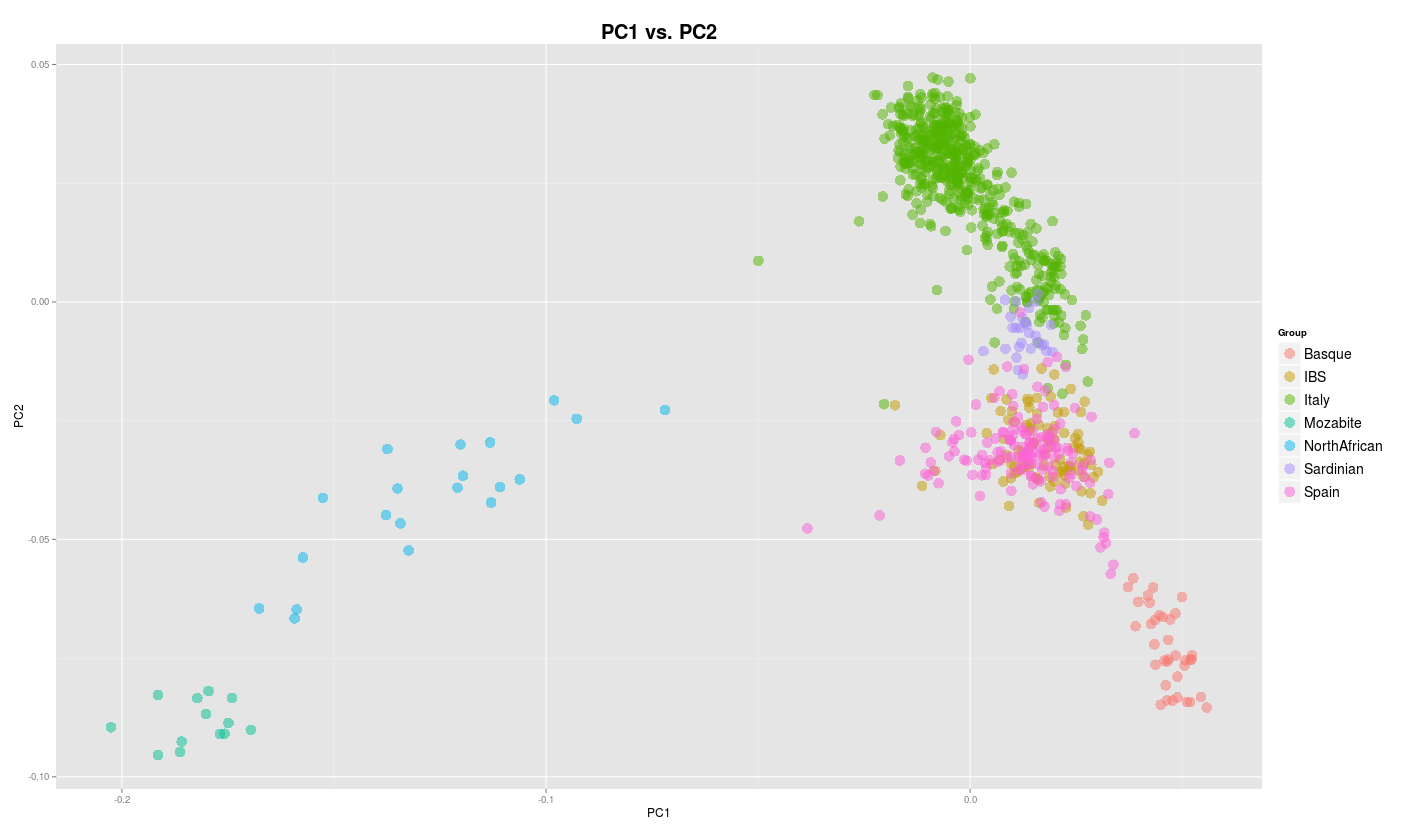
Genetic addendum: I have my own data sets, and decided to double check the results above. Including in these data the 1000 Genomes IBS (Spain) samples. You can see from the PCA and TreeMix (all of them exhibited the same topology) that something is going on with non-Basque Spaniards. The Italian position is explained by the fact that these are southern Italian samples, and those tend to exhibit affinities to Eastern Mediterranean groups. Please note that I removed all markers with missing calls and outliers as well. There were 130,000 SNPs in the final data.

Comments are closed.