
|
Thursday, January 21, 2010
What era are our intuitions about elites and business adapted to?
posted by
agnostic @ 1/21/2010 01:36:00 AM


Well, just the way I asked it, our gut feelings about the economically powerful are obviously not a product of hunter-gatherer life, given that such societies have minimal hierarchy, and so minimal disparities in power, material wealth, privileges of all kinds, etc. Hunter-gatherers don't even tolerate would-be elite-strivers, so beyond a blanket condemnation of trying to be a big-shot, they don't have the subtler attitudes that agricultural and industrial people do -- these latter groups tolerate and somewhat respect elites but resent and envy them at the same time.
So that leaves two major eras -- agricultural and industrial societies. I'm going to refer to these instead by terms that North, Wallis, & Weingast use in their excellent book Violence and Social Orders. Their framework for categorizing societies is based on how violence is controlled. In the primitive social order -- hunter-gatherer life -- there are no organizations that prevent violence, so homicide rates are the highest of all societies. At the next step up, limited-access social orders -- or "natural states" that sprung up with agriculture -- substantially reduce the level of violence by giving the violence specialists (strongmen, mafia dons, etc.) an incentive to not go to war all the time. Each strongman and his circle of cronies has a tacit agreement with the other strongmen -- who all make up a dominant coalition -- that I'll leave you to exploit the peasants living on your land if you leave me to exploit the peasants on my land. This way, the strongman doesn't have to work very much to live a comfortable life -- just steal what he wants from the peasants on his land, and protect them should violence break out. Why won't one strongman just raid another to get his land, peasants, food, and women? Because if this type of civil war breaks out, everyone's land gets ravaged, everyone's peasants can't produce much food, and so every strongman will lose their easy source of free goodies (rents). The members of the dominant coalition also agree to limit access to their circle, to limit people's ability to form organizations, etc. If they let anybody join their group, or form a rival coalition, their slice of the pie would shrink. And this is a Malthusian economy, so the pie isn't going to get much bigger within their lifetimes. So by restricting (though not closing off) access to the dominant coalition, each member maintains a pretty enjoyable size of the rents that they extract from the peasants. Why wouldn't those outside the dominant coalition not try to form their own rival group anyway? Because the strongmen of the area are already part of the dominant coalition -- only the relative wimps could try to stage a rebellion, and the strongmen would immediately and violently crush such an uprising. It's not that one faction of the coalition will never raid another, just that this will be rare and only when the target faction has lost some of its share in the balance of power -- maybe they had 5 strongmen but now only 1. Obviously the other factions aren't going to let that 1 strongman enjoy the rents that 5 were before, while they enjoy average rents -- they're going to raid him and take enough so that he's left with what seems his fair share. Aside from these rare instances, there will be a pretty stable peace. There may be opportunistic violence among peasants, like one drunk killing another in a tavern, but nothing like getting caught in a civil war. And they certainly won't be subject to the constant threat of being killed and their land burned in a pre-dawn raid by the neighboring tribe, as they would face in a stateless hunter-gatherer society. As a result, homicide rates are much lower in these natural states than in stateless societies. Above natural states are open-access orders, which characterize societies that have market economies and competitive politics. Here access to the elite is open to anyone who can prove themselves worthy -- it is not artificially restricted in order to preserve large rents for the incumbents. The pie can be made bigger with more people at the top, since you only get to the top in such societies by making and selling things that people want. Elite members compete against each other based on the quality and price of the goods and services they sell -- it's a mercantile elite -- rather than based on who is better at violence than the others. If the elites are flabby, upstarts can readily form their own organizations -- as opposed to not having the freedom to do so -- that, if better, will dethrone the incumbents. Since violence is no longer part of elite competition, homicide rates are the lowest of all types of societies. OK, now let's take a look at just two innate views that most people have about how the business world works or what economic elites are like, and see how these are adaptations to natural states rather than to the very new open-access orders (which have only existed in Western Europe since about 1850 or so). One is the conviction, common even among many businessmen, that market share matters more than making profits -- that being more popular trumps being more profitable. The other is most people's mistrust of companies that dominate their entire industry, like Microsoft in computers. First, the view that capturing more of the audience -- whether measured by the portion of all sales dollars that head your way or the portion of all consumers who come to you -- matters more than increasing revenues and decreasing costs -- boosting profits -- remains incredibly common. Thus we always hear about how a start-up must offer their stuff for free or nearly free in order to attract the largest crowd, and once they've got them locked in, make money off of them somehow -- by charging them later on, by selling the audience to advertisers, etc. This thinking was widespread during the dot-com bubble, and there was a neat management-oriented book written about it called The Myth of Market Share. Of course, that hasn't gone away since then, as everyone says that "providers of online content" can never charge their consumers. The business model must be to give away something cool for free, attract a huge group of followers, and sell this audience to advertisers. (I don't think most people believe that charging a subset for "premium content" is going to make them rich.) For example, here is Felix Salmon's reaction to the NYT's official statement that they're going to start charging for website access starting in 2011: Successful media companies go after audience first, and then watch revenues follow; failing ones alienate their audience in an attempt to maximize short-term revenues. Wrong. YouTube is the most popular provider of free media, but they haven't made jackshit four years after their founding. Ditto Wikipedia. The Wall Street Journal and Financial Times websites charge, and they're incredibly profitable -- and popular too (the WSJ has the highest newspaper circulation in the US, ousting USA Today). There is no such thing as "go after audiences" -- they must do that in a way that's profitable, not just in a way that makes them popular. If you could "watch revenues follow" by merely going after an audience, everyone would be billionaires. The NYT here seems to be voluntarily giving up on all its readers outside the US, who can’t be reasonably expected to have the ability or inclination to pay for web access. It had the opportunity to be a global newspaper, leveraging both the NYT and the IHT brands, and has now thrown that away for the sake of short-term revenues. This sums up the pre-industrial mindset perfectly: who cares about getting paid more and spending less, when what truly matters is owning a brand that is popular, influential, and celebrated and sucked up to? In a natural state, that is the non-violent path to success because you can only become a member of the dominant coalition by knowing the right in-members. They will require you to have a certain amount of influence, prestige, power, etc., in order to let you move up in rank. It doesn't matter if you nearly bankrupt yourself in the process of navigating these personalized patron-client networks because once you become popular and influential enough, you stand a good chance of being allowed into the dominant coalition and then coasting on rents for the rest of your life. Clearly that doesn't work in an open-access, competitive market economy where interactions are impersonal rather than crony-like. If you are popular and influential while paying no attention to costs and revenues, guess what -- there are more profit-focused competitors who can form rival companies and bulldoze over you right away. Again look at how spectacularly the WSJ has kicked the NYT's ass, not just in crude terms of circulation and dollars but also in terms of the quality of their website. They broadcast twice-daily video news summaries and a host of other briefer videos, offer thriving online forums, and on and on. Again, in the open-access societies, those who achieve elite status do so by competing on the margins of quality and price of their products. You deliver high-quality stuff at a low price while keeping your costs down, and you scoop up a large share of the market and obtain prestige and influence -- not the other way around. In fairness, not many practicing businessmen fall into this pre-industrial mindset because they won't be practicing for very long, just as businessmen who cried for a complete end to free trade would go under. It's mostly cultural commentators who preach the myth of market share, going with what their natural-state-adapted brain reflexively believes. Next, take the case of how much we fear companies that comes to dominate their industry. People freak out because they think the giant, having wiped out the competitors, will enjoy a carte blanche to exploit them in all sorts of ways -- higher prices, lower output, shoddier quality, etc. We demand the protector of the people to step in and do something about it -- bust them up, tie them down, resurrect their dead competitors, just something! That attitude is thoroughly irrational in an open-access society. Typically, the way you get that big is that you provided customers with stuff that they wanted at a low price and high quality. If you tried to sell people junk that they didn't want at a high price and terrible quality, guess how much of the market you will end up commanding. That's correct: zero. And even if such a company grew complacent and inertia set in, there's nothing to worry about in an open-access society because anyone is free to form their own rival organization to drive the sluggish incumbent out. The video game industry provides a clear example. Atari dominated the home system market in the late '70s and early '80s but couldn't adapt to changing tastes -- and were completely destroyed by newcomer Nintendo. But even Nintendo couldn't adapt to the changing tastes of the mid-'90s and early 2000s -- and were summarily dethroned by newcomer Sony. Of course, inertia set in at Sony and they have recently been displaced by -- Nintendo! It doesn't even have to be a newcomer, just someone who knows what people want and how to get it to them at a low price. There was no government intervention necessary to bust up Atari in the mid-'80s or Nintendo in the mid-90s or Sony in the mid-2000s. The open and competitive market process took care of everything. But think back to life in a natural state. If one faction obtained complete control over the dominant coalition, the ever so important balance of power would be lost. You the peasant would still be just as exploited as before -- same amount of food taken -- but now you're getting nothing in return. At least before, you got protection just in case the strongmen from other factions dared to invade your own master's land. Now that master serves no protective purpose. Before, you could construe the relationship as at least somewhat fair -- he benefited you and you benefited him. Now you're entirely his slave; or equivalently, he is no longer a partial but a 100% parasite. You can understand why minds that are adapted to natural states would find market domination by a single or even small handful of firms ominous. It is not possible to vote with your dollars and instantly boot out the market-dominator, so some other Really Strong Group must act on your behalf to do so. Why, the government is just such a group! Normal people will demand that vanquished competitors be restored, not out of compassion for those who they feel were unfairly driven out -- the public shed no tears for Netscape during the Microsoft antitrust trial -- but in order to restore a balance of power. That notion -- the healthy effect for us normal people of there being a balance of power -- is only appropriate to natural states, where one faction checks another, not to open-access societies where one firm can typically only drive another out of business by serving us better. By the way, this shows that the public choice view of antitrust law is wrong. The facts are that antitrust law in practice goes after harmless and beneficial giants, hamstringing their ability to serve consumers. There is little to no evidence that such beatdowns have boosted output that had been falling, lowered prices that had been rising, or improved quality that had been eroding. Typically the lawsuits are brought by the loser businesses who lost fair and square, and obviously the antitrust bureaucrats enjoy full employment by regularly going after businesses. But we live in a society with competitive politics and free elections. If voters truly did not approve of antitrust practices that beat up on corporate giants, we wouldn't see it -- the offenders would be driven out of office. And why is it that only one group of special interests gets the full support of bureaucrats -- that is, the loser businesses have influence with the government, while the winner business gets no respect. How can a marginal special interest group overpower an industry giant? It must be that all this is allowed to go on because voters approve of and even demand that these things happen -- we don't want Microsoft to grow too big or they will enslave us! This is a special case of what Bryan Caplan writes about in The Myth of the Rational Voter: where special interests succeed in buying off the government, it is only in areas where the public truly supports the special interests. For example, the public is largely in favor of steel tariffs if the American steel industry is suffering -- hey, we gotta help our brothers out! They are also in favor of subsidies to agribusiness -- if we didn't subsidize them, they couldn't provide us with any food! And those subsidies are popular even in states where farming is minimal. So, such policies are not the result of special interests hijacking the government and ramrodding through policies that citizens don't really want. In reality, it is just the ignorant public getting what it asked for. It seems useful when we look at the systematic biases that people have regarding economics and politics to bear in mind what political and economic life was like in the natural state stage of our history. Modern economics does not tell us about that environment but instead about the open-access environment. (Actually, there's a decent trace of it in Adam Smith's Theory of Moral Sentiments, which mentions cabals and factions almost as much as Machiavelli -- and he meant real factions, ones that would war against each other, not the domesticated parties we have today.) We obviously are not adapted to hunter-gatherer existence in these domains -- we would cut down the status-seekers or cast them out right away, rather than tolerate them and even work for them. At the same time, we evidently haven't had enough generations to adapt to markets and governments that are both open and competitive. That is certain to pull our intuitions in certain directions, particularly toward a distrust of market-dominating firms and toward advising businesses to pursue popularity and influence more than profitability, although I'm sure I could list others if I thought about it longer. Labels: Economic History, Economics, Evolutionary Psychology, History, politics, Psychology
Wednesday, December 02, 2009
Saturday, October 24, 2009
The other day I saw a flier for a colloquium in my department that sounded kind of interesting, but I thought "It probably won't be worth it," and I ended up not going. After all, anyone with an internet connection can find a cyber-colloquium to participate in -- and drawn from a much wider range of topics (and so, one that's more likely to really grab your interest), whose participants are drawn from a much wider range of people (and so, where you're more likely to find experts on the topic -- although also more know-nothings who follow crowds for the attention), and whose lines of thought can extend for much longer than an hour or so without fatiguing the participants.
So, this is something like the Pavarotti Effect of greater global connectedness: local opera singers are going to go out of business because consumers would rather listen to a CD of Pavarotti. It's only after it becomes cheap to find the Pavarottis and distribute their work on a global scale that this type of "creative destruction" will happen. Similarly, if in order to get whatever colloquia gave them, academics migrated to email discussion groups or -- god help you -- even a blog, a far smaller number of speakers will be in demand. Why spend an hour of your time reading and commenting on the ideas of someone you see as a mediocre thinker when you could read and comment on someone you see as a superstar? Sure, perceptions differ among the audience, so you could find two sustained online discussions that stood at opposite ends of an ideological spectrum -- say, biologists who want to see much more vs. much less fancy math enter the field. That will prevent one speaker from getting all the attention. But even here, there would be a small number of superstars within each camp, and most of the little guys who could've given a talk here or there before would not get their voices heard on the global stage. Just like the lousy local coffee shops that get displaced by Starbucks -- unlike the good locals that are robust to invasion -- they'd have to cater to a niche audience that preferred quirkiness over quality. So the big losers would be the producers of lower-quality ideas, and the winners would be the producers of higher-quality ideas as well as just about all consumers. Academics wear both of these hats, but many online discussion participants might only sit in and comment rather than give talks themselves. It seems more or less like a no-brainer, but will things actually unfold as above? I still have some doubts. The main assumption behind Schumpeter's notion of creative destruction is that the firms are competing and can either profit or get wiped out. If you find some fundamentally new and better way of doing something, you'll replace the old way, just as the car replaced the horse and buggy. If academic departments faced these pressures, the ones who made better decisions about whether to host colloquia or not would grow, while those who made poorer decisions would go under. But in general departments aren't going to go out of business -- no matter how low they may fall in prestige or intellectual output, relative to other departments, they'll still get funded by their university and other private and public sources. They have little incentive to ask whether it's a good use of money, time, and effort to host colloquia in general or even particular talks, and so these mostly pointless things can continue indefinitely. Do the people involved with colloquia already realize how mostly pointless they are? I think so. If the department leaders perceived an expected net benefit, then attendance would be mandatory -- at least partial attendance, like attending a certain percent of all hosted during a semester. You'd be free to allocate your partial attendance however you wanted, just like you're free to choose your elective courses when you're getting your degrees -- but you'd still have to take something. The way things are now, it's as though the department head told its students, "We have several of these things called elective classes, and you're encouraged to take as few or as many as you want, but you don't actually have to." Not exactly a ringing endorsement. You might counter that the department heads simply value making these choices entirely voluntary, rather than browbeat students and professors into attending. But again, mandatory courses and course loads contradict this in the case of students, and all manner of mandatory career enhancement activities contradict this in the case of professors (strangely, "faculty meetings" are rarely voluntary). Since they happily issue requirements elsewhere, it's hard to avoid the conclusion that even they don't see much point in sitting in on a colloquium. As they must know from first-hand experience, it's a better use of your time to join a discussion online or through email. The fact that colloquia are voluntary gives hope that, even though many may persist in wasting their time, others will be freed up to more effectively communicate on some topic. Think of how dismal the intellectual output was before the printing press made setting down and ingesting ideas cheaper, and before strong modern states made postage routes safer and thus cheaper to transmit ideas. You could only feed at the idea-trough of whoever happened to be physically near you, and you could only get feedback on your own ideas from whoever was nearby. Even if you were at a "good school" for what you did, that couldn't have substituted for interacting with the cream of the crop from across the globe. Now, you're easily able to break free from local mediocrity -- hey, they probably see you the same way! -- and find much better relationships online. Labels: academia, Economics, education, Technology
Wednesday, September 23, 2009
Antitrust suits are brought by busted businesses, not consumer crusaders: Dairy edition
posted by
agnostic @ 9/23/2009 10:22:00 PM
 After reading Arthur De Vany's Hollywood Economics and Winners, Losers, and Microsoft by Stan Liebowitz and Stephen Margolis, I got the impression that antitrust cases on the whole have been misguided and often remarkably stupid. Looking a little more into it, I found that economists now are pretty much agreed on that picture. Here is the entry on antitrust from the Concise Encyclopedia of Economics, which has a nice brief list of references. Most cases are not brought by public representatives, whether elected or self-appointed, but by private companies, often rivals of the defendant who are being driven out of business. Businessmen believe that competition is good if they win but bad if the other guy wins. After reading Arthur De Vany's Hollywood Economics and Winners, Losers, and Microsoft by Stan Liebowitz and Stephen Margolis, I got the impression that antitrust cases on the whole have been misguided and often remarkably stupid. Looking a little more into it, I found that economists now are pretty much agreed on that picture. Here is the entry on antitrust from the Concise Encyclopedia of Economics, which has a nice brief list of references. Most cases are not brought by public representatives, whether elected or self-appointed, but by private companies, often rivals of the defendant who are being driven out of business. Businessmen believe that competition is good if they win but bad if the other guy wins.Because these facts are not widely known outside of economics circles, and because most of us learned bogus stories about Standard Oil, etc., in high school history class, I figured I'd illustrate them with a recent complaint about alleged anti-competitiveness in the dairy industry. The farmers on the losing side of the commercial contest claim one thing, but I show that the facts prove the opposite. First, here are free WSJ articles about the small farmers' complaints and a follow-up on the response of the DoJ's antitrust division. We can ignore the complaints of all the farmers quoted, as well as the talk from politicians in dairy states, because the very first sentence says that there is a "price-depressing glut of milk." A monopoly harms consumers by restricting output in order to shoot prices up -- think of a diamond company that owns almost all diamonds but only allows a tiny amount to get into circulation. So right away we see that there is the exact opposite of monopolistic practices in dairy -- there is a glut rather than a dearth of output, and prices are plummeting rather than soaring. Is the 2001 merger of two large dairy processors to "blame" for greater output and lower prices, as suggested by the complainers? No. The article doesn't provide a broader perspective, but I looked up data from the Statistical Abstract of the United States' agriculture tables. Here is the price of milk received by farmers from 1980 to 2009, both unadjusted and adjusted for inflation using the CPI: 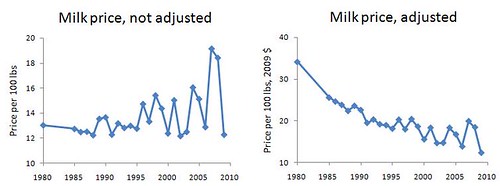 There is clearly no change in the trend during or after 2001. The real price of milk has been falling at least since 1980, and in this decade it has actually slowed down -- it's "showing signs of stabilization," as we would hear in another context. The nominal price shows no trend up or down, just greater volatility starting around 1995. OK, what about output -- was the recent merger responsible for flooding the market? Let's have a look: 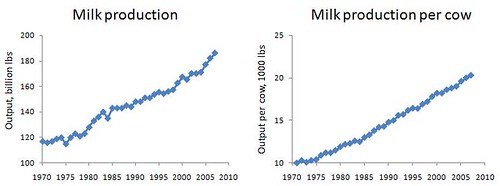 The left graph shows that output has been increasing steadily at least since 1970. The only somewhat recent change is that the increase appears to get faster around 1995, compared to its shallower rate from 1985 to 1995. Again we see no effect of the 2001 merger -- let alone a harmful downward one. The graph on the right shows the trend for milk cows' productivity, or output per cow: it too has been steadily increasing since at least 1970, probably due to some combination of better technology and selective breeding. Here there is no change whatsoever in the rate around 2001 -- it's basically linear after 1975. So we have greater output, lower prices, and greater productivity. What about having "too much" market share? The articles say that Dean Foods buys less than 15% of the nation's supply of raw fluid milk, which is hardly a concentration of the industry -- even if market concentration mattered per se (which it doesn't). It is a red herring that it has market shares closer to 70% or 80% in some regions -- it could not try to restrict output and thus raise prices in these regions anyway. Why not? If Dean Foods tried to gouge consumers in Michigan, anyone in Michigan could simply buy milk from a state where the supposed monopolistic gouging was absent, transport it to Michigan, and sell it below what the monopolist was charging. And -- boom -- just like that, competition neuters gouging. (Looking more generally, milk is a commodity like gold, so just imagine if Michigan residents were charged up the ass for gold, while Ohio residents weren't. You could get rich quick in Michigan by buying gold in Ohio and selling it in Michigan, low enough to undercut the monopolist but high enough to cover your costs. Since these get-rich-quick opportunities would quickly exhaust themselves and drive down the monopolist's prices, we don't expect to see such price-gouging even if the company did have an incredibly large market share.) But are the big bad companies even driving the little guy out of business? In my quick search, I didn't find data for this year, but a press release on the state of US agriculture in 2007 says that it's the middle-sized farms that are getting cleared out, suggesting greater specialization (like Wal-Marts co-existing with tiny local boutiques): The latest census figures show a continuation in the trend towards more small and very large farms and fewer mid-sized operations. Between 2002 and 2007, the number of farms with sales of less than $2,500 increased by 74,000. The number of farms with sales of more than $500,000 grew by 46,000 during the same period. Granted, this is for all farms, not just dairy farms, but I'd be surprised if the pattern were in the other direction for the subset of dairy farms. Again, even if it were, that might make us feel bad about small farmers going out of business, but it would not be evidence of monopoly, anti-competition, or whatever else. Output and productivity are going up, and prices are going down. It doesn't get any simpler than that. As the CEE antitrust entry notes, most lawsuits are brought by companies who are suppliers or buyers of the targeted company. That's what we have here, since Dean Foods buys milk from the embittered dairy farmers. The incentive to make it an antitrust suit is that they can win three times the damages than if they didn't. So the next time you hear about some company coming under antitrust scrutiny, just keep this big picture in mind. Pretty much all such cases are bogus. Rather than crusades in the consumers' interests, they are cowardly attempts by a loser to have the referee handicap the winner just as they're about to get knocked out. I encourage readers to look through some of the references in the CEE entry; it is quite illuminating to see how backwards the history of antitrust has been, and how baldly we were lied to in high school about Standard Oil and the rest.
Tuesday, September 22, 2009
I stumbled onto these data which show meat consumption in kilograms over the years for a range of nations. I was curious as to the relationship between meat consumption & GDP PPP per capita. My logic is that the more $ you have the more calories you'll purchase in form of flesh protein & fat. That being said, there's obviously a limit to how many calories you might want to purchase per day, so extra cost of meat for the wealthy would be in the form of quality (e.g., eating only Kobe beef). I took the 2002 data on meat consumption and plotted it against GDP PPP per capita from 2007. The relationship is rather straightforward.
 The thick black line is a fit via loess. Here's a plot that's log-transformed:  OK, but what you want to do are the deviations from the trend line, right? If you're "Green" minded, the "naughty and the nice."
The Virgin Islands is entered like that in the data, so perhaps it is a data entry error.... Labels: Economics
Thursday, August 27, 2009
Web 2.0 party is over -- you're going to pay for the news again, and hopefully more
posted by
agnostic @ 8/27/2009 12:52:00 AM
Recently at my personal blog I've been focusing on the idiocy of Web 2.0's central strategy for growth, namely creating online networks or communities where costly participation is given away for free. (The profitable online papers charge, YouTube and Facebook still not profitable, and a more general round-up of the second dot-com bust.) The hope was that hosting a free party with an open bar would attract a large crowd, and that this in turn would lead to ever-increasing ad revenues. That business model was doomed to failure during the first dot-com boom, and it is just as doomed during the second one (Web 2.0). In the meantime, following this strategy leads to cultural output typical of attention whores rather than the output of inventors and creators with secure patronage.
I was delighted today to discover that all of this is about to change. It's still pretty hush-hush -- no "buzz in the blogosphere" -- as I've read a fair number of articles on the topic, yet none has mentioned the coming change, even if they've mentioned the change earlier in the year. Starting sometime this fall, online newspapers will finally start to charge for access to their sites, although who they charge, how much, and in what manner (yearly, per article, etc.), is entirely up to the individual papers, and we don't know what shape that will take just yet. The business model of Journalism Online, the group that's spearheading the change, says they're aiming to get revenues from the top 10% of readers by visit frequency. In any case, the point is that the era of unlimited free access to online journalism is dead. Journalism Online seems to be a central hub that readers will go through to get to the various member organizations' publications, perhaps the way college students go through their university library's website to get access to various journals. According to co-founder Leo Hindery (as I heard on Bloomberg TV today), there are over 600 papers on board, and you can bet that includes most or all of the big ones, as they provide the best quality and yet receive no money from users (other than the FT and WSJ). All of the customer's payments will be kept track of through this one site. I don't have much more detail to give, since the Journalism Online website lays it out succinctly. Go read through the business model section and the press section (the 31-page PDF listed under "Industry Reports" is the most detailed). This is the first nail in the coffin of Web 2.0, and once the other give-it-away internet companies see how profitable it is to actually -- gasp! -- charge for your product, they will wake up from their pipe dream of growing by attracting a big crowd and pushing ads. YouTube, Facebook, MySpace, perhaps other components of Google, Wikipedia -- they can either charge and profit or get shoved out of the market by those who are growing by charging. The winners will have more to invest in improving their products and maybe even funding their industry's equivalent of basic R&D, we'll see a cultural output that won't pander quite so much to the lowest common denominator to chase ad revenue, and best of all -- the quality newspapers, social networking sites, and so on, will continue to exist and grow rather than be claimed as further casualties of the moronic dot-com boom mentality. At last the internet is sobering up from its 15-year Bender of Free. Labels: Economics, Media, Technology
Tuesday, August 25, 2009
At the end of an otherwise good reflection in the WSJ on where Google can go from here, we read the following:
It would be foolish to predict that Google won't have another business success, of course. Microsoft managed to leverage its strength in PC operating systems into a stranglehold over the word-processing and spreadsheet applications. Stan Liebowitz and Stephen Margolis debunked this at least 10 years ago in their book Winners, Losers, and Microsoft, and probably earlier, though I can't recall which journal article it originally appeared in. Scroll down to Figure 8.18 at Liebowitz's website, which shows the market share of Excel and Word in the Macintosh vs. Windows markets. They conclude: Examination of Figure 8.18 reveals that Microsoft achieved very high market shares in the Macintosh market even while it was still struggling in the PC market. On average, Microsoft's market share was about forty to sixty percentage points higher in the Macintosh market than in the PC market in the 1988-1990 period. It wasn't until 1996 that Microsoft was able to equal in the PC market its success in the Macintosh market. These facts can be used to discredit a claim sometime heard that Microsoft only achieved success in applications because it owned the operating system, since Apple, not Microsoft, owned the Macintosh operating system and Microsoft actually competed with Apple products in these markets. Labels: Economics, Technology
Wednesday, August 19, 2009
The greater fool theory 1: A mostly verbal mathematical model
posted by
agnostic @ 8/19/2009 09:22:00 PM
Here is a brief description of the idea that price bubbles are caused by people buying something, not necessarily because they think it's worth anything, but because they think they can find an even greater fool to buy it at a higher price. This continues until no more such fools can be found, and this bust drives prices back down to what they were before the boom began.
I didn't see any references to mathematical models of the theory at Wikipedia or through Googling around a bit, so I made one up today at Starbucks since I didn't have anything to read to pass the time. Because I'm not an economist, I don't know how original it is, or how it compares with alternative models of the greater fool theory (if they exist). So, this is intended just as an exercise in modeling, explaining the model, and hopefully shedding some light on how the world works. I've kept most of the exposition straightforward and largely verbal, so that you don't need to know much math at all to understand what the model says and what its implications are. In part 1, I lay out the logic of the model and explain enough of it to show that it is capable of producing a single round of boom-and-bust for price hype. Part 2 will provide more mathematical detail about how the dynamics unfold, a phase plane analysis, and graphs of how the variables of interest would change over time, to better wrap your brain around what the model predicts. This is a dynamic model, or one that tracks how things change over time -- after all, we want to see how price, the number of fools, etc., evolves. It is made of several differential equations, and all these equations say is what causes something of interest to go up or go down over time. (You may recall that the sign of a derivative tells you whether a function is increasing or decreasing, and the magnitude says by how much.) I'll only explain what is absolutely necessary for the reader to see what's going on, with the less necessary math being confined to footnotes. First, we set up the basic picture before we write down equations. My version of the greater fool theory goes like this. There is a population of people, and during a price bubble they can fall into three mutually exclusive groups: suckers (S), who are susceptible to joining in on the bubble; investors (I), who currently own the speculative stuff (such as a home bought for speculation); and those who are retired from the bubble (R), who used to be investors but have gotten rid of their investment. And of course there is the price of the thing -- I model only the extra price that it enjoys due to hype (P), above its fundamental value, since this is the only component of price that changes radically during the bubble. I set the population to be fixed in size during the bubble, since growth or decline is negligible over the handful of years that the bubble lasts. I also set the amount of speculative stuff to be fixed, which is less general -- supply should shoot up to meet the rising demand during a bubble. So, this model is restricted to cases where you can't produce lots more of the stuff, relative to how much already exists, on the time-scale of the bubble's boom stage (say, 5 years or less). Or perhaps no more of it will be produced at all, such as video game consoles from decades ago that the original manufacturers will never bring back into production, but which nostalgic fans have taken to buying and selling speculatively (like NEC's TurboDuo). Last, the amount of stuff that each investor has is the same across all investors and stays constant -- say, if each investor always owned just one speculative home. At the start of the bubble, there is a certain number of early investors. In order to sell their stuff, they need to meet a sucker to sell it to. When they meet -- and I assume the two groups are moving around independently of each other -- there is a probability that the sale will be made. If they make a deal, the sucker is now an investor, and the former investor is now retired. In this model, retireds do not again become suckers -- they consider themselves lucky to have found a greater fool and stay out of the bubble for good afterward. That's the extent of how people change between groups. As for price hype, again I'm not an economist, so the exact formula may differ from what's standard. I take it to respond positively to demand -- namely, the number of suckers -- and that there is a multiplier that serves as a reality check. This reality check should be weak at the start when most non-investors are suckers, and should be strong near the end when most non-investors are retired. In other words, the price hype at the beginning is a near total distortion -- nearly 0% accurate -- whereas the price hype near the end is nearly 100% accurate. This will make more sense once we write down formulas. Now we get to the differential equations for how these things change. We write down one equation for each variable whose values we're tracking over time. I use apostrophes to denote the derivative with respect to time (i.e., rate of change): S' = -aSI Since suckers can only lose members (by turning into investors), there is only one term, and it shows how suckers decline (negative sign). Remember, retireds do not go back into the pool of potential buyers. And investors either make a sale and go into the retired group, or they sit on their stuff in hope of selling, so they never contribute to the growth of suckers. Thus, there is no growth term. The parameter a shows the probability that, when a sucker and an investor meet, the investor will transfer his stuff to the sucker. ("Parameter" is another word for "constant," in contrast to a variable that changes.) The reason we use the product of S and I is that this is essentially the rate at which the two groups encounter each other when they move around independently of each other. [1] I' = aSI - aSI = 0 Investors both grow and decline, so one term is positive and the other negative. They grow by having a sucker join their ranks, which as we saw above happens at rate aSI. However, each time that happens, the investor loses his stuff and becomes retired. That happens at the same rate, and the negative sign just shows that this causes I to decline. When we simplify, we get I' = 0 -- that is, the number of investors does not change over time. That makes sense because each bundle of stuff always has an owner, regardless of how it may change hands, somewhat like the game of hot potato. When something doesn't change, it is constant, so whenever we see I from now on, we'll know that this is just another parameter, not a variable that changes. In particular, it refers to the initial number of early investors who get the bubble going. R' = aSI Retireds never join the suckers again. And recall the mindset of a retired person -- they knew the stuff was junk and are glad to have gotten through the selling process, so they cannot be sold the stuff again to become investors once more. Thus, there is no way for them to lose numbers. They grow by former investors making a sale and becoming retired, which once again happens at rate aSI. Here's the neat thing: notice that S' + R' = -aSI + aSI = 0. The sum of the two derivatives equals zero, and since taking a derivative shows the distributive property, this also means that (S + R)' = 0. That is, the sum of suckers and retireds does not change over time. This makes sense since, if the number of investors stays constant, the leftovers -- suckers and retireds -- is constant, regardless of how each separate group grows or shrinks. We can take this further to note that S' + I' + R' = 0, which means (S + I + R)' = 0. That is, the combined size of all three groups does not change over time -- which is just what we claimed by keeping total population size constant. (Otherwise, each group would have birth and death terms, aside from the terms that show how their members switch between groups.) We'll call this constant total population size N. So, S + I + R = N. Now, I is just a constant, so we'll move it to the other side: S + R = N - I. We have two variables, S and R, but we just wrote an equation connecting them, so we can re-write one in terms of the other. I'll choose R, but it doesn't matter. So, R = N - I - S, and anywhere we see R, we can replace it with N - I - S. In other words, we've removed R from our focus -- we can always get it from knowing what the variable S is, as well as the two parameters N and I. That means the equation for R' only gives us redundant information, and we can ignore it. We can also ignore the I' equation, since it just tells us that I is constant, and we're only interested in things that change. So we're left with just the S' equation. Now we move on to the price hype formula and how it changes over time. First, the formula for price as a function of demand and the reality check, since hype is never totally irrational and at least tries to take stock of reality: P = bS(R / Rmax) = bS(R / (N - I)) Demand is driven by the number of suckers -- the ones who eventually want to get in on the bubble -- and the parameter b says how strongly demand responds to the number of suckers. The multiplier (R / Rmax) provides a reality check. If you landed from Mars and only knew the number of suckers, you would also want to know how many retireds there were -- if there were few retireds, that would tell you the bubble had only just begun, so that hype is likely to be high and to go even higher short-term. Thus, this filter should not let much of the demand information through. Indeed, when R is very low compared to Rmax, the multiplier is near 0. However, if you saw that there were many retireds, that would say the bubble was near its bust moment, and that the information from demand is very accurate by this point. Indeed, when R is near Rmax, the multiplier is near 1 and the filter lets just about all of the demand information through. What is Rmax? It is the value when no one is a sucker and everyone is retired, aside from the constant number of investors. Looking above at the equation S + R = N - I, we see that when there are no suckers, R = N - I. Now we need to find the differential equation for how P changes over time. Using the product rule for derivatives [2], we get: P' = (abI / (N - I)) * S(2S + I - N) Since a, b, I, and N - I are always positive, and since S is positive except for the very end of the bubble when it is 0, in the meantime, whether price hype shoots up or crashes down depends on whether the term 2S + I - N is positive or negative. It is positive and price hype grows when S exceeds (N - I) / 2, which is half the size of non-investors. It is negative and price hype declines when S is below (N - I) / 2. It is 0 and price hype momentarily stalls out when S is exactly (N - I) / 2. Because the bubble starts with all non-investors being suckers, S is initially N - I, which is greater than (N - I) / 2. So at first the price hype shoots up. However, remember that S only declines -- as more and more of the suckers are drawn into the bubble (some of whom may also make sales and become retireds), S will inevitably fall below (N - I) / 2 and price hype will start to contract. When S inevitably reaches 0 -- when all non-investors are out of the bubble for good -- then P = 0 (recall that P = bS(R / Rmax)). Moreover, at that time P' = 0 too. Thus, at the end, price hype has completely evaporated and it will stay that way. This is a single round of boom-and-bust for price hype. In this post, I've shown how some pretty simple "greater fool" dynamics can lead to a boom-and-bust pattern for price hype. You can quibble with all of the assumptions I've made, but the model shows that the greater fools theory is a viable explanation for price bubbles. I've relaxed some of the assumptions to see if it makes a difference, like making the decline of S be a saturating rather than linear function of S, and so far they don't seem to affect things qualitatively. A more realistic model would have P appear in the equation for S' -- that is, to have price hype affect the probability of making a sale. Or rather, the trend of prices (P' ) should affect sale probability -- if suckers see that price hype is increasing, they should want to get in on the bubble, and to stay put if price hype is dropping. Also, allowing retireds to re-enter the pool of suckers would be more general and would almost certainly lead to sustained cycles of boom-and-bust, rather than a single round. But that's for another slow afternoon. In part 2, I'll go into more mathematical detail about how we see what states this system is at rest in, and whether they are stable to disruptions or not. I'll look more at the formula for the maximum level of price hype, and interpret that in real-world terms in order to see what things will give us larger-amplitude bubbles. I'll provide a picture of the phase plane, which shows what the equilibrium points are, and how the variables will change in value on their way from their starting values to the final ones. I'll also have a couple of graphs showing how the number of suckers and retireds, and the amount of price hype, change over time. [1] Draw one person at random, and the chance that they're a sucker reflects S. Draw another one at random, and the chance that they're an investor reflects I, since the draws are independent. The chance of doing both is just the product of the two separate probabilities. [2] P' = (bS(R / Rmax))' = (b / (Rmax)) (S' * R + S * R') A little algebra, which you can confirm by hand or using Maple, gives the equation in the main body for P'. Labels: Behavioral Economics, Economics, mathematics, Modeling
Wednesday, July 15, 2009
How soon businesses forget how loony the loony ideas of yesterday were
posted by
agnostic @ 7/15/2009 10:37:00 PM
Mathematical models of contagious diseases usually look at how people flow between three categories: Susceptible, Infected, and Recovered. In some of these models, the immunity of the Recovered class may become lost over time, putting them back into the Susceptible class. This means that if an epidemic flares up and dies down, it may do so again. If we treat irrational exuberance as contagious, then we can have something like a recurring exuberant-then-gloomy cycle within people's minds. That is, people start out not having strong opinions either way, they get pumped up by hype, then they panic when they figure out that the hype had no solid basis -- but over time, they might forget that lesson and become ripe for infection once more.
I'm in the middle of Stan Liebowitz's excellent post-mortem of the dot-com crash, Re-thinking the Network Economy, and in Chapter 3 he reviews the "first mover wins" craze during the tech bubble. According to this idea, largely transplanted into the business world from economists who'd already spread the myth of QWERTY, the prospect of lock-in was so likely -- even if newcomers had a superior product -- that it paid to rush your product to the market first in order to get the snowball inevitably rolling, no matter its quality. The idea was bogus, of course, as everyone learned afterward. (There were plenty of examples available during the bubble, but the exuberance prevents people from seeing them -- Betamax was before VHS, WordPerfect was before Microsoft Word, Sega Genesis was before Super Nintendo, etc. And there were first-movers who won, if their products were highly rated. So, when you enter doesn't matter, although quality of product does.) But when I looked up data on how much the media bought into this idea, I was surprised (though not shocked) to see that it was resurrected during the recent housing bubble, although it has been declining since the start of the bust phase. Below the fold are graphs as well as some good representative quotes over the years. First, here are two graphs showing the popularity of the idea in the mainstream media. The first is from the NYT and controls for the overall number of articles in a given year. (I excluded a few articles that use "first mover" in reference to the Prime Mover god concept in theology.) I don't have the total number of articles for the WSJ, so those are raw counts. Still, the pattern is exactly the same for both, and it very suggestively reflects the two recent bubbles: 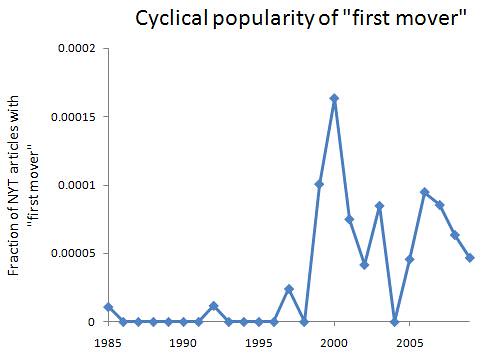 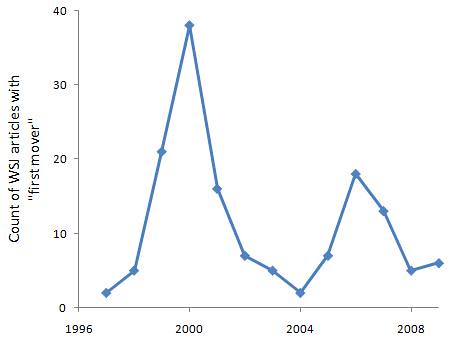 The first epidemic is easy enough to understand -- after languishing in academia during the mid-1980s through the mid-1990s, the ideas of path dependence, lock-in, and first-mover advantage caught on among the business world with the surge of the tech bubble. When it became apparent that the dot-coms weren't as solid as was believed (to put it lightly), everyone realized how phony the theory supporting the bubble had been. Here's a typical remark from 2001: WHEN they were not promoting the now-laughable myth of ''first mover advantage,'' early e-commerce proponents proffered the idea that self-service Web sites could essentially run themselves, with little or no overhead. But clear-headedness eventually wears off, and when another bubble comes along, we can't help but feel exuberant again and take another swig of the stuff that made us feel all tingly inside before. Here's a nugget of wisdom from 2006: Media chieftains may be kicking themselves a few years from now because they didn't step up to pay whatever it took to own the emergent first mover in online video.And a similar non-derogatory, non-ironic use of the phrase from 2007: For the current generation of Internet applications, sometimes referred to as "Web 2.0," the data collected from users is the true source of competitive advantage. And the first movers, the companies that understand and apply this insight, have services that get better fast enough that their competition never catches up. Thankfully we've been hearing less and less of this stupid idea ever since the housing bubble peaked, and at least the most recent peak was lower than the first one, but we can still expect to hear something like this during whatever the next bubble is. Note that the first-mover-wins idea wasn't even being applied primarily to real estate during the housing bubble -- the exuberance in one domain carried over into a completely unrelated domain where it had flourished before. So, if you're at all involved in the tech industry, be very wary during the next bubble of claims that "first mover wins" -- it wasn't true then (or then, or then), and it won't be true now. Labels: Economics, History, Technology
Monday, July 13, 2009
QWERTY-nomics debate thriving 20 years after "The Fable of the Keys"
posted by
agnostic @ 7/13/2009 02:05:00 AM
In 1990, Stan Liebowitz and Stephen Margolis wrote an article detailing the history of the now standard QWERTY keyboard layout vs. its main competitor, the Dvorak Simplified Keyboard. (Read it here for free, and read through the rest of Liebowitz's articles at his homepage.) In brief, the greatest results in favor of the DSK came from a study that was never officially published and that was headed by none other than Dvorak himself. Later, when researchers tried to devise more controlled experiments, the supposed superiority of the DSK mostly evaporated.
Professional typists may have enjoyed about a 5% faster rate, or maybe not -- despite the conviction of the claims you hear, this isn't a well established body of evidence, such as "smarter people have faster reaction times." Moreover, most keyboard users aren't professional typists, and the vast bulk of their lost time is due to thinking about what they want to say. Therefore, the standardization of the QWERTY layout is not an example of our being locked in to an inferior technology. Which isn't to say that the QWERTY layout is the best imaginable -- but certainly not a clearly inferior layout compared to the DSK. While Liebowitz and Margolis may have hoped that their examination of the evidence would have thrown some cold water on the "lock-in to inferior standards" craze that had gotten going in the mid 1980s, with QWERTY as the proponents favorite example, the idea appears too appealing to academics to die. (Read this 1995 article for a similar debunking of Betamax's alleged superiority over the VHS format.) Liebowitz appeared on a podcast show just this May having to reiterate again that the standard story of QWERTY is bogus. To investigate, I did an advance search of JSTOR's economics journals for "QWERTY" and divided this count by the total number of articles. This was done for five four-year periods because it's not incredibly popular in any year, and that creates more noise in a year-by-year picture. I excluded the post-2004 period since there's typically a 5-year lag between publication and archiving in JSTOR. This doesn't show what the author's take is -- only how in-the-air the topic is. With the two major examples having been shown to not be examples of inferior lock-in at all, you'd think the pattern would be a flaring up and then dying down as economists were made aware of the evidence, and everyone can just leave it at that. But nope: 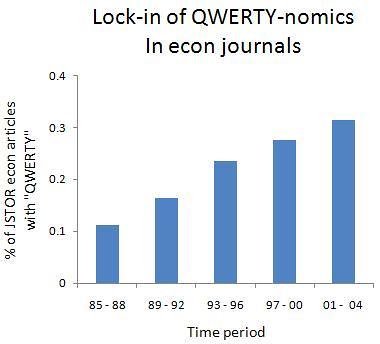 Note that the articles here aren't the broad class discussing various types of path dependence or network effects, but specifically the kind that lead to inferior lock-in -- as signalled by the mention of QWERTY. I attribute the locking in of this inferior idea to the fact that academia is not incentivized in a way that rewards truth, at least in the social sciences. Look at how long psychoanalysis and Marxism were taken seriously before they started to die off in the 1990s. Shielded from the dynamics of survival-of-the-fittest, all manner of silly ideas can catch on and become endemic. In this case, the enduring popularity of the idea is accounted for by the Microsoft-hating religion of most academics and of geeks outside the universities. For them, Microsoft is not a company that introduced the best word processors and spreadsheets to date, and that is largely responsible for driving down software prices, but instead a folk devil upon which the cult projects whatever evil forces it can dream up. Psychologically, though, it's pretty tough to just make shit up like that. It's easier to give it the veneer of science -- and that's just what the ideas behind the QWERTY and Betamax examples were able to give them. Overall, Liebowitz's work seems pretty insightful. There's very little abstract theorizing, which modeling nerds like me may miss, but someone's got to take a hard-nosed look at what all the evidence says in support of one model or some other. He and Margolis recognized how empirically unmoored the inferior lock-in literature was early on, and they also saw how dangerous it had become when it was used against Microsoft in the antitrust case. [1] He also foresaw how irrational the tech bubble was, losing much money by shorting the tech stocks far too early in the bubble, and he co-wrote an article in the late 1990s that predicted The Homeownership Society would backfire on the poor and minorities it was supposed to help. (Read his recent article on the mortgage meltdown, Anatomy of a Train Wreck.) Finally, one of his more recent articles looks at how file sharing has hurt CD sales. Basically, he details everything that a Linux penguin shirt-wearer doesn't want to hear. [1] Their book Winners, Losers, and Microsoft and their collection of essays The Economics of QWERTY attack the idea from another direction -- showing how the supposed conditions for lock-in or market tipping were met, and yet time and again there was turnover rather than lock-in, with each successive winner having received the highest praise. Labels: culture, Economics, History, Technology
Sunday, July 12, 2009
Robert Frank is promoting his idea that Charles Darwin will become more important than Adam Smith as an intellectual forebear of future economics in The New York Times. That is fine as it goes but I suspect that the bigger issue in the sciences of humanity is that there will be problems with relying on only one disciplinary framework and one general model. For example Frank points out that evolutionary fitness is generally conceived of in a relative sense (population mean fitness being the baseline), but the same dynamic crops up in neuroscience due to biophysical computational efficiencies from relative heuristics as opposed to a laundry list of absolute fixed preferences. R. A. Fisher famously wished to lay the seedbed for a thermodynamics of evolution in The Genetical Theory of Natural Selection. Whether one can envisage this in evolutionary genetics, it seems even less likely in the human sciences, at least to the extent of making a generalization which is not trivial. The rut which orthodox evolutionary psychology has found itself in is probably due to this assumption that our species is at some biobehavioral equilibrium due to an exceedingly unrealistic model of evolutionary dynamics.
Labels: Behavior Genetics, Behavioral Economics, Economics
Tuesday, July 07, 2009
Anti-Irish caricatures, the hypothesis that some races contain little intra-race variation, and how economists keep arguing--normatively and positively--for the rough equality of humankind: It's all in Peart and Levy's book The Vanity of the Philosopher.
The book is highly recommended to GNXPers with any interest in the complicated historical relationship between genetics and social science. The major value-added comes from the oft-ignored tension between economic theorists and evolutionary theorists. Well, that and the cartoons. The book builds on Levy's earlier work How the Dismal Science Got its Name. A free, abbreviated version of that story is here, and is wiki'd here. For some HBD newbies, the best part of Vanity will be the discussion of the Irish: In the early days of Darwinism, the people of the Emerald Isle were Exhibit A (or B) of an inferior race. Peart and Levy have a great discussion of how 19th century intellectuals hoped the Irish to evolve to become as well-mannered as, say, the English. And in the 19th century, whenever attacks on the Irish started up, attacks on abstract, unrealistic, ahistorical economic theory were rarely far behind. Funny, that... Oh, one more reason to take a look at Vanity: Peart and Levy slide the knife into Charles Dickens, a sight always to be relished. Labels: Economics
Friday, July 03, 2009
I was listening to Marketplace the other day and Kevin Hassett delivered a commentary combining economics with a revisionist evaluation of the American Revolution. Hassett's argument seems to be that the Revolution, which was notionally predicated on taxation without representation, will in the long run be a historical blip of no consequence as the United States converges upon the same tax and spend structure as the United Kingdom. From this convergence of tax and expenditure structures Hassett infers an eventual closing of the $10,000 GDP per capita gap between the United States and the United Kingdom. What therefore was the point of breaking away if 200 years later the USA is going to be so similar to the United Kingdom?
There are many ways to critique this sort of analysis, but there are two major issues that I jumped out for me. First, 200 years is not a trivial interval of time, especially when taking into account the large numbers of Americans who lived between then and now. To view economic history as convergence toward equilibria as a few parameters are modulated at some point in the future seems worthless, just as pointing out that the Sun will go nova, or that the universe may be doomed to heat death. There is a big difference between asserting that the GDP per capita gap will close within 10 years, and within 100 years. Tractable and elegant macroeconomic models may be mostly junk over the short term, but I'm pretty sure that they're total junk over the long term. Inferences from stylized facts may provoke, but spare me the assumption that that the error bars of projections aren't so huge as to make them useless even for government work. Second, it isn't as if the only things that separate the United States and the United Kingdom are institutional frameworks. Even within the United States there is quite a bit of regional variation in culture. Perhaps Hassett would say that specific variation in the instantiation of human capital is totally irrelevant, but most people wouldn't assume that as a given. Secondarily there is a sense here that historical contingency doesn't exist, that there is no path dependence in economic development. So the 200 year interval whereby the American Revolution served as an exogenous shock which tore the thirteen colonies out of the British Empire had no significant effect by shifting initial parameters in a manner which might "lock in" a bias toward some developmental paths as opposed to others. But evaluated over a long enough interval all historical events can be marginalized as futile acts against the trendline, whatever it is. Instead of using an abstract framework riddled with assumptions that many people would find laughable, why not go the route of pointing to the nature of the British settler colonies which did not revolt, but eventually became independent? Obviously Australia, Canada and New Zealand are different in myriad ways from the United States, but are the comparisons more strained than the model that Hassett posits?
Thursday, July 02, 2009
In the new issue of The New Yorker, Malcolm Gladwell reviews some book about using the appeal of FREE to grow your business. This is supposed to apply most strongly to information, so that as more and more of a firm's product / service consists of information, the more it can use the appeal of FREE to earn money.
What both Gladwell and the reviewed book's author, Chris Anderson, don't seem to realize is that the appeal of FREE creates pathological behavior. Gladwell even cites a revealing behavioral economics experiment by Dan Ariely: Ariely offered a group of subjects a choice between two kinds of chocolate -- Hershey's Kisses, for one cent, and Lindt truffles, for fifteen cents. Three-quarters of the subjects chose the truffles. Then he redid the experiment, reducing the price of both chocolates by one cent. The Kisses were now free. What happened? The order of preference was reversed. Sixty-nine per cent of the subjects chose the Kisses. The price difference between the two chocolates was exactly the same, but that magic word "free" has the power to create a consumer stampede. In other words, FREE caused people to choose an inferior product more than they would have if the prices were both positive. Thus, in a world where there is more FREE stuff, the quality of stuff will decline. It's hard to believe that this needs to be pointed out. And again, this is not the same as prices declining because technology has become more efficient -- prices are still above 0 in that case. FREE lives in a world of its own. If you're only trying to get people to buy your target product by packaging it with a FREE trinket, then that's fine. You're still selling something, but just drawing the customer in with FREE stuff. This jibes with another behavioral economics finding -- that when two items A and B are similar to each other but very different from item C, all lying on the same utility curve, people ignore C because it's hard to compare it to the altneratives. They end up hyper-comparing A and B since their features are so similar, and whichever one is marginally better wins. So if you have three more or less equally useful products, A B and C, where B is essentially what A is, just with something FREE thrown in, people find it a no-brainer to choose B. An exception to the rule of "FREE leads to lower quality" might be the products that result from dick-swinging competitions, where the producer will churn out lots of FREE stuff just to show how great they are at what they do. They're concerned more with reputation than getting by. Academic work could be an example -- lots of nerds post and critique scientific work at arXiv, PLoS, as well as the more quantitatively oriented blogs. But in general, you can imagine the quality level you'd enjoy from a free car or an all-volunteer police force. Even sticking with just information, per Chris Anderson, look at what movies you can download without cost on a peer-to-peer site or whatever -- they mostly all suck, being limited to the library of DVDs that geeks own. Sign up for NetFlix or a similar service, and you have access to a superior library of movies, and it hardly costs you anything -- it's just not FREE. Ditto for music files you can download cost-free from a P2P site vs. iTunes, or even buying the actual CD used from Amazon or eBay. Admittedly I don't know much about computer security, but just by extending the analogy of a voluntary police force, I'd wager that security software that costs anything is better than FREE or open source security software. To summarize, though, Gladwell's discussion about FREE misses the most important part -- it tends to lower quality. I don't want to live in a word of lower quality of items that aren't of major consequence, and (hopefully) the people in charge of high-consequence items like the police and my workplace's computer security will never be persuaded to go for FREE crap in the first place. This aspect alone answers the question he poses in the sub-headline, "Is free the future?" However, wrapping your brain around the idea that FREE tends to lower quality is discordant with a Progressive worldview, which explains why Gladwell just doesn't get it. Labels: Behavioral Economics, Economics, Media, Technology
Thursday, June 25, 2009
Updated
This may be old hat for some readers, but it's worth reviewing and providing some good new data for. The motivation is the idea that monopoly-haters have that when some company comes to dominate the market, they will have no incentive to change things -- after all, they've already captured most of the audience. The response is that industries where invention is part of the companies' raison d'etre attract dynamic people, including the executives. And such people do not rest on their laurels once they're free from competition -- on the contrary, they exclaim, "FINALLY, we can breathe free and get around to all those weird projects we'd thought of, and not have to pander to the lowest common denominator just to stay afloat!" Of course, only some of those high-risk projects will become the next big thing, but a large number of trials is required to find highly improbable things. When companies are fighting each other tooth-and-nail, a single bad decision could sink them for good, which makes companies in highly competitive situations much more risk-averse. Conversely, when you control the market, you can make all sorts of investments that go nowhere and still survive -- and it is this large number of attempts that boosts the expected number of successes. With that said, let's review just a little bit of history impressionistically, and then turn to a new dataset that confirms the qualitative picture. Taking only a whirlwind tour through the pre-Information Age time period, we'll just note that most major inventions could not have been born if the inventor had not been protected from competitive market forces -- usually from protection by a monopolistic and rich political entity. Royal patronage is one example. And before the education bubble, there weren't very many large research universitities in your country where you could carry out research -- for example, Oxford, Cambridge, and... well, that's about it, stretching back 900 years. They don't call it "the Ivory Tower" for nothing. Looking a bit more at recent history, which is most relevant to any present debate we may have about the pros and cons of monopolies, just check out the Wikipedia article on Bell Labs, the research giant of AT&T that many considered the true Ivory Tower during its hey-day from roughly the 1940s through the early 1980s. From theoretical milestones such as the invention of information theory and cryptography, to concrete things like transistors, lasers, and cell phones, they invented the bulk of all the really cool shit since WWII. They were sued for antitrust violations in 1974, lost in 1982, and were broken up by 1984 or '85. Notice that since then, not much has come out -- not just from Bell Labs, but at all. The same holds true for the Department of Defense, which invented the modern airliner and the internet, although they made large theoretical contributions too. For instance, the groundwork for information criteria -- one of the biggest ideas to arise in modern statistics, which tries to measure the discrepancy between our scientific models and reality -- was laid by two mathematicians working for the National Security Agency (Kullback and Leibler). And despite all the crowing you hear about the Military-Industrial Complex, only a pathetic amount actually goes to defense (which includes R&D) -- most goes to human resources, AKA bureaucracy. Moreover, this trend goes back at least to the late 1960s. Here is a graph of how much of the defense outlays go to defense vs. human resources (from here, Table 3.1; 2008 and beyond are estimates):  There are artificial peaks during WWII and the Korean War, although it doesn't decay very much during the 1950s and '60s, the height of the Cold War and Vietnam War. Since roughly 1968, though, the chunk going to actual defense has plummeted pretty steadily. This downsizing of the state began long before Thatcher and Reagan were elected -- apparently, they were jumping on a bandwagon that had already gained plenty of momentum. The key point is that the state began to give up its quasi-monopolistic role in doling out R&D dollars. Update: I forgot! There is a finer-grained category called "General science, space, and technology," which is probably the R&D that we care most about for the present purposes. Here is a graph of the percent of all Defense outlays that went to this category: 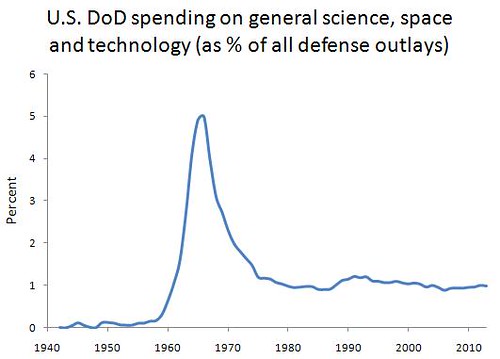 This picture is even clearer than that of overall defense spending. There's a surge from the late 1950s up to 1966, a sharp drop until 1975, and a fairly steady level from then until now. This doesn't alter the picture much, but removes some of the non-science-related noise from the signal. [End of update] Putting together these two major sources of innovation -- Bell Labs and the U.S. Defense Department -- if our hypothesis is right, we should expect lots of major inventions during the 1950s and '60s, even a decent amount during the 1940s and the 1970s, but virtually squat from the mid-1980s to the present. This reflects the time periods when they were more monopolistic vs. heavily downsized. What data can we use to test this? Popular Mechanics just released a neat little book called Big Ideas: 100 Modern Inventions That Have Changed Our World. They include roughly 10 items in each of 10 categories: computers, leisure, communication, biology, convenience, medicine, transportation, building / manufacturing, household, and scientific research. They were arrived at by a group of around 20 people working at museums and universities. You can always quibble with these lists, but the really obvious entries are unlikely to get left out. There is no larger commentary in the book -- just a narrow description of how each invention came to be -- so it was not conceived with any particular hypothesis about invention in mind. They begin with the transistor in 1947 and go up to the present. Pooling inventions across all categories, here is a graph of when these 100 big ideas were invented (using 5-year intervals): 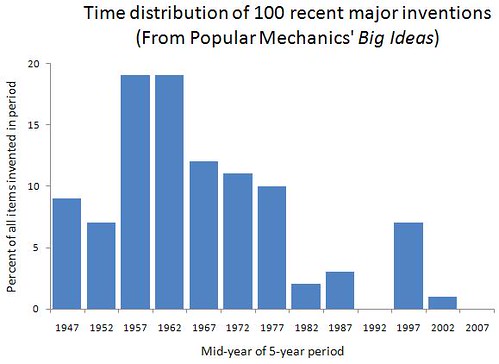 What do you know? It's exactly what we'd expected. The only outliers are the late-1990s data-points. But most of these seemed to be to reflect the authors' grasping at straws to find anything in the past quarter-century worth mentioning. For example, they already included Sony's Walkman (1979), but they also included the MP3 player (late 1990s) -- leaving out Sony's Discman (1984), an earlier portable player of digitally stored music. And remember, each category only gets about 10 entries to cover 60 years. Also, portable e-mail gets an entry, even though they already include "regular" e-mail. And I don't know what Prozac (1995) is doing in the list of breakthroughs in medicine. Plus they included the hybrid electric car (1997) -- it's not even fully electric! Still, some of the recent ones are deserved, such as cloning a sheep and sequencing the human genome. Overall, though, the pattern is pretty clear -- we haven't invented jackshit for the past 30 years. With the two main monopolistic Ivory Towers torn down -- one private and one public -- it's no surprise to see innovation at a historic low. Indeed, the last entries in the building / manufacturing and household categories date back to 1969 and 1974, respectively. On the plus side, Microsoft and Google are pretty monopolistic, and they've been delivering cool new stuff at low cost (often for free -- and good free, not "home brew" free). But they're nowhere near as large as Bell Labs or the DoD was back in the good ol' days. I'm sure that once our elected leaders reflect on the reality of invention, they'll do the right thing and pump more funds into ballooning the state, as well as encouraging Microsoft, Google, and Verizon to merge into the next incarnation of monopoly-era AT&T. Maybe then we'll get those fly-to-the-moon cars that we've been expecting for so long. I mean goddamn, it's almost 2015 and we still don't have a hoverboard. Labels: Economics, History, politics, Technology
Sunday, May 10, 2009
A Genetically Mediated Bias in Decision Making Driven by Failure of Amygdala Control:
Genetic variation at the serotonin transporter-linked polymorphic region (5-HTTLPR) is associated with altered amygdala reactivity and lack of prefrontal regulatory control. Similar regions mediate decision-making biases driven by contextual cues and ambiguity, for example the "framing effect." We hypothesized that individuals hemozygous for the short (s) allele at the 5-HTTLPR would be more susceptible to framing. Participants, selected as homozygous for either the long (la) or s allele, performed a decision-making task where they made choices between receiving an amount of money for certain and taking a gamble. A strong bias was evident toward choosing the certain option when the option was phrased in terms of gains and toward gambling when the decision was phrased in terms of losses (the frame effect). Critically, this bias was significantly greater in the ss group compared with the lala group. In simultaneously acquired functional magnetic resonance imaging data, the ss group showed greater amygdala during choices made in accord, compared with those made counter to the frame, an effect not seen in the lala group. These differences were also mirrored by differences in anterior cingulate-amygdala coupling between the genotype groups during decision making. Specifically, lala participants showed increased coupling during choices made counter to, relative to those made in accord with, the frame, with no such effect evident in ss participants. These data suggest that genetically mediated differences in prefrontal–amygdala interactions underpin interindividual differences in economic decision making. Check out the Wikipedia entry on 5-HTTLPR; lots of behavioral phenotypes associated with this variant. ScienceDaily: The researchers also measured the degree of interaction, or connectivity, between the amygdala and the prefrontal cortex, the brain region most implicated in human intelligence, personality and decision making. When resisting the frame effect, the participants with two copies of the long variant had stronger connectivity between the prefrontal cortex and amygdala, while those with a pair of short variants did not. So this genetic variation only explains 10% of the variation within the population when it comes to frame effect in behavioral economics. Fair enough. But, I do wonder if in the current political environment fewer would oppose genetically black-balling individuals with the short variants of 5-HTTLPR from becoming traders! (I'm not proposing this seriously myself, but I think there might be some amygdala-driven acceptance of this sort of genetic profiling right now even if the returns are small) Labels: Behavioral Economics, Economics, Neuroscience
Tuesday, May 05, 2009
A simple but powerful way to determine whether or not there's a irrational bubble is to look for a lot of people who are participating in a trend who have no business doing so. For instance, a Mexican strawberry-picker making $15,000 a year who gets a $720,000 loan for a home. If these don't-belong-there people make up a larger and larger fraction of all who get loans, that strongly suggests that everyone is trying to get in on a speculative bubble -- and that the gatekeepers of the activity are increasingly debauching their entry standards to accommodate the losers.
One datum that suggests an irrational bubble in education is that a much larger fraction of the population is going to college now, and that not surprisingly the average IQ of college students has declined by about 2/3 s.d. -- admissions boards began to scrape deeper down into the sludgebucket of society. How about looking even earlier? High school is compulsory, so we can't really use high school enrollment to judge whether there's a bubble or not. But what about the sub-group of high school that ostensibly is there to prepare college-bound students for college? That is up to the choice of students, perhaps being bullied by their parents. There is strong evidence even at this early stage of an irrational bubble. What got me thinking about this was a recent NYT article on how teachers feel about the Advanced Placement program, which is based on a report from the Thomas B. Fordham Institute. The key item that popped out was the claim that participation in the AP program has exploded in recent years, and that this has made a fair fraction of teachers anxious about whether there are students there who shouldn't be. This sure smells like a bubble. First, let's make sure that the AP program really is exploding as they say, and then we'll see if there's a rational basis for it or not. To measure participation in the AP program, I simply took the number of AP tests taken and divided it by the high school population size. (The AP data are here, and the high school pop data are here, Table A-1.) The AP data go back to 1988, while the high school pop data end in 2007, so I looked at the period from 1988 to 2007. Here are both the total number of AP tests taken and the per capita rate:  An exponential trend accounts for 99.8% of the year-to-year variation for the total number of tests taken, and 99.2% in the per capita case. So, clearly participation in the AP program has been exploding at least since 1988. Now, is there a sound basis for this increase -- like, maybe kids these days are just getting exponentially smarter? Without looking at the data, we know this is wrong since the main determinant of doing well in AP classes is IQ, and that is influenced mostly by genes and unpredictable aspects of the environment, which haven't been changing so rapidly from one year to the next. Turning to data on how well 17 year-olds are doing academically, let's look at some tables from the 2007 version of the Digest of Education Statistics (all under Chapter 2, and then Educational Achievement). Table 112 shows that on the National Assessment of Educational Progress, the average reading score for 17 y.o.s did not change from 1971 to 2004. Table 115 shows that the percent of 17 y.o. students who are at the 300 level or above in reading did not change from 1971 to 2004. Tables 125 and 126 show the same lack of change for math skills tested by the NAEP. Table 135 shows that the average Critical Reading score on the SAT did not change from 1988 onward -- indeed, it was steady back to about 1976, and had been declining before then. There was a modest uptick in Math scores (15 points, or 0.15 s.d.). The Critical Reading or Verbal score is more highly g-loaded than the Math score for the SAT, or is a better measure of IQ, which means the apparent uptick in Math scores may not mean as much as we'd think. Taken together, these data show that the academic fundamentals of high schoolers has not changed since the 1970s. If there has been no upswing at all in the fundamentals -- let alone an exponential one -- then the explosion of the AP program is accounted for completely by irrational factors. It seems just like the housing bubble -- the size of deserving borrowers didn't explode, so the surge in borrowing must have been due to a bunch of undeserving people pouring into the building, namely low-income people. Here are two graphs showing that this happened in the AP program too:   The first shows the distribution of AP scores, where 5 is greatest. You can check the numbers for yourself in the previous link to the AP data, but there has been no change in the percent of all tests that received a score of 4 or 5 -- there have not been more and more smarties piling into AP classrooms, at least not since 1988. Therefore, everyone who deserved to be there was already there. However, the percent of all tests receiving a score of 1 -- telling the student, "why did you even bother?" -- has doubled from 10% to 21%. Those receiving a 2 shrunk a tiny amount, from about 23% to 21%. But those receiving a 3 declined from about 32% to 24%. This means that, unlike for smarties, more and more dummies have been allowed into the AP program. This is reflected in the change in the mean and standard deviation of test scores: keeping the smarties fixed while adding a lot more dummies will drag down the mean and increase the heterogeneity or variance. That's analogous to the housing bubble causing a decline in the mean creditworthiness of the population of borrowers, and an increase in their heterogeneity, as both the sound and the unsound begin to rub shoulders in loan offices. And just as lenders increasingly cheapened their standards by not requiring down payments or proof of income, so high school teachers and administrators have allowed increasingly ill-prepared -- stupid -- students into the AP program. In sum, there is very strong evidence from AP tests for a speculative bubble in education. Most of what I've read on whether or not such a bubble exists has focused on college -- soaring tuition, more and therefore dumber students, and so on. These data, though, show that the mania extends even to high school, not just higher ed. For at least the past five years, there have been many news stories about competitive admission to pre-school, so perhaps someone could dig up some numbers to show an exponential increase there too that can't be rationalized by a change in fundamentals. In any case, it's clear that this bubble is much more general than the college data suggest. Curiously, the phrase "education bubble" has not appeared at all in the NYT, although it has appeared many times in the blogs that the newspaper hosts. Googling the phrase gets 39,000 hits. Rises and falls in tuition get plenty of coverage, but that doesn't show that the reporters are aware of the irrational bubble -- they just think it's unfair, that college should be cheaper so that more can attend. But just as no one was allowed to say that most low-income borrowers were undeserving of home loans since they were disproportionately black and Hispanic, so we aren't allowed to say that a lot of college students are nowhere near being "college material" -- that would violate the "demotic life and times," as Jacques Barzun has dubbed the zeitgeist from roughly the 1960s until today. We cripple our minds by imbibing political correctness. The bursting of the education bubble may be decades away -- it sure has been going on for awhile, so its period may be much longer than that of the housing or stock market bubbles. Let's just hope that when it happens, it will turn out that hedge funds and investment banks won't have exposed themselves to all of this silliness, and that we won't be plunged into another multi-year recession. Labels: Economics, education, IQ, Sociology
Saturday, May 02, 2009
Will of Ambrosini Critique makes the case. I actually don't accept the contention that chemistry is more intuitive than physics (physics can mean a lot of things, some of which can be demonstrated with balls, and mixing random chemicals together and trying to understand it intuitively has generally led alchemy, not chemistry), but that's not really the point. The post seems prompted by a discussion of Daniel Ariely's Predictably Irrational at my other weblog.
Labels: Economics
Sunday, April 26, 2009
Over at ScienceBlogs I have a post which highlights the bizarre likelihood that in China atheists are actually some more hostile to the precepts of godless Communism than the religious. I talked to Michael Vassar about this and he thought it was curious that Chinese atheists are probably among the segments of the world population most likely to appreciate the non-zero sum power of capitalism and economic growth. Well, I guess Mao and the Cultural Revolution would do that to you, right? In any case, in the World Values Survey there is a question about income inequality, here 0 = Incomes Should Be Made More Equal, and 10 = We need larger income differences as incentives. Below the fold are a selection of nations with the proportions of those in the 15-29 age ranges who agree with a "10" when it comes to income inequality.
Hong Kong, by the way, had the population which was most averse to income inequality.... Labels: Economics, World Values Survey
Friday, April 24, 2009
Cognitive skills affect economic preferences, strategic behavior, and job attachment:
Economic analysis has so far said little about how an individual's cognitive skills (CS) are related to the individual's economic preferences in different choice domains, such as risk taking or saving, and how preferences in different domains are related to each other. Using a sample of 1,000 trainee truckers we report three findings. First, there is a strong and significant relationship between an individual's CS and preferences. Individuals with better CS are more patient, in both short- and long-run. Better CS are also associated with a greater willingness to take calculated risks. Second, CS predict social awareness and choices in a sequential Prisoner's Dilemma game. Subjects with better CS more accurately forecast others' behavior and differentiate their behavior as a second mover more strongly depending on the first-mover's choice. Third, CS, and in particular, the ability to plan, strongly predict perseverance on the job in a setting with a substantial financial penalty for early exit. Consistent with CS being a common factor in all of these preferences and behaviors, we find a strong pattern of correlation among them. These results, taken together with the theoretical explanation we offer for the relationships we find, suggest that higher CS systematically affect preferences and choices in ways that favor economic success. From the discussion: The novel relationships we find have potentially deep implications. For example, Gregory Clark recently suggested that the initial location of the industrial revolution in England may have been due to a "survival of the richest" selection process, that operated there from as early as 1250 C.E...This selection may have been cultural, genetic, or both. He suggests that selection favored "capitalist" traits that include several of the ones (e.g. risk taking and saving propensity) we analyze herein. Were these traits independent, it is hard to imagine how a selection process could induce such a bundled concentration in the time frame suggested. But if these traits are correlated due to their linkage with cognitive skills, then a "selection of the richest" explanation, operating through selection for cognitive skills, becomes more plausible.... Labels: Behavioral Economics, Economics
Sunday, April 19, 2009
As a follow-up to the previous post on measuring the price-to-earnings ratio of composers, I've done the same thing for painters. The motivation is the same, and I'm still using the painter's score in Charles Murray's Human Accomplishment to measure earnings (the more objective valuation). Here, instead of measuring price (the more fashion-driven valuation) with the number of works available at Amazon.com, I'm using the number of works available at AllPosters.com, the main place that people visit to buy inexpensive high art.
The AllPosters score is simply number of works available, divided by the max for any artist (which happens to be for Monet), multiplied by 100. So, like the HA score, it is a measure of how valued an artist's works are, using the most highly valued artist of all as a reference point. A look at the data shows several similarities to the case of composers, suggesting that -- for example -- we overhype a certain time period in general, even though it could arguably be the peak for one art form and yet be only mediocre for another art form. We are more likely to fall for the whole zeitgeist, rather than ruthlessly discriminate and have a separate "favorite period" for different art forms. Anyway, let's get to the results. I've uploaded the dataset here, where you can copy & paste the text into an Excel spreadsheet to play around with it yourself. I'm only using painters because the sculptors and architects don't have much available at AllPosters -- people want to buy prints of paintings, not of sculptures. Although I haven't used them in the analysis, I've still included the sculptors and architects in the raw data. This only excludes 12 of 111 artists, and they're pretty spread out across time periods. As with composers, the agreement between encyclopedia writers and educated laymen is pretty close. Spearman's rank correlation between the HA score and the AllPosters score is rho = +0.58 (p less than 10^-6). As before, a fair amount (about 34%) of the variation in subjective valuations can be accounted for by variation in fundamental worth, but that still leaves plenty of room for hype to influence poster-buyers. Here is a plot of the two scores: 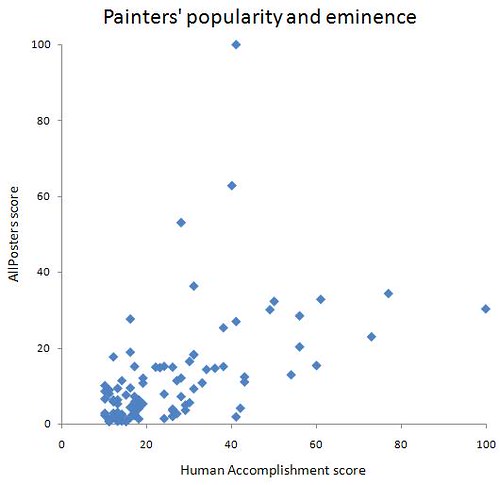 The two biggest outliers are Monet, who dominates the poster market but is considered second-tier in encyclopedias, and Michelangelo, who dominates encyclopedias but doesn't appear on many people's walls. This could be due to a lot of his work being sculpture and architecture. (None of the results are affected by counting Michelangelo as a sculptor / architect and removing his data-point from the analysis.) Picasso also gets a lot of coverage in encylopedias, while not attracting much attention from poster-buyers. As with Schoenberg among composers, this may suggest that Murray's decision to use 1950 as a cut-off was still a bit too late to fully remove the effects of hype. Still does a very good job, given that only a couple of probably over-rated Moderns have P/E ratios that say they're actually under-rated (e.g., Picasso, Max Ernst, de Chirico). The clearest case of a painter who is very eminent is encyclopedias but fairly neglected by the lay public is Raphael -- his HA score is 73, while his AllPosters score is 23. Most people my age wouldn't even recognize him, were it not for the Teenage Mutant Ninja Turtle named after him. For fun, here are the top 10 under-valued and over-valued painters, where hype increases as you go down either list: Top 10 under-valued painters Masaccio Pol de Limbourg Antonio del Pollaiolo Max Ernst Giorgio de Chirico Cimabue Piet Mondrian Hugo van der Goes Martin Schongauer Frans Hals Top 10 over-valued painters Marc Chagall Fra Angelico Henri Rousseau Edgar Degas Camille Pissarro Salvador Dali Vincent Van Gogh Henri de Toulouse-Lautrec Pierre-Auguste Renoir Claude Monet And as we saw with composers, the P/E ratios of painters are highly skewed, with most painters being under-rated and a tiny handful who are blown out of proportion. As before, a log-normal (or maybe exponential) distribution probably underlies the pattern. Here is the distribution, where the average is 0.4: 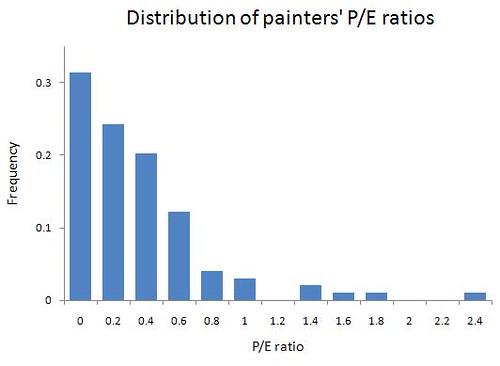 Finally, here is a look at how P/E ratios vary based on when the painter flourished: 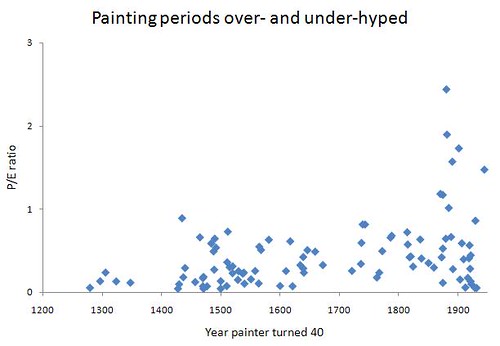 Just as with composers, those painters who flourished in the second half of the 19th C are the most over-valued. In a response to my composers post, Steve Sailer suggested that the time series showed that Western music reached its pinnacle during the Late Romantic period, perhaps because it was more profound than what he considers the daintier Classical-era music. But the painters who are responsible for inflating the hype of late-19th-C painting cannot be said to represent the perfection of technique, the profound rather than the light, and so on. These are the Impressionists and some Post-Impressionists, after all -- not their Academic contemporaries like Bouguereau. The only commonality with their musical contemporaries is a preference for expression, emotion, and well, the impressionistic. So, there are two explanations for the over-valuation of late-19th-C music and painting: 1) there is currently an irrational fashion bubble for that time period -- it had to be some period, so why not that one? The bubble would encompass the entire zeitgeist, regardless of whether the different parts of it represented the pinnacle of art in their respective media. Or 2) the art-consuming public is more sentimental than judges of art, so that the public tends to over-value time periods that gave greater emphasis to the emotions per se, independent of their artistic merit or the profundity of emotion expressed. This second explanation includes all class-based explanations, such as the one that says that academics favor aristocratic art, while the lay public is mostly upper-middle class professionals who have a weak spot for the high point of art consumed by the bourgeoisie. It was the new merchant class, remember, that was responsible for cleaning up the lurid spots left by the aristocratic and lower classes -- ending public hangings (and then hangings altogether), campaigning for animal rights, looking upon duels and other fights as barbaric rather than civilized, and so on. So we could just be seeing a class phenomenon, given that the middle class is more sentimental. Labels: arts, culture, Economics
Wednesday, April 15, 2009
Risk-dependent reward value signal in human prefrontal cortex:
When making choices under uncertainty, people usually consider both the expected value and risk of each option, and choose the one with the higher utility. Expected value increases the expected utility of an option for all individuals. Risk increases the utility of an option for risk-seeking individuals, but decreases it for risk averse individuals. In 2 separate experiments, one involving imperative (no-choice), the other choice situations, we investigated how predicted risk and expected value aggregate into a common reward signal in the human brain. Blood oxygen level dependent responses in lateral regions of the prefrontal cortex increased monotonically with increasing reward value in the absence of risk in both experiments. Risk enhanced these responses in risk-seeking participants, but reduced them in risk-averse participants. The aggregate value and risk responses in lateral prefrontal cortex contrasted with pure value signals independent of risk in the striatum. These results demonstrate an aggregate risk and value signal in the prefrontal cortex that would be compatible with basic assumptions underlying the mean-variance approach to utility. Labels: Economics
Tuesday, April 07, 2009
The concept of price-to-earnings ratio can be extended to anything that has an objective, fundamental value and a subjective value that people give to the thing -- assuming these can be measured, however crudely. The ratio gets bigger when the price goes up while the thing is still generating the same amount of earnings, or when it generates less earnings while being priced the same. So, larger values of this ratio mean that the thing is overhyped, while smaller values mean it's overlooked.
When lots of instances of the same thing are over-hyped, and when this over-hyping steadily increases for a stretch of time, we have a bubble. When people wake up to reality and the P/E ratio plummets, the bubble bursts. See the first graph in the Wikipedia link above for stock market data that show this relationship. These bubbles are counter-examples to the efficient-market hypothesis, which holds that prices already contain all known information about the stock -- or, say, the house. Under the hypothesis, a smarty-pants could not predictably outperform the stock (or housing) market, since they can't know anything that everyone else does not already know. But in reality, people who didn't believe the hype about houses, such as hedge fund manager Steve Eisman, got rich by betting that everyone else was nuts. Below the fold, I develop a rough P/E ratio for Western composers, calculate it for 69 eminent ones, and discuss some applications. For the measurement of the composer's fundamental value, I use his score in Charles Murray's Human Accomplishment, which measures how much space he is given across a wide variety of music encyclopedias -- how deserving he is. It's true that article writers could be in the midst of an irrational bubble for Beethoven and devote more space to him than he merits, but by using encyclopedias across many different languages and time periods, Murray protected as much as possible against this bias. He also excluded figures who flourished in the second half of the 20th C, just in case article writers were still affected by a recent bubble. For the measurement of the public's subjective valuation of the composer, I use the number of results returned from a search of his name in the "classical" section of Amazon's music section. (This is the name listed under "composer" in the work's webpage.) Unlike the number of Google results, the number of works offered for sale is a good measure of how much hype the composer enjoys among real consumers of classical music. I normalize these results by dividing by the maximum number of results (which happens to be for Mozart) and multiplying by 100, to put it on a 0 - 100 scale, as with the HA scores. The measurement of how under- or over-valued a composer is, the P/E ratio, is just the scaled Amazon score divided by the HA score. Higher P/E scores suggest he is over-hyped -- if two composers have the same amount of space devoted to them by those in the best position to objective judge the composers' excellence, the one with many more works being offered enjoys the influence of hype. And so does the composer who has the same number of works being offered as another, but who has much less space devoted to him in encyclopedias. One drawback here is that, unlike the P/E ratio for stocks or houses, the two parts of the ratio aren't measured in the same units, or even close -- they are a scaled measure of column inches and a scaled measure of works being offered. So the ratio here doesn't have an intuitive interpretation. But if we just want to see who's over- and under-valued, that doesn't matter. I calculated this P/E ratio for anyone in Murray's list of Western composers who scored 10 or above on his 0 to 100 scale, which yielded 69 data-points. To see all composers' data, you can download the spreadsheet here by clicking on view data and copying & pasting (as text) into an Excel file. Briefly, though, for fun here are the 10 most under- and over-valued composers, where the P/E ratio increases as you go down each list. (Thus, Willaert suffers the least from hype, and Puccini the most.) Bear in mind that "over-valued" does not mean "junk," and "under-valued" does not mean "awesome" -- only that the composer is given too much attention, or too little. 10 most under-valued composers Adrian Willaert Jean-Baptiste Lully Anton Webern Guillaume de Machaut Guillaume Dufay Arnold Schoenberg Josquin des Prez Giovanni Pierluigi da Palestrina Jean-Philippe Rameau Orlande de Lassus 10 most over-valued composers Johannes Brahms Camille Saint-Saens Charles Gounod Giuseppe Verdi Edvard Grieg Antonio Vivaldi Antonin Dvorak Pyotr Tchaikovsky Georges Bizet Giacomo Puccini Despite the presence of hype, though, the Amazon score and HA score agree pretty well with each other, as you see here:  The Spearman rank correlation between the two scores is +0.53 (p less than 10^-6). So, to some degree, the greater the esteem from encyclopedists, the more works are offered for sale. Still, differences in HA scores only account for under 30% of the variation in Amazon popularity, leaving plenty of room for the influence of hype. And do the P/E scores form a bell-shaped normal distribution? No. The average is 0.73 -- about what Domenico Scarlatti scores -- but most of the data are below this, and less above it. The graph below shows this skewed distribution, where most composers are actually rather under-valued and a handful are fairly over-hyped. 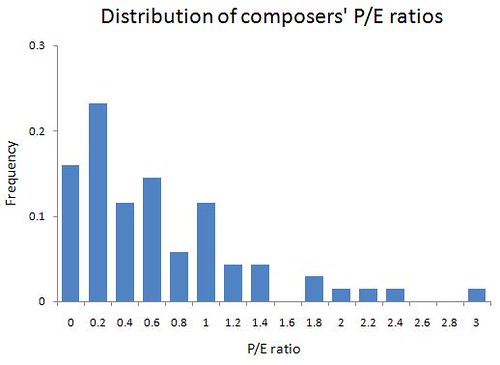 I don't have Amazon scores going back years -- or even one year -- so I can't make a series similar to the one that shows rising P/E ratios as the stock market enters a bubble, and declining values when the bubble bursts. I could find how many articles JSTOR contains that mention the composer, and measure this for all 69 composers across the years, and re-scale them by dividing by the maximum score in each year. But I'm not that interested in this topic, so I've done something a little different to detect bubbles. Murray also includes the year that each composer flourished -- i.e., when he turned 40 -- and I've plotted each composer's P/E score for the year he flourished. This allows us to see if composers from one time period are more or less over-hyped compared to those of another: 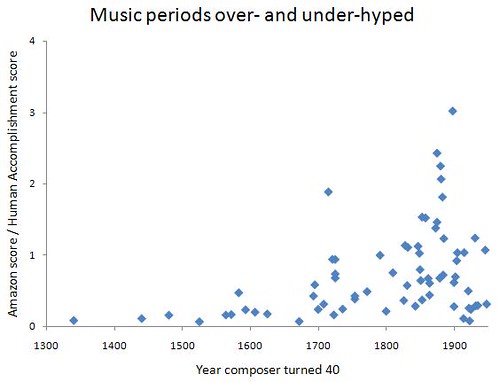 The composers of the pre-Classical periods (Medieval, Renaissance, and Baroque) are below-average in hype. Classical composers are average or a bit below, and the early Romantics are also about average. However, the late Romantics are vastly over-hyped. The Moderns are all over the place, although none is very over-hyped. It could be, though, that for the Moderns, an "overlooked" composer could have an unjustifiably high HA score, if Murray's article writers were not yet distanced enough to avoid the effects of recent manias for Modern composers. As a non-music buff, I feel my pedestrian tastes have been vindicated, as I've never gotten into the late Romantic period, but have always loved the Baroque most, then Classical, and even some early Romantic stuff. I have some catching up to do with Medieval and Renaissance composers, though. Culture mavens tell me that Baroque music is considered too nerdy and mostly suited for guy consumption, while the Romantics appeal more to normal people and women. So, music that appeals to more emotional people is over-valued, while music that appeals to more cerebral people is under-valued. This confirms that over-hyping something and an irrational, emotional mindset go hand-in-hand. On the topic of bubbles, Murray mentions that you do see fashion cycles, or booms and busts, in the percentage of an orchestra's output that comes from a particular composer -- e.g., that Bach might be very popular one year and decline for the next, say, 10 years. This is despite the fact that the aesthetic value of his work -- however we measure it -- hasn't changed. I think this argues against the cultural version of the efficient-market hypothesis. The public valuation of a composer may capture plenty of information about his fundamental worth, but there's a lot that's left out, such as the strong chance that a composer with a high P/E ratio owes some of his popularity to a bubble mindset among consumers. There are plenty of other cases you can apply this approach to, not to mention further refinements in looking at composers. What I'd really like to see is an objective measure of female celebrities' attractiveness -- say, by plugging measurements of their face, body, etc., into a regression equation -- and compare this against the number of results returned in a Google Image search for their name. I predict Angelina Jolie would score in the far-over-hyped range, Monica Bellucci in the average range of hype, and Jean Shrimpton in the over-looked range. Labels: arts, culture, Economics
Monday, April 06, 2009
A randomized trial of the effect of estrogen and testosterone on economic behavior:
Existing correlative evidence suggests that sex hormones may affect economic behavior such as risk taking and reciprocal fairness. To test this hypothesis we conducted a double-blind randomized study. Two-hundred healthy postmenopausal women aged 50–65 years were randomly allocated to 4 weeks of treatment with estrogen, testosterone, or placebo. At the end of the treatment period, the subjects participated in a series of economic experiments that measure altruism, reciprocal fairness, trust, trustworthiness, and risk attitudes. There was no significant effect of estrogen or testosterone on any of the studied behaviors. Labels: Economics, sex differences
Tuesday, March 31, 2009
In A Farewell to Alms, Gregory Clark provides data on interest rates to show that Europeans gradually developed lower time preferences. In other words, they were more likely to delay gratification and plan for the future -- paying back loans, for example. He also interprets data on wills as showing that most people of English descent today are the genetic legacy of the middle class, the poor and the aristocracy mostly having failed to reproduce themselves. That leaves us with a society where the average person maximizes their long-term material welfare much better than their counterparts would have in the Middle Ages or before. There appears to be somewhat of a drawback, though: doing so makes you more miserable over the long term.
John Tierney recently reviewed a series of studies on how the intensity of guilt and regret change over time. Read the most recent article for free here, which contains five related studies. The journal article and Tierney's write-up are brief and straightforward, so I own't belabor the details here. Basically, in the short term, indulgence-driven guilt stings more than prudence-driven regret, and this motivates us toward virtuous behavior, such as delaying material gratification. In the long term, though, guilt has faded away and regret over missing out on life's pleasures weighs more heavily on our mind. Oddly, then, maximizing long-term material well-being minimizes long-term hedonic well-being. If the big shift to low time preferences was as recent as Clark suggests -- during the Modern and especially Industrial period -- then perhaps our brain's pleasure or reward system hasn't had enough time to rewire itself to make us feel warm and fuzzy about having saved, abstained, and done the prudent thing in the past. Rather, since all other human groups before the big change, and certainly other primate groups, had very high time preferences, the reward system is probably designed to make us feel happy as we pour over a mental photo album that's stuffed with memories of irresponsible fun and indulgence. Hey, no one ever said that changing the world and getting shit done was going to be emotionally uplifting. I'd like to see follow-up studies focus on individual differences in how strongly they are motivated by guilt vs. regret. Most personality questionnaires measure something called excitement seeking or novelty seeking, as well as impulsiveness. We might predict that impulsive and excitement-seeking people are more motivated by avoiding regret than avoiding guilt, which leads them toward indulging more in the present. You could re-do all of the five studies in the article above, but using personality traits as predictor variables. If different parts of the brain light up when we feel guilt vs. regret, you could see if impulsive and excitement-seeking people showed greater responses to regret-based scenarios than guilt-based scenarios. (E.g., they read a story about someone else feeling these emotions, they reflect on an episode from their own lives, they see pictures of the faces of others expressing these emotions, and so on.) On an applied level, if you suffer from "hyperopia" -- planning to much for your material future -- you can push yourself to indulge merely by reflecting on how you may in 20 years regret missing out on having fun now. If you remind yourself that "You'll regret it if you don't," then you won't find yourself sighing later on about that more exciting trip you should have taken your son on, that year of working in a more fulfilling city for less pay, or that student who made a pass at you that you should have slept with. Labels: Economics, Evolutionary Psychology, Psychology
Thursday, March 19, 2009
Tracking economists' consensus on money illusion, as a proxy for Keynesianism
posted by
agnostic @ 3/19/2009 02:07:00 PM
I'm probably not the only person playing catch-up on economics in order to get a better sense of what the hell is going on. Just two economists clearly called the housing bubble and predicted the financial crisis, and only one of them has several books out on the topic -- Robert Shiller, the other being Nouriel Roubini. With Nobel Prize winner George Akerlof, Shiller recently co-authored Animal Spirits, a popular audience book making the case that human psychology and behavioral biases need to be taken into account when explaining any aspect of the economy, especially when things get all fucked up. That argument would seem superflous, but economics is the butt of "assume a can-opener" jokes for a reason.
To be fair to the field, though, they point out that before roughly the 1970s, mainstream economists all believed that the foibles of human beings, as they really exist, should be incorporated into theory, rather than dismissing them as behaviors that only an irrational dupe would show. Remember that Adam Smith was a professor of moral philosophy and wrote extensively about human psychology. From what I can tell, the recent shift does not have to do with the introduction of math nerds into the field, since the man who laid most of the formal foundation -- Paul Samuelson -- was squarely in the "psychology counts" camp. It looks more like a subset of math nerds is responsible -- call them contemptuous autists, as in "What kind of idiot would engineer the brain that way?!" (Again, these are very rough impressions, and I'm winging it in categorizing people.) Of the many ideas relevant to understanding financial crises, a key one from the old school period is money illusion, or the idea that people think in terms of nominal rather than real prices. For example, if the nominal prices of things you buy go down by 20%, you won't be any better or worse off in real terms if your nominal wages also go down by 20%. However, most people don't think this way, and would see a 20% pay-cut in this context as a slap in the face, a breach of unspoken rules of fairness. This is an illusion because a dollar (or euro, or whatever) isn't a fixed unit of stuff -- what it measures changes with inflation or deflation. It's the same reason that women's clothing designers use fuzzy units of measurement -- "sizes" -- rather than units that we agree to fix forever, such as inches or centimeters. By artificially deflating the spectrum of sizes, a woman who used to wear a size 10 now wears a size 6, and she feels much better about herself, even if she has stayed the same objective size or perhaps even gotten fatter. How could they be so stupid to fall for this, when everyone knows it's a trick? Who knows, but they do. Similarly, everyone knows that inflation of prices exists, and yet the average person still falls victim to money illusion, and economic theory will just have to work that in, just as evolutionary theory must work in the presence of vestigial organs, sub-optimally designed parts, and other things that make engineers' toes curl. Animal Spirits provides an overview of the empirical research on this topic, and it looks like there's convincing evidence that people really do think this way. To take just one line of evidence, wages appear to be very resistant to moving downward, even when all sorts of other prices are declining, and interviews and surveys of employers reveal that they are afraid that wage cuts will demoralize or otherwise antagonize their employees. This is obviously a huge obstacle during an economic crisis, since firms will find it tough to hemorrhage less wealth by lowering wages -- even only by lowering them enough to match the now lower cost-of-living. The way Akerlof and Shiller present the history of the idea, it was mainstream before Milton Friedman and like-minded economists tore it down starting around 1967 and culminating by the end of the 1970s, although they hint that the idea may be seeing a rebirth. As an outsider, my first question is -- "is that true?" I searched JSTOR for "money illusion" and plotted over time the fraction of all articles in JSTOR that contain this term: 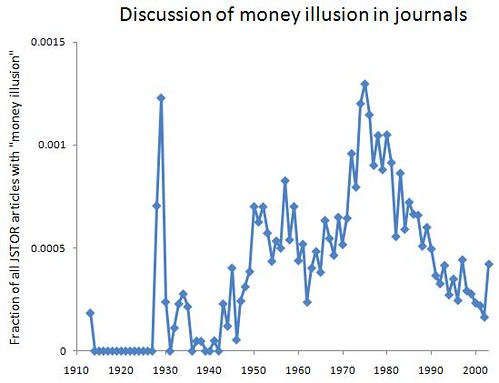 Although the term was coined earlier, the first appearance in JSTOR is a 1913 article by Irving Fisher, and the surge around 1928 - 1929 is due to commentary on his book titled Money Illusion. Academics were still talking about it somewhat through 1934, probably because the worst phase of the Great Depression spurred them to try to figure out what went wrong. The idea becomes more discussed during World War II, and especially afterwards when Keynesian thought swept throughout the academic and policy worlds within the developed countries. In the mid-'50s, the term decelerates and then declines in usage, although the policies of its believers are still in full swing. I interpret this as showing that from the end of WWII to the mid-'50s, their ideas were debated more and more, and after this point they considered the matter settled. Starting in the mid-late-1960s, though, the term begins to surge in usage to even greater heights than before, peaking in 1975, and plummeting afterward. This of course parallels the questioning of many of the ideas taken for granted during the Golden Age of American Capitalism, and the transition to Friedman-inspired thinking in academia and Thatcher-inspired thinking in public policy. Party affiliation clearly does not matter, since the mid-'40s to mid-'60s phase showed bipartisan support for Keynesian thinking, and after the mid-'70s there was also a bipartisan consensus on theory and policy applications. I interpret this second rise and fall as a re-ignited debate that was then considered a resolved matter -- only this time with the opposite conclusion as before, i.e. that "everyone knows" now that money illusion is irrational and therefore doesn't exist. The data end in 2003, since there's typically a five-year lag between the publication date of an article and its appearance in JSTOR. So, unfortunately I can't use this method to confirm or disconfirm Akerlof and Shiller's hints that the idea might be on its way to becoming mainstream in the near future. Whatever the empirical status of money illusion turns out to be -- and it does look like it's real -- the bigger question is whether or not economists will return to a serious, empirical consideration of psychology -- both the universal features (however seemingly irrational), as well as the individual differences that allow Milton Friedman to easily work through a 10-step-long chain of backwards induction, but not a typical working class person, who isn't smart enough to get into college (and these days, that's saying a lot). If all the positive press, not to mention book deals, that Shiller is getting are any sign, the forecast looks optimistic. Labels: Economics, intellectual history, politics, Psychology
Sunday, March 15, 2009
Will the recession bring anti-globalization protests back?
posted by
agnostic @ 3/15/2009 03:05:00 AM
When I was a clueless sophomore and junior in college, 2000 - 2001, the cool thing that was sweeping through campuses was anti-globalization. It was more than just that, but this was the core. (There was also the Nader campaign, the Florida vote fiasco, Enron, and 9/11.) At the time I was incredibly far left (left anarchist) but drifted away from the movement around the spring of 2003, the last big protest being against the invasion of Iraq. I didn't have anything to do with it after that, and my views have moved to the center-right.
As this list of anti-globalization protests confirms, I wasn't unusual. The really large protests took place in 2000 and especially 2001, they were on the decline by 2003, and from 2004 through 2006, they were non-existent within the First World (aside from ritualistic May Day protests). There's a slight uptick in 2007, and now The Telegraph reports that London is preparing for the biggest protest in a decade. The umbrella group organizing the protest is G20 Meltdown. Maybe it's not surprising, but it looks like these things flare up during recessions and abate during booms. The first round took place during the dot-com crash, and by 2004, college students and 20-somethings were too busy applying their dopey open minds to the topics of metrosexual facial moisturizers, which regional real estate bubble they would exuberantly contribute to, and the crunk and post-punk revival music that was out -- way cooler than that Blink182 bullshit that was popular from about 1997 to 2002. But now that young people sense bad things ahead, we may be in for another deluge of protesting professors, fliers for International Socialist Organization meetings, and low-status young males lobbing rocks to impress the one cute anarchist chick at the protest. Labels: Economics, History, politics
Monday, February 02, 2009
Jim Manzi:
This Baconian revolution is coming to economics and social science. Jim is describing what Michael Vassar terms "integrative social science." My own interests in behavioral economics and economic history make it rather clear that I do hope that Jim is right. Labels: Economics
Saturday, January 17, 2009
See Greg Clark's paper In Defense of the Malthusian Interpretation of History if you haven't read Farewell to Alms. Commentary from Calculated Exuberance.
Labels: Economics
Huge Rise In Male Mortality Coincided With Move From Communism To Capitalism. In other news, A Trivers-Willard Effect in Contemporary Humans: Male-Biased Sex Ratios among Billionaires (H/T Dienekes). Economics might not take human biology into account, but it have an influence on human biological processes (recall that fertility collapsed in Russia after the fall of Communism).
Labels: Economics
Wednesday, December 24, 2008
Massimo Pigliucci has a post up, Economics learns a thing or two from evolutionary biology. There are many points within the post which I would agree or disagree with, but, I get the sense that the current economic morass is precipitating these sorts of criticisms of "economics." I'm not one to disagree on the importance of behavioral economics, and I believe a serious engagement with the reality that rationality is bounded will only benefit the human sciences. That being said, it seems to me that the current problems are not ones of economics or the economics profession as much as the particularities of the finance profession in terms of its incentive structure. By analogy, imagine blaming zoologists and botanists for the actions of agribusiness (e.g., excessive utilization of antibiotics so as to maximize short term firm productivity at cost to a risk of a high negative externality). Rather than suggest that economics needs to learn from the life sciences (I think this is happening), I believe that you need to look to public choice theory and other extant frameworks available off the shelf.
Labels: Economics
Tuesday, December 16, 2008
Post-Columbian population movements and the roots of world inequality:
Why should we care about the apparently powerful influence that population origins exert on country and sub-national incomes levels? Also, Ancestors and incomes: More on the roots of world inequality. I don't doubt all sorts of implicit cultural norms, information, etc., are transmitted from generation to generation. But there's also something else which is passed from generation to generation which might come to mind.... Labels: Economics, human biodiversity
Monday, December 15, 2008
Most scientists believe that only objective factors are real and try to eliminate all subjectivity from their explanations -- subjectivity is seen primarily as a source of error. Economists are the most objective social scientists, and they customarily sneer at dumber so-called scientists who fail to reduce human behavior to hard facts.
When things are going well, that is. During times of prosperity economics is a hard science like physics. It's only when things go badly that they kick the can over to psychology and reach for mental factors like "irrational exuberance" and "mental depression" so that they can blame other, stupider sciences for their failures. (Quantum physicists also reach desperately for The Mind at times, since after sixty or seventy years their data are still impossible to interpret.) So here's my explanation of the present Collapse of Western Civilization: amphetamines. The world of finance is a rather small one, populated entirely by supersmart, extremely aggressive and competitive men (mostly) who have to go at top speed twelve or more hours a day, day after day. How do they do it? Performance-enhancing drugs, that's how: legally-prescribed amphetamines. (Cocaine is uncool, and so Eighties.) And since finance controls the world, when the tweakers crash, the whole world crashes with them. Like a football team collapsing in the fourth quarter, the world has run out of beans. We've had our jag, and now we're crashing. Not much fun. In my small experience, amphetamines are very nice. The world becomes a happy place. You get smarter and have lots of energy, and you can keep on going indefinitely. Complex ideas seem simple and all of your ideas look good. The crash isn't even that bad if you use in moderation. But amphetamines are not conducive to moderation. A friend working in a major science research institute has told me in confidence that a psychologist had told him (also in confidence) that the majority of the researchers there were using amphetamines or something of that kind. Paul Erdos, one of the greatest mathematicians of our time and probably the most prolific, was famous for his reliance on amphetamines. Science magazine has recently suggested that we seriously look into the possibility that the use of amphetamines for performance enhancement should be medically authorized, allowing scientists to do openly what they're already doing under the table. Erdos always worked with collaborators, and maybe this is the reason for that. While it's working, amphetamine only shows you the bright side of things. It doesn't enhance your judgment, your capacity for self-criticism, or your awareness of problems. Maybe Erdos needed a ground man -- someone to point at his work and say "You know, Paul, I think that you skipped about seventeen steps right there." The mathematics community is self-policing, but finance absolutely isn't, at least in the short term. A rising tide raises all boats, and when things are going well a clever but foolhardy investor can keep winning for years. Furthermore, someone's who's already persuasive will be even more persuasive while in the grip of amphetamine-induced enthusiasm. Optimists who believe what they're saying are the best con men, and speed gives them the sincere optimism they need. (Have Glassman and Hassett ever been pee tested?) Negative thinking is necessary and good. The disseminated optimism of crowds is not to be trusted. If we'd had fewer people lighting candles and more people cursing the darkness, we wouldn't be in this fix. The crash phase of amphetamine psychosis is now before us. Labels: civilization, Economics
Wednesday, September 17, 2008
Here is a nice follow-up to the Herbert and Coates study on London floor traders where they study the profitability of traders and testosterone levels. In this new paper, "Testosterone and Financial Risk Preferences", available on the website on one of the authors, a Harvard-led team of researchers report that men with higher T make more financially risky decisions. They are careful to note that it is merely an association. But it is a start. The slam dunk paper that remains to be written is one with exogenous administration of testosterone (and placebo). That would hopefully settle the causality issue (and might therefore excite the imaginations of some economists!). There are some interesting ideas in the manuscript about financial-risk taking as a form of male-male competition.
Labels: Biological Psychology, Economics
Sunday, September 07, 2008
Cantons of Switzerland, per capita GDP, language and religion
posted by
Razib @ 9/07/2008 03:05:00 AM
Update: Added populations.
Update: Added 1980 vintage language data. Note that Italians are the largest foreign population traditionally. Update II: I tried to plot the 1980 language proportions against 2005 per capita income. I know, not kosher, but doesn't matter, almost none of the income variation can be accounted for by language variation (around 5%, with a slight positive relation between Germanity and wealth). Using the 1980 language data and 2005 per capita cantonal GDP the nominal per capita GDP would be 56,000 for German speakers and 51,000 for French speakers. A commenter asked about Switzerland. I'd been meaning to look deeper into the issue for a long time, so I decided to give it a try. Below the fold are the Swiss Cantons organized by the variables you see in the title. I had to collect the information from various sources, explaining the obviously non-Anglicized names of some of the Cantons (I've just finished looking up the language and religious proportions in a somewhat time consuming manner, so I am not inclined to change the names since they're rather intelligible). I ran into some papers relating factors such as government expenditure and economic productivity and Protestantism, but I'll leave the data without comment and as a reference for readers. I also included a map below which can give you a sense of where the Cantons are and the distributed. One thing to note, several sources noted that in Switzerland Protestantism historically tended to be urban, which I thing goes a long way toward explaining what seems to be a difference in per capita GDP.
* Nominal per capita GDP 20005, swiss franc 
Sunday, August 31, 2008
 Variation is interesting. Why are there species, for example? Why do identical twins vary in life outcomes at all? How, and why, do the two antipodal maritime temperate regions of Eurasia, China and Europe, differ? The answers one comes up with vary by discipline and scope. In Farewell to Alms the economic historian Gregory Clark explains the genetic outcome of differences in lactase persistence (LP) as a function of variation in wealth; Europeans were wealthier so they could invest in the expensive production of milk and meat. I suspect most natural scientists would look to environmental constraints as the largest effect variables; LP arises in environments where cattle culture is more productive on a per area unit basis than grain culture. And then there is of course the fact that human lifestyles do not exist in a social and historical vacuum. There is evidence that wide swaths of the north China plain were abandoned by farmers during periods of political disorder due to their vulnerability to the depredations of nomadic groups (Genghis Khan's plan to depopulate the Yellow River plain and turn it into pasture was not as bizarre as one might think). When political stability returned there would be a shift in the boundary between nomad and farmer. If Peter Turchin is right then the variables effecting these changes are endogenous to a model of historical dynamics which are characterized by cycles (Turchin's case study of the expansion of Slavs and farming along the Ukrainian Cossack frontier is a classical case where politics rather than ecology served as the limiting reagent). Variation is interesting. Why are there species, for example? Why do identical twins vary in life outcomes at all? How, and why, do the two antipodal maritime temperate regions of Eurasia, China and Europe, differ? The answers one comes up with vary by discipline and scope. In Farewell to Alms the economic historian Gregory Clark explains the genetic outcome of differences in lactase persistence (LP) as a function of variation in wealth; Europeans were wealthier so they could invest in the expensive production of milk and meat. I suspect most natural scientists would look to environmental constraints as the largest effect variables; LP arises in environments where cattle culture is more productive on a per area unit basis than grain culture. And then there is of course the fact that human lifestyles do not exist in a social and historical vacuum. There is evidence that wide swaths of the north China plain were abandoned by farmers during periods of political disorder due to their vulnerability to the depredations of nomadic groups (Genghis Khan's plan to depopulate the Yellow River plain and turn it into pasture was not as bizarre as one might think). When political stability returned there would be a shift in the boundary between nomad and farmer. If Peter Turchin is right then the variables effecting these changes are endogenous to a model of historical dynamics which are characterized by cycles (Turchin's case study of the expansion of Slavs and farming along the Ukrainian Cossack frontier is a classical case where politics rather than ecology served as the limiting reagent).But for a moment I want to zoom the scale. In The Retreat of the Elephants: An Environmental History of China, there is a chapter, The Riddle of Longevity: Why Zunhua?: People lived longer in the late-imperial department Zunhua in the mountains along the old Ming northern frontier...The expectation of life at birth for a woman was in the high forties, twice as long as in Jiaxing.... Jiaxing is highlighted because another chapter focuses on the taming of this region and its transition from being a marginal territory on the periphery of Chinese civilization to a rationally managed agricultural heartland. A case in point supporting the thesis of hydraulic despotism. The author notes a few points to contrast Zunhua and Jiaxing: 1) Climate. Zunhua was much colder in winter, with temperatures generally falling below zero. This surely dampened the local pathogen load. 2) Ecological differences. Zunhua is relatively mountainous, while Jiaxing is a coastal wetland region tamed into an expanse of intensive rice production. Irrigation is common in Jiaxing, but there were ecological constraints on its utilization in Zunhua (the soil is very sandy and so there are major issues with drainage which reduced the efficiency of canals). 3) Differences in diet. Zunhua's populace had a relatively diverse diet, where dry land agriculture was balanced with animal husbandry and hunting and gathering. In contrast, Jiaxing was a classic climax rice monoculture where almost all calories were from grain. 4) There were differences in ethnicity. The local historical identity of non-Han peoples was far stronger in Zunhua than in Jiaxing. The process of Sinicization had proceeded to completion in Jiaxing, which now lay along the axis of the economic heartland of China. In contrast, Zunhua was for nearly 3,000 years on the northeast boundary of Han habitation. It was known to the ancient Chinese, and Han populations were generally extant within its territory, but it was often dominated culturally by non-Han groups who would play a large role without Chinese history, culminating in the Manchus. The author also notes that there was a large difference in the extent of female labor in Jiaxing and Zunhua. It was a prominent feature of the life of peasants in Jiaxing, but not so of Zunhua. Additionally, one bureaucrat observed that unlike many other parts of China it was not typical for very poor women in Zunhua to supplement their income with de facto prostitution (random "walks" in the fields). The inhabitants of Zunhua were consumers of a fair amount of meat, but interesting they were also milk drinkers, atypical for China. The Census data from 1820 to 1910 suggests that Zunhua was relatively underpopulated (the author's focus here is on observations hinged around the late Imperial Manchu dynasty). This probably explains the relative wealth of a the typical peasant in Zunhua vis-a-vis one in Jiaxing (as well as lack of epidemics). But why was Zunhua so underpopulated in the first place? Are the data from the late Imperial period just a transient which captures a snapshot before the region is caught in a Malthusian Trap? To some extent I suspect so, but, I wanted to note specifically that Zunhua was on the radar of Chinese annalists nearly 3,000 years ago. Unlike vast regions of far southern inland China it was not new to Sinicization, rather, Sinicization simply never completed itself over the ensuing centuries. In fact, the region was for long periods under barbarian rule and outside of China proper. First, I want to repeat one of the major obvious insights of The Retreat of the Elephants, the process of Sinicization was inevitable, a matter of time, across much of what is today China. The millet and rice based agricultural systems associated with Han Chinese swept away competing lifestyles before them like a deterministic physical system. A proactive program of cutting down forests and clearing land, as well as channeling and controlling the flow of running water across the landscape, was part and parcel of the expansion of the Chinese state and Han identity. Some of the increase in the numbers of the latter is surely a matter of demographics, as Chinese settlers push into cleared land. On the other hand, there is extensive documentary evidence that those non-Chinese tribes which adhered to lifestyles which were at variance with that of the Han on many occasions adopted the intensive farming lifestyle when their territories were impinged upon. Eventually they saw themselves as Han. In the Christian and Islamic world it was common to assert that war against those outside of the bounds of their religious civilization was by nature just because they were infidels, and that enslavement of unbelievers was acceptable. Some of the material in this book highlights a similar ideology on the part of the the Han Chinese through their perception that those who were not Han were fundamentally not human or subhuman. But, just as with Christianity or Islam, tribes and peoples could become Han. This process was one less of ideology, though certainly elites adopted Confucian ethics and the Chinese classics, as opposed to one characterized by a way of life in terms of the optimal mode of resource extraction and utilization. To be Han the commoners farmed like the Han, and the rulers ruled like the Han. The Han way of life was eminently successful in terms of extracting more productivity per unit are of land, as evidenced by the fact that China is now well over 90% Han, and, its historically high population density. It was not a rigid orthodoxy, the original millet based farming system which arose around the Yellow River plain gave way to the dominance of rice agriculture, likely originally a feature of the culture of non-Han populations of central and south China. The Han way of life was one of maximal resource extraction and mass mobilization of populations under the aegis of a central governing unit. The transition from Han to non-Han seems to have been partly due to demic and cultural diffusion as a bottom-up process, but, as documented in The Retreat of the Elephants, it was also a function of the greater robusticity of the war machines of Han states. Not only could they mobilize more men, but they could they could organize and coordinate their actions because of the central nature of their polities. Local peoples had an advantage in terms of their knowledge of regional conditions and could wage a persistent rearguard action over the centuries by disrupting the social and agriculture systems (e.g., canals, bridges, bureaucrats, etc.) which Han society depended upon, but over the long haul Sinicization marched on. The machine could be broken, but never utterly destroyed. So why did Zunhua resist Sinicization so long? I suspect that the prevalence of animal husbandry indicates that the Han agricultural complex was simply not as well suited to this region. In areas too dry for agriculture irrigation is an option, but as noted above it was not an ideal one in Zunhua because of the characteristics of the terrain and soils. During the Former Han dynasty the emperor Wu engaged in a series of wars with the nomadic Xiongnu, but a serious problem with defeating these peoples was that a Chinese victory did not result in cultural assimilation. There were instances where the nomads could not win, but they could never truly lose. In areas too dry, cold and rugged for Han agricultural techniques nomadic life simply was more economically more efficient, or, more accurately the only option aside from hunting and gathering. The final Chinese "victory" over the Xiongnu occurred via co-option from their within by dividing their elite and brandishing the allure of civilized luxury goods. To some extent there was little difference in the material conditions of the Xiongnu elite, instead of engaging in raids to obtain wealth they were bribed or paid by the Chinese polity. In terms of efficiency this reduced the uncertainty on the part of the Chinese and so was economically a good decision as it allowed for a shift toward lower time preference. Reading the chapter in question here, I got the feeling that the economic and social conditions in Zunhua mimicked the contrasts which one might draw between pre-modern Europe and China. Europeans had a more mixed diet than the Asian peasant, and their agricultural complex relied to a far greater extent on animal husbandry and cattle (or, differently stated, more inputs of capital than labor to increase marginal returns). The average European peasants was arguably wealthier than the average Chinese peasant. In Farewell to Alms Greg Clark points to better hygiene in East Asia leading to a different death schedule, so that the Chinese would be pushing against the Malthusian limit to a greater extent (fewer mouths dividing up a finite pie in Europe vs. China at any given time). On the other hand, economic historians such as Raymond Crotty have emphasized the peculiar ecology of Northern Europe, and the incentives that existed toward raising of cattle stock as opposed to cereal agriculture. From what I have read it seems clear that in places such as Scandinavia traditional cereal agriculture gave a relatively low in yield. After all, wheat is a crop of the Mediterranean. Oats were a better bet, but are relatively unpalatable to humans, so they were more effectively grown as fodder for cattle. A quick look at a world map will show that Europe is far to the north of China. Because of the disparate impact of Westerlies the different sides of continents at the same latitude may experience climatic regimes which vary a great deal. Northern California and New Jersey are an example. Distance from oceans also matter, southern Nebraska has a more "continental" climate than either New Jersey or northern California despite similar latitudes. It seems to me that on reason China and Europe took such radically different paths in terms of agriculture styles, in particular northern Europe and China, were differences in their ecological parameters. Europe is a very high latitude temperate zone characterized by moderation in its climate and relative regularity in its precipitation. China is a relatively low latitude temperate zone because of its exposure to the winter air of central Asia, as well as being subject to the reversal monsoonal flow during the summer, which is the season of greatest precipitation. The region of Europe at the similar latitude as north China, the Mediterranean zone, is characterized by much milder temperatures in winter as well as an inverted precipitation regime from Asia, with a maximum during the cold season of least sunlight. But in the case of Zunhua ecology is probably not the only constraint. Its local population in the ancient phase included many "friendly" Xiongnu, suggesting its proximity to the steppe heartland. The period which The Retreat of the Elephants surveys is one of relative peace when Zunhua was not on a political frontier, the Manchu dynasty had subjugated Mongolia, and pushed the north boundaries of the Chinese Empire past the Amur river. For much of Chinese history in contrast Zunhua was a borderland, often not under Chinese hegemony. It seems plausible that therefore Zunhua was often a "No Man's Land," and so not subject to economic exploitation because of the risks inherent. I suspect an analogy to arable regions of Ukraine which were long occupied by nomads may be made. Up until the expansion of the Czarist state during the 17th century farmers that lived in central and eastern Ukraine would be subject to brutal exploitation by nomadic peoples, a dynamic one can glean as far back as the Scythians. Only with the rise of the Gunpowder Empires were the nomads on the marchlands finally defeated and extinguished as a threatening wild card which dissuaded farmers from settling vast swaths of Inner Eurasia. To some extent this might be interpreted simply as a variant of Greg Clark's point about shifting the death schedule; during periods when Zunhua was on the borders only those who were willing to risk life and limb would settle there, and periodic wars would "clean out" the region demographically. Ultimately though I am curious as to why agriculture developed the way it did in China, being so focused on human labor. In The Great Divergence it is pointed out that China was more densely populated than India, and that land was more plentiful in South Asia. In Cows, Pigs, Wars, and Witches it is argued that cattle reverence in India is a function of the fact that bulls are an essential draft animal (the author notes that a disproportionate number of feral cattle are cows). In When Histories Collide Raymond Crotty argues that cattle reverence in India is due to the fact that killing calves would be counterproductive in terms of milk production. I have already provided some general rationales for why animal husbandry was relatively rational in Europe. In China, the primary animal was the pig. In terms of domesticates it seems that the pig is nearly feral, generally subsisting on offal. The pig can not produce milk, nor can it serve as a work animal. Various regions of Eurasia developed "critical mass" as complex literate societies during the pre-modern era, but gross features of their modes of production still differed. Why? Some ideas. Going off William H. McNeill's arguments in Plagues and Peoples, I suggest that South Asia had a higher pathogen load than East Asia, and so there was always downward pressure on the population so that it did not "push" against the Malthusian Trap to the same extent. This also freed up more land so that successful farmers might get a relatively larger marginal return from the utilization of cattle as draft animals. In Europe the variables were not disease related, but structural differences in climatic regimes. Northern Europe was well watered, but extremely cool and moist. It was not suited to the arid adapted grains from the temperate zone because of the latter parameter, but also not appropriate for rice agricultural because of the former (the Po river valley has rice now due to advanced irrigation techniques). Mediterranean Europe is subject to the peculiarities of its winter maxima precipitation regime. This allows for the cultivation of olives and other specialty crops, but, it also results in a situation where most of the rain falls during the season of least sunlight. The ecological differences between Europe and China had an agricultural/economic implication: the Chinese could maximize caloric output per unit area of land through pure cereal cultivation. In contrast, the Europeans could not maximize calorie output through cereal cultivation but had to engage in "mixed" agriculture. The caloric total extractable out of the land per unit area was lower when summing the complements which were produced in European agriculture, but, the balance of nutritional intakes (protein, vitamins, etc.) was superior. This resulted in naturally greater physiological fitness for Europeans than Chinese as well as a lower final population density, and also natural evolutionary changes such as LP to deal with specific nutritional intakes. Finally, I want to touch upon the general manner in which farming spread. It is quite clear that over the long term in China the Han way of life resulted in reduced lifetime physiological fitness. Nevertheless, it was above the threshold of fitness necessary for viability so that an individual could reproduce. Additionally during the transient when it was expanding into regions where land was in surplus it might actually have been a lifestyle that lead to relative affluence. The main problem is that this affluence was temporary as the population reached the local Malthusian limit. At this point the exhaustion of the local ecological base which might have supplemented the grain monoculture was beyond a point of no return and the society was "boxed in" to a lifestyle predicated on surviving through the next harvest. Additionally, judging by the fact that Han elites had surplus which they could use to bribe barbarian warlords the quantitative rise in the subjects from which to extract rents was sufficient to more than cancel out the qualitative decline in the character of the tax extracted. The Han way of life might have been misery for the peasantry, but there was a reasonable case that the Confucian bureaucratic fixation on a free peasant base as the ideal subject population was self-interested. Underfed farmers made quiescent subordinates. In contrast, nomads were notoriously factious, and their periodic organized eruptions were contingent upon coalescence around a particularly charismatic figure, or, more often the collapse of the Chinese political order and the opportunity for unparalleled plunder. Nevertheless, the fact that nomads were presences along the northern edge of Chinese civilization implies that there were ecological constraints on the spread of the Han lifestyle. Beyond the reach of dryland farming and irrigation there was no possibility of settlement. While nomads could always turn arable land into pasturage, the Han could not always turn pasturage into arable land. Labels: China, Economics, History
Tuesday, August 19, 2008
The first correct daily temperature forecast was not broadcast [in China] until July 1999. Previously, temperature predictions were never permitted to fall outside the range for efficient factory work. That's from Cultures Merging: A Historical and Economic Critique of Culture, by Eric Jones. Jones is best known for his book The European Miracle, an anti-Pomeranz text if there ever was one. In Cultures Merging, he provides decent anecdotal evidence that while "bad culture" might be able to hold back a country back a little, cultures are actually fairly fluid over the span of decades, and tend to steer in the direction of economic efficiency (a point emphasized by Clark). Jones's pet example is East Asia, where Confucianism was once said to be a barrier to economic development (too much blind obedience to the dead hand of hierarchy) but is now lauded as the driving force behind superior "Asian Values" of hard work and sacrifice. The first half of the book (parts one and two of four total) can be easily recommended to those interested in the culture question. Lots of stories, some big-think, some bold generalizations. The second half is filled with stories about his Asian graduate students; not sure what that's all about. But while it's fun to read books about culture, it sure would be nice to bring some rigor to the debate, wouldn't it? My preference--typical for an economist--is to look for the key under the lamppost of things we can actually measure. Lynn and Vanhanen's national average IQ measures spring to mind--and boy are those scores ever robust as predictors of national economic outcomes. And Jones and Schneider show that even if you control for "cultural" variables like Confucianism, Islam, or Buddhism, the nation's average IQ is still a strong predictor of economic performance. High-IQ groups are likely to have some good cultural traits like patience, cooperativeness, and a tendency to agree with economists on the merits of untrammeled competition. What'd be nice to know at this point is "What's left after you control for national average IQ?" Do cultural variables (as measured in, say, the World Values Survey) still have predictive power? It might be all stems and seeds, but right now we don't know. Sure would be nice if someone out there did some research into this....
Debin Ma of the London School of Economics has spent time in the archives and has come to conclusions quite different from Pomeranz's.
Ma's recent papers (especially this one and this one) make archive-driven comparisons of European and East Asian living standards around the start of the industrial revolution. Both papers have coauthors, but I focus on Ma because he speaks and reads both Japanese and Chinese, something lamentably rare among economic historians at English-speaking universities. One quote from the abstract of the first-linked paper: Matching caloric and protein contents in our Japanese consumption baskets with those in European baskets, we compare Japanese and European urban real wages. Real wage rates in Kyoto and later Tokyo are about a third London wages but comparable to wages in major Southern and Central European cities for the 1700-1900 [period]. From the abstract of the second-linked paper: In the eighteenth century, the real income of building workers in Asia was similar to that of workers in the backward parts of Europe and far behind that of workers in the leading economies in northwestern Europe. Industrialization led to rising real wages in Europe and Japan. Real wages declined in China in the eighteenth and early nineteenth centuries.... A lot of Ma's work is Japan v. China, not Asia v. Europe, so both lines of his agenda are likely of interest to GNXP readers. Given the overfishing in the pool of English-language economic history documents, Ma should be able to just throw his net overboard and pull in the big hauls for at least another decade.
Wednesday, July 30, 2008
Yesterday I finally finished Kenneth Pomeranz's The Great Divergence: China, Europe, and the Making of the Modern World Economy. This was no easy read, even at only ~300 pages. Will Ambrosini characterized Greg Clark's Farewell to Alms as a book length response to The Great Divergence, and I can see where he is coming from. Contra Clark and the dominant consensus in economic history Pomeranz marshals the evidence which suggests that China & Japan were basically as wealthy as western Europe during the 18th century, and that many of the presumed necessary preconditions for the economic liftoff which we term the Industrial Revolution after the fact also held for eastern Eurasia. But Pomeranz has his own solution for why the West, and in particular England, rose to prominence when it did: the location of coal near the core economic regions combined with the massive input of land due to the opening up of the New World.
Those of us who are a bit younger no doubt encountered a fair amount of revisionist history. Instead of a "Whiggish" vision where civilization ascended in a linear fashion from Greece, to Rome, to the Middle Ages and onto the culmination of the Anglo-American culture, we were reminded that during the medieval period the West was much less than the rest, while even during the height of Imperial Rome Han China flourished with relative parity. Instead of these impressionistic generalizations the central figures in economic history, such as Angus Madison, emphasize that the revisionism might have been true in economic terms in 1000, but not by 1500. In the year 1000 western Europe was a rather poor region compared to the Islamic societies or China. By 1500 the conventional wisdom seems to be that much of western Europe was at least at parity, and likely one of the wealthier regions of the world on a per capita basis, if not the wealthiest. Because of the raw size of China and India Asia was still the economic center of the world, but by 1500 Europe, in particular its west, was no longer marginal. Between 1500 and 1800 western Europe might have been the wealthiest and most powerful region of the world on a per unit basis, but non-European powers could still operate on the same playing field, as evidenced by the need for European powers such as Britain and France to curry favor with Asian potentates to obtain trading rights. During the 19th century this changed; what was a difference in wealth on the margins transformed into one characterized by a qualitative chasm (symbolized by the maxim machine gun). The Great Divergence tries to throw some cold water on the metrics used to make the case that Europe was already wealthier, and more well positioned institutionally, to achieve liftoff at the end of the 18th century. It is obvious that Pomeranz is correct when he seems to imply that there are apples to oranges comparisons; much of eastern Europe remained quite poor, so it was not Europe as a whole which was wealthy (there were even extremely large variations within nations, such as the Rhineland vs. eastern Prussia). Additionally, China was characterized by a great deal of the regionalism so that the most dynamic subunits of that civilization are more usefully compared to with France, Britain and the Low Countries, the most advanced subunits of the greater European economic region. All that being said, only someone who is rather well versed in the literature in economic history could appreciate much of the material that Pomeranz references throughout the narration; to a great extent The Great Divergence was argument by filibuster. Those who are familiar with the full body of the literature may be able to evaluate the power of the argument, but for those of us who are relatively uninformed we are simply confronted with an undifferentiated mass of data. Some of the data and insight was very useful. For example, cultural historians often attempt to claim that one reason that the Chinese imported so little from European nations was because of their own superior attitude. In other words, the dynamics we observe were driven by variations in taste. This is an entirely plausible argument, and one which I accepted. Entire swaths of scholarship are based for example on the contempt which the Chinese government directed at European trade delegations and their wares. Pomeranz makes the argument that the imbalance in trade was a function of the fact that China was re-monetizing their economy with silver, and Europeans were there to provide silver through the opening of New World mines. The difference in value of silver in China and the rest of the world naturally resulted in an arbitrage opportunity so that the Middle Kingdom was a magnet for this metal; naturally the Chinese had to pay for silver with products, ergo, the export in finished goods such as porcelain. This economic argument does not negate the cultural explanation, one might admit that cultural and economic trends often dovetail or play off each other synergistically, but this sort of datum is gold in trying to understand how history plays out. With that, I'll open up the comments to those who know the literature and what their opinions might be.
Friday, July 18, 2008
Gintis and Bowles have done great work cleaning up a lot of the discussion about cooperation, evolution, and economic outcomes. A Google Scholaring of their names turns up 14 items with over 100 citations, most of which would be well worth reading for GNXP regulars.
But that said, in their 2002 Journal of Economic Perspectives piece "The Inheritance of Inequality," they appear to make a small error. It's an error that's all-too-easy for even good folks to make: They apparently squared the h-squared. Their big insight and their small error are all part of answering a simple question: How much of the correlation of income between parent and child can be explained by the heritability of IQ? You might think it's straightforward: IQ is highly heritable, so if there's some channel linking IQ to income, then it's all over but the shouting. But numbers matter. And Gintis/Bowles work out the numbers, finding that there's a weak link in that causal chain: The low correlation (0.27 according to Gintis and Bowles) between IQ and wages. The causal chain goes like this: 1. Parental earnings have a 0.27 correlation with parent's IQ. 2. Heritability of IQ between parent and child is a bit more than 1/2 of h-squared (why a bit more? assortive mating). They take an h-squared of 0.5 for IQ. 3. Child's earnings have a 0.27 correlation with child's IQ. So the net result is 0.27*0.3*0.27 = 0.022 (page 10). A very small number, especially since the raw parent-child income correlation in U.S. data is about 0.4. So yes, knowing a parent's income helps you predict their adult (especially male) child's income. But only 5% (or 0.022/0.4) of the total correlation can be explained by IQ's impact on wages. Small potatoes. (Oh, but where's the small error? It's where Gintis and Bowles report that the net result is 0.01 instead of 0.022--a difference that I can most easily attribute to a mistaken squaring of the h-squared.) If I really wanted to get that net result up from a measly 5%--if I knew in my heart that IQ really was a driving force in intergenerational income inequality--then how would I do it? Well, I might use a higher heritability of IQ, I might assume more assortive mating, or I might assume a bigger correlation between wages and IQ. Hard to do much to budge that IQ/wage link: Zax and Rees's paper only has a 0.3 correlation between teenage IQ and middle-aged wages, and when Cawley, Heckman et al. regress NLSY wages on the first 10 principal components of the AFQT, they get a similar result. So you think maybe a higher heritability of IQ will save you? Well, let's just go all the way to perfect heritability of IQ and perfect assortive mating on IQ. In other words, let's see if "IQ clones" will be have enough similarity in wages to match the 0.4 intergenerational correlation of income. Will the IQ clones have similar incomes? Not so much. (0.3^2)*1 still equals something small: 0.09. Less than 1/4 of the intergeneration correlation in income. Medium-sized potatoes, but we had to make a ton of ridiculous assumptions to get there. It's that doggone low correlation between IQ and wages, a correlation that has to be squared because we're comparing parent to child. So a high heritability of IQ doesn't imply a high heritability of IQ-caused-income. Another reminder that lots of things impact your wages: Not just how smart you are. Gintis and Bowles work through some finger exercises to argue for big environmental effects, and that's all well and good. But to my mind, the interesting fact is that income is still highly heritable! G/B report that MZT (identical twin) earnings correlation is 0.56, and DZT (fraternal twin) earnings correlation is 0.36, so using the crudest of approximations, the heritability of earnings is still (0.56-0.36)*2=0.4. So income apparently has a modestly high heritability, but most of it can't be explained by the IQ-wage channel. Looks like the genetic heritability of income is being driven mostly by non-IQ channels. Labels: Behavior Genetics, Economics, IQ
Tuesday, July 15, 2008
Genetic Diversity and Economic Development: A Goldilocks Story
posted by
Herrick @ 7/15/2008 11:22:00 PM
From Oded Galor and his promising grad student Quamrul Ashraf, another paper that ties together genes and group productivity.
Their big result (Figure 5 below) is that a population cluster's genetic heterozygosity has a Goldilocks relationship with population density in 1500AD: Too much heterozygosity (Sub-Saharan Africa) or too little heterozygosity (Americas) predicts low population density. And in a pre-modern world (heck, even in the modern world), population density is a rough measure of technological progress. 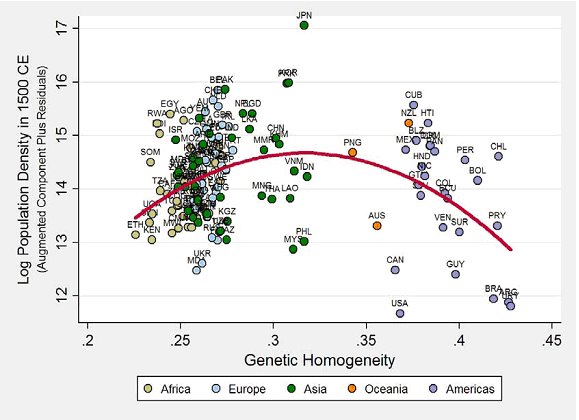 Surprisingly, the Goldilocks result holds even when you control for a bunch of other stuff like arable land and the timing of a population's agricultural transition. And perhaps most surprisingly, the much-hyped correlation between latitude and population density vanishes when you control for pretty much anything in addition to latitude. So the "distance from the equator" variable that growth economists spend so much time on may just be epiphenomenal. The authors admit they don't have a great theory for why the warm porridge tastes best–the goal of their paper is basically to get the Goldilocks result out there for others to work on. Here's hoping some economists take the bait..... Bonus: Portfolio's Zubin Jelveh gets Galor to comment on what all this means for Jared Diamond.
Thursday, June 19, 2008
Made in America? The New World, the Old, and the Industrial Revolution. Greg Clark is one of the authors. Robin Hanson has the summary up.
Labels: Economics
Sunday, May 25, 2008
When Histories Collide: The Development and Impact of Individualistic Capitalism
posted by
Razib @ 5/25/2008 06:10:00 PM
 A few weeks ago Steve mentioned Raymond Crotty's When Histories Collide: The Development and Impact of Individualistic Capitalism. When I clicked through the link the cover looked familiar; turns out that I'd seen it at my local used book store and had passed on it since I already had a backlog of economic history I was working through. But Steve's post piqued my interest, and Greg also had mentioned Crotty's lactose tolerant-centric theory of history. So I purchased it, and read it over the past week. Even including the foreword and preface this is a short work, around 300 pages, but When Histories Collide is relatively data dense and at times almost inscrutable to anyone not stepped in Irish agricultural economics & cliometrics. The text has a disjointed feel, and Crotty's son who had to edit the work after his father's death notes that he placed the Irish chapters near the end of the narrative despite the fact that they would likely have been interspersed through the text seamlessly if his father had his way. Though the author's death before the final revisions to When Histories Collide might have dampened its public reception somewhat, I have to observe that Crotty's swan song is laced with far more quantitative econometric detail than Greg Clark's Farewell to Alms. Combined with the constant algebra of factors of production and implicit references to comparative statics, I believe that When Histories Collide simply lacks the literary elegance to have had any mass market appeal. That being said, who cares about mass market appeal? I don't. When Histories Collide is larded with just the type of data which keeps you turning the page. A few weeks ago Steve mentioned Raymond Crotty's When Histories Collide: The Development and Impact of Individualistic Capitalism. When I clicked through the link the cover looked familiar; turns out that I'd seen it at my local used book store and had passed on it since I already had a backlog of economic history I was working through. But Steve's post piqued my interest, and Greg also had mentioned Crotty's lactose tolerant-centric theory of history. So I purchased it, and read it over the past week. Even including the foreword and preface this is a short work, around 300 pages, but When Histories Collide is relatively data dense and at times almost inscrutable to anyone not stepped in Irish agricultural economics & cliometrics. The text has a disjointed feel, and Crotty's son who had to edit the work after his father's death notes that he placed the Irish chapters near the end of the narrative despite the fact that they would likely have been interspersed through the text seamlessly if his father had his way. Though the author's death before the final revisions to When Histories Collide might have dampened its public reception somewhat, I have to observe that Crotty's swan song is laced with far more quantitative econometric detail than Greg Clark's Farewell to Alms. Combined with the constant algebra of factors of production and implicit references to comparative statics, I believe that When Histories Collide simply lacks the literary elegance to have had any mass market appeal. That being said, who cares about mass market appeal? I don't. When Histories Collide is larded with just the type of data which keeps you turning the page.Of course, data isn't the only item on the menu here, as an economist Crotty brings some noticeable theoretical baggage. His central thesis is that the rise of individualistic capitalism in West Central Europe1 is sui generis, as distinct from hunter-gatherer, pastoralist and Asiatic modes of production (he uses the term riverine agriculture, but it's pretty clear that most people would recognize this as Asiatic mode of production). Additionally, there are a few other types, such as the slave based individualistic capitalism of the ancient Mediterranean, and the elite capitalism of post-colonial states (e.g., Latin America). Crotty's macrohistorical model as it applies to development economics is rather straightforward: individualistic capitalism emerged in a particular place and time, and the Great Divergence is a byproduct of those conditions. These means the export of this system of economic development and productivity is going to be problematic; the societies of East Asia are a particular exception because they were not colonized and so their indigenous cultural systems were not extinguished. Rather, these societies integrated Western ideas and tools in an eclectic manner in keeping with their cultural biases and strengths. Crotty labels the East Asian Tigers as "collectivist capitalism." From what little I know of East Asian economic production I don't think this is an unfair characterization, though globalization is making these typologies less relevant when transnational companies span civilizational boundaries. Despite the editing which places the Irish material toward the end of the book it is quite clearly foreshadowed throughout the book. It is Crotty's deep case study which illustrates just how sui generis individualistic capitalism is, and how difficult, nigh, impossible, it is to export it to colonized societies which are habituated toward a different mode of production (Ireland leans towards pastoralism). Ireland, being the British nation's first large scale colony, and the longest experiment in such a relationship (lasting from the Tudor period down to 1921), is therefore ideally placed to illustrate the general dynamics. Additionally, a few particularities of Ireland such as its proximity to the colonizing country and its later assimilation into the European Economic Community bring into sharper focus the causal factors behind its deviations from the standard post-colonial narrative. There is unfortunately an awkward problem; the Celtic Tiger. Crotty died in 1994, and he was clearly writing until the end as his statistics are up to date as of 1992. But it is also obvious that a great deal of the material draws upon the author's nearly 40 years of scholarship in the field of agricultural economics, so the echo of the Ireland of 1960 looms large. From what I can tell it seems that Crotty assumed that the economic robusticity of the Ireland of the second half of the 20th century was a credit driven mirage which would ultimately founder on the lack of institutional support; and it seemed that he believed he saw it already occurring by the early 1990s. I am well aware that there is a great deal of debate about Ireland's economic growth and how to interpret the various indices. As with much social science there is plenty of revisionism which attempts to dig out more nuance from the "first look" impressions generated by something like per capita income. I'll grant that on the margins there is something to debate, but I think it's pretty clear at least over the past 15 years Crotty was just not right about Ireland and its inability to join the other nations of Europe on their level and terms. The foreword for When Histories Collide was penned by a colleague of the author in 2001; and I felt his assessment of the Irish economy since Crotty's death was telling, as he made only the most perfunctory attempts to defend his friend's doom & gloom prognostication. It seemed implicitly to be suggesting that prediction is less critical in a work of such grand scope as When Histories Collide, at least over normal human time frames, and the insights which one might gather are still worth an examination of the full structure of the argument.2 I agree with this. Because of my general skepticism of the predictions made in When Histories Collide I will avoid detailing the Georgist prescription which Crotty offers as his ultimate plan for how to ameliorate poverty. But, I want to highlight one more systematic flaw: a general tendency toward historical sloppiness. This seems to be a major feature of economic history in general; the preoccupation with macroeconomic forces tends to sweep aside details of history to the point where falsity and misrepresentation regularly creep in. John Nye's War, Wine, and Taxes: The Political Economy of Anglo-French Trade, 1689-1900 is a nice exception to this general rule, but I suspect the rather narrow purview of this work explains the tight fidelity to reality as opposed to the standard stylized historical sketches borrowed from high school textbooks. I will offer two examples which illustrates the weakness in the area of historical details which plague When Histories Collide. First, Crotty offers a model for the emergence of ancient Mediterranean civilization predicated on the synthesis of Indo-European pastoralists with indigenous Phoenician agriculturalists. What's the problem here? Phoenicians were a specific group of Semitic speaking peoples who flourished in what is today's Lebanon. As a colonizing people they do not pre-date ~ 1000 BCE. We know that Greek was spoken in Greece by ~1500 BCE; and likely Indo-European languages were extant on the northern shore of the Mediterranean well before 1500 BCE. Additionally, note that I stated on the northern shore of the Mediterranean, Phoenician colonies as it happened were almost all planted in non-Indo-European areas, and mostly on the south shore. By Phoenician Crotty actually means the diverse pre-Indo-European speaking substrate of the northern Mediterranean which the Greeks, Latins and other assorted peoples replaced and assimilated (some of these pre-Indo-European speakers remained down to the Roman period, e.g., Iberian). Of course, I will admit that to some extent the error doesn't truly undermine the structure of the author's thesis: that there was a synthesis between these two broad cultural types (whatever you may term them) which resulted in the civilization of the Mediterranean. The second argument is specifically about the economic motor of the ancient Mediterranean, and I believe it to be a more telling error. In short, Crotty argues that the creativity of ancient Mediterranean capitalism was contingent upon the ubiquity of slavery. Slavery was a normal institution before the modern period; all societies had some forms of slaves, but different societies practiced slavery to different quantitative extents. The cultures of the ancient Mediterranean, specifically Greece and Rome, as well as the more recent race-based slave societies of North America and the Caribbean, are exceptional in the centrality of slavery in terms of economic production (in many societies slaves are luxuries or a trivial demographic). Though slaves were only a minority in the Roman world (around 25% of the population) Crotty argues that their economic productivity was the engine which drove the efflorescence of ancient civilization. Slaves could not consume the fruit of their own labors, so their productivity so sequestered freed up ancient elites as surplus for leisure and warfare. The structure of the argument here is plausible, but the problem is when Crotty makes the argument about where the slaves came from: the steppe. Here Crotty his going back to his history where Indo-Europeans and Phoenicians came together to produce Mediterranean civilization; the steppe is a region where the need for labor is minimal because of the pastoral lifestyles, it is land that is limiting, and so the excess population is driven into the cauldron of civilization. Here, they are enslaved and their productivity drives Mediterranean society. The problem is that it seems to me totally implausible that the steppe had a large enough population that it could ever have supplied enough human beings to replenish the constantly dying 1/4 of the Roman Empire's population which consisted of slaves. As a point of fact it seems that Northern Europeans, especially those from beyond the limes, were the primary exogenous source of slaves. But, I also have read that the Romans bred slaves on farms in Sicily, so there was also endogenous production. Crotty's argument is that when the Roman Empire reached its natural limit and was no longer sucking in slaves through wars it naturally collapsed because of the diminishing of its economic engine. I don't believe this, it oversimplifies some real complexities of the period between Augustus (the early Empire) and Late Antiquity, when the classical state collapsed. The consensus scholarship seems to be that the Roman Empire recovered from a near collapse in the 3rd century in the 4th, and though society was reconstituted so that we could see the vaguest of outlines of the medieval system already in the post-Diocletian period, it may be only that repeated exogenous shocks in the 5th century succeeded where those of the late 2nd and 3rd failed. Instead of a historical deterministic process, what we have is historical contingency which would have lead to a fall probabilistically at some point. I've harped on the negative points of the book to this point because I don't want people to purchase this assuming that they'll get a literary tour de force on the scale of Guns, Germs and Steel; rather, When Histories Collide exhibits all the strengths and weaknesses of Farewell to Alms magnified. But what are those strengths? Here's a sample of what I think is worth reading through all the issues above for: ...Very roughly, the same pastoral resources will, in a year produce 400 gallons of milk (the yield from a mediocre cow) or 250 lbs. liveweight gain from a bullock, or ox. Consider that. The milking of cows can increase the agricultural productivity of a unit of land by an order of magnitude! (assuming that the land is not arable) No wonder lactose tolerance swept across many populations so fast! Crotty identifies three general cow-cultures: 1) The pastoralist model 2) The South Asian model, the "apotheosis of the cow" 3) The European model; in particular, the model associated with the rise of individualistic capitalism The pastoralist model is pretty straightforward; man have cow, man milk cow, man defend cow from enemy. This way of life puts a premium on land but requires little labor or capital inputs; you put the cattle out to pasture and make sure that they do their thing and protect them from predators and rustlers. Crotty presumes that this was the culture which arose among the Proto-Indo-Europeans on the steppe, and it is what exists among the Nilotic peoples of Africa, and also was the norm among the pre-modern Irish. The apotheosis of the cow doesn't need much description, everyone knows that South Asians (Hindus and affinal groups specifically) do not consume beef and hold the cow to be sacred. The standard economic explanation here is that cows are more efficient bundles of calories integrated over time through milk extraction than as a one time item for slaughter. But there's a twist to this in India which I only know because of Marvin Harris' Cows, Pigs, Wars, and Witches: The Riddles of Culture: the cows which wander the cities and countryside of India are generally cows, that is, female. Where are all the bulls? They're being used as draught animals! South Asian agriculture is obviously extremely intensive in labor, and cattle serve the role that water buffalo do in the moister regions of Asia (including the margins of South Asia). Crotty doesn't mention this, but I think that's another part of the puzzle. And it fits in which another datum which plays a role in the thesis of how and why individualistic capitalism arose: Indian cows need to have their young reared to give milk. Obviously you couldn't kill the calf which was the reason for the milk production. The final cattle culture is that of Western Central Europe; the region of northern France, the Low Countries and Western Germany characterized by 3-crop rotation and draft animals with mouldboard plough by the medieval period. I can't do justice to the detail of Crotty's argument here, and to some extent I don't think it all fits together, but there are many intriguing pieces. Lactose tolerance comes into the picture because when the Proto-Indo-Europeans brought the cow and their ability to digest milk into Central Europe they opened up the possibility for a new lifestyle. Because of the low agricultural productivity in this region in regards to cereals, using these crops as fodder for cattle was attractive. Middle Eastern cereals were simply not well adapted during the early phases to the Northern European climatic regime. Additionally, low quality or unpalatable crops like oats were sometimes the only option, and these were more productively fed to cattle to convert into more palatable nutritional items (whether as milk or meat). But there's a problem here: European winters mean that there's no pasturage to keep the cattle alive through the winter. So fodder is of the essence. Because this is relatively limited Europeans would have to kill most calves so as to maximize the feed for the adult cows. After you kill an animal, of course you eat it since to do otherwise would waste valuable protein and fat, so there is no apotheosis of the cow in a society where the cow may nevertheless be a central fixture. The production and generation of fodder for cattle by smallholders is a critical part of the story of the generation of individualistic capitalism. In short, it habituates the average person toward low time preference as an interlocking set of agricultural operations are set into motion to maintain subsistence in an ecologically marginal environment. For Crotty the "bottom up" nature of this societal shift is critical as the emphasis on capital over land or labor as the factor of production which would increase marginal product is what will lead to the takeoff of the Great Divergence thousands of years into the future. Unlike classical Mediterranean civilization Western European individualistic capitalism can weather famine, pestilience, and other exogenous shocks of God. Capital persists while slaves die. The dispersal of technological initiative through society gives it a redundant robusticity lacking in other top-down civilizations. In our modern world the power of capital in the form of technological innovation in perpetuating a world of plentitude always outrunning the Malthusian Trap is obvious, but only Central West Europe managed to hit upon that formula in the pre-modern world because of the confluence of particular ecological and cultural parameters at a particular moment in time. Crotty argues that the capital intensive post-Malthusian Developed World was not inevitable, but a contingent fact of history. Ecological constraints play a large role in explaining why Ireland is different in this model; the mildness of Ireland's maritime regime means that winter fodder is unnecessary. Transhumance and semi-pastoralism is feasible in this scenario; and, critically it is important to note that pre-modern Irish cattle were more like their South Asian cousins than continent European lineages. They only gave milk when with calf! The selection process whereby only the best milk producing lineages were kept and most calves killed in the fall did not apply to Ireland. From this ecological difference flows the great differences between the folkways of the Irish and those of peoples to the East. Speaking of which, When Histories Collide takes occasional forays into Eastern Europe, where it is explained that autocratic capitalism developed along the Slavic frontier. Here obviously land was not limited, and labor was at a premium, but capital intensive methods from the West could be introduced periodically to push the frontiner outward. By the time of the gunpowder empires the steppe ascendency in terms of arms was finally banished and a synergistic alliance of peasants (labor) and boyars (capital) swept across the land. But the fundamental distribution of techniques remained distinct from those of Western Europe, where technological innovation bubbled up from below rather than horizontally via elites. In the north, in Scandinavia, the local human capital was well equipped to leverage the horizontally transmitted suite of the Western European economic system, replicating individualistic capitalism once the technological wavefront had pushed far enough to overcome ecological hurdles. Obviously this is only a small slice of the arguments presented in Raymond Crotty's magnum opus, but it's a representative taste. Clearly I think there are some serious issues with the depth of the scholarship on the margins, but the details of history which I think are rather embarrassing in the ignorance that they bespeak is not entirely out of place in the corpus of economic history. That being said, as I noted above some of the arguments about the slave-based individualistic capitalism of the ancient Mediterrean are premised on unrealistic assumptions which derive directly from the lack of a dense network of historical priors. Crotty's analytic tools were ones of mathematical economics, and his empirical database was one of agricultural economics, in particular Irish agricultural econometrics and history. The limits to his disciplinary horizons often shows. Nevertheless, I don't believe that Crotty falsified the tables or the quantitative data he repeats, and those alone are worth perusing this book. Who knew that for most of history the per unit productivity of agriculture in China was about twice that of South Asia? Crotty did, and I didn't. I don't think that the grand theoretical arguments should be taken without some major salting and curing; as I said recent history seems to have proved him wrong in Ireland, and to a lesser extent the post-colonial world as a whole. His model of the past has great descriptive flaws and would have been better served with a more robust cliometric framework. But by & large When Histories Collide is a good complement to more polished recent works such as Farewell to Alms and The Great Divergence. Related: 10 Questions for Greg Clark, A World of Difference: Richard Lynn Maps World Intelligence, Group lifespan differences? Maybe it's agriculture and The Horse, the Wheel, and Language: How Bronze-Age Riders from the Eurasian Steppes Shaped the Modern World. Do note that Amazon is telling me that those who purchased When Histories Collide also bought The Horse, the Wheel, and Language: How Bronze-Age Riders from the Eurasian Steppes Shaped the Modern World. Not surprising, but shows the general slant of Crotty's macrohistory. 1 - By West Central Europe one can imagine the lands which are just to the West and East of the Rhine; northern France, the Low Countries and western Germany. 2 - Crotty also asserts that post-colonial poverty will increase in the future do the poor fit between individualistic capitalism and most societies. I think on the balance Crotty has again been proven wrong; even removing China from the equation it seems that on the whole the world has not seen economic retrogression with the possible exception of large swaths of Africa. Despite the Asian flu of '98 and rollback from the Washington Consensus, both Southeast Asia and Latin America seem to be better off than they were a generation ago.
Thursday, February 21, 2008
Robert J. Samuelson is not an economist (Paul A. Samuelson is)
posted by
Razib @ 2/21/2008 01:42:00 AM
 This is a post for Google. A post I wish had been there for me during my periods of confusion on this topic. I notice that Chris Roach recently referred to Robert J. Samuelson as a "Respected economist." He isn't. Robert J. Samuelson is a financial and economic journalist. He has bachelor's degree in government from Harvard, so one assumes he has taken an economics course or two or three. Samuelson has a column in Newsweek which often focuses on economics; this means that he is a major public figure in this area. I had assumed that Robert J. Samuelson was a prominent economist who was moonlighting as a journalist until a few years ago when I was curious if he was related to Larry Summers. I knew Summers was related to an economist with the last name Samuelson. I think this is a reason that people assume that Robert J. Samuelson is an economist. Paul A. Samuelson is obviously an economist, to some extent the economist of the 20th century (along with Kenneth Arrow and a few others). When I didn't know anything about economics I too believed that Robert J. Samuelson was an economist partly because I vaguely knew Paul A. Samuelson was the economist, which says a lot about how eminent Paul A. Samuelson must be if I had any awareness of the man! This is a post for Google. A post I wish had been there for me during my periods of confusion on this topic. I notice that Chris Roach recently referred to Robert J. Samuelson as a "Respected economist." He isn't. Robert J. Samuelson is a financial and economic journalist. He has bachelor's degree in government from Harvard, so one assumes he has taken an economics course or two or three. Samuelson has a column in Newsweek which often focuses on economics; this means that he is a major public figure in this area. I had assumed that Robert J. Samuelson was a prominent economist who was moonlighting as a journalist until a few years ago when I was curious if he was related to Larry Summers. I knew Summers was related to an economist with the last name Samuelson. I think this is a reason that people assume that Robert J. Samuelson is an economist. Paul A. Samuelson is obviously an economist, to some extent the economist of the 20th century (along with Kenneth Arrow and a few others). When I didn't know anything about economics I too believed that Robert J. Samuelson was an economist partly because I vaguely knew Paul A. Samuelson was the economist, which says a lot about how eminent Paul A. Samuelson must be if I had any awareness of the man!Labels: Economics
Wednesday, February 20, 2008
I've been reading a fair amount of economic history and political economy recent (e.g., A Concise Economic History of the World, The Moral Consequences of Economic Growth and Angus Maddison's substantial body of work). I've read a few micro & macro texts so I come into this with some vague theoretical understanding of the framework which economists are marinated in, and of course I know about comparative advantage and am broadly sympathetic to globalization. The analytic sharpness that economics brings to broad historical questions is illuminating. That being said, on occasion there are comments which make me wonder about the excessive simplicity of the economic narrative.
Consider the case of two nations which trade with each other. One nation starts out far wealthier. Businesses in the wealthier nation relocate some factories to the poorer nation. This increases aggregate utility, consumers in the wealthy nation can now purchase cheaper products, while a substantial number of workers in the poorer nation are more well off than they otherwise would be. But, there's an issue here, inequality is likely to increase within the nations. Overall inequality in the aggregate has decreased, the poorer nation is now far wealthier and so the income gap is not as stark across national boundaries. But a minority of those who had factory jobs in the wealthy nation now might have to shift to lower paying service sector employment. Additionally, income inequality might initially also increase in the poorer nation as some are left behind (though as economic development proceeds one might suppose that the lower orders would catch up). As someone who lives in a relatively wealthy nation let's just consider that case. I'm not sure if I'm particularly reassured that aggregate utility has increased across the world while a bunch of factory workers now go unemployed or are marginally employed. It's not that I'm a particularly empathetic person, I'm not, but perhaps I'll run into these people in the subway or at the shopping mall. It's great that people in a far off country are now wealthier and also increase my own access to more baskets of goods; but I can't but help be a little worried about idle hands and potential riots in the streets from the "victims" of the redistribution of economic activity. More immediately, what's the point in my being able to purchase more bling if it only invites a mugging at hands of the victims of globalization? I have Joseph Stiglitz's Making Globalization Work on my "to read" list, so perhaps my qualms will be addressed at some point. So far I'm not reassured that economists truly internalize the structural biases in human psychology when talking about these macro-level issues. It seems that in universal suffrage democracies the political class always has to pretend as if comparative advantage doesn't exist and mouth populist slogans, but they always favor globalization when it comes to implementing policy (at least over the long term). At this point most humans understand that the the earth is not at the center of the solar system; but it seems to me that that is an easier concept to grasp than the logic of economics, in part because human intuitions about social facts and dynamics are very strong and persistent in the face of intellectual persuasion. Note: Feel free to recommend books on economic history in the comments. Douglass North is also on my "to read." Labels: Economics
Tuesday, January 29, 2008
Two interesting articles out in the PNAS early release feed.
Molecular insights into human daily behavior: Human beings exhibit wide variation in their timing of daily behavior. We and others have suggested previously that such differences might arise because of alterations in the period length of the endogenous human circadian oscillator. Using dermal fibroblast cells from skin biopsies of 28 subjects of early and late chronotype (11 "larks" and 17 "owls"), we have studied the circadian period lengths of these two groups, as well as their ability to phase-shift and entrain to environmental and chemical signals. We find not only period length differences between the two classes, but also significant changes in the amplitude and phase-shifting properties of the circadian oscillator among individuals with identical "normal" period lengths. Mathematical modeling shows that these alterations could also account for the extreme behavioral phenotypes of these subjects. We conclude that human chronotype may be influenced not only by the period length of the circadian oscillator, but also by cellular components that affect its amplitude and phase. In many instances, these changes can be studied at the molecular level in primary dermal cells. Weird. ScienceNow notes some implications: ...raises the possibility of an inexpensive and objective test of a person's "owlness" or "larkness." Such a test would be no small matter, given the prevalence of sleep disorders and the fact that many drugs, including cholesterol medications and chemotherapy, work more effectively if administered at certain points in a person's sleep/wake cycle. Pinpointing individual clock cycles could pave the way for personalized sleep and drug therapies, says Achim Kramer, a Free University chronobiologist who helped design the study. Selectivity of Black Death mortality with respect to preexisting health: Was the mortality associated with the deadliest known epidemic in human history, the Black Death of 1347-1351, selective with respect to preexisting health conditions ("frailty")? Many researchers have assumed that the Black Death was so virulent, and the European population so immunologically naive, that the epidemic killed indiscriminately, irrespective of age, sex, or frailty. If this were true, Black Death cemeteries would provide unbiased cross-sections of demographic and epidemiological conditions in 14th-century Europe. Using skeletal remains from medieval England and Denmark, new methods of paleodemographic age estimation, and a recent multistate model of selective mortality, we test the assumption that the mid-14th-century Black Death killed indiscriminately. Skeletons from the East Smithfield Black Death cemetery in London are compared with normal, nonepidemic cemetery samples from two medieval Danish towns (Viborg and Odense). The results suggest that the Black Death did not kill indiscriminately-that it was, in fact, selective with respect to frailty, although probably not as strongly selective as normal mortality. We've all read Farewell to Alms, so we know the argument that quick die offs can be good for standards of living by relieving some of the Malthusian pressure. Though if you ever took a normal medieval history course you'd probably be told about the premium on labor which emerged after the Black Death due to shortages and its affect on the collapse of the old manorial system (I was). But this data is interesting because it confirms that the most economically productive proportion a society where muscle power might was of essence have increased as a proportion of the population after these sorts of epidemics swept through. Perhaps these are the sorts of shocks that social systems need to shift toward another equilibrium? (I know, morbid) Labels: Behavior Genetics, Economics, History
Sunday, November 11, 2007
Economists Oded Galor of Brown and Omer Moav of Hebrew U. argue in a new paper that the Agricultural Revolution created longer lifespans. A simple version of their model goes like this:
Agriculture-->Disease-->Somatic Investment in stronger bodies-->Longer lifespans once things settle down. This result hoists Jared Diamond on his own petard: If the Agricultural Revolution really did make life worse (as he frequently argues), then the forces of evolution would have noticed that fact and reacted in some way. Galor and Moav argue that evolution would respond by building stronger bodies in high-disease environments, and the result would be longer lifespans once those dangers of disease recede in the modern world. More importantly, Galor and Moav argue that we're still living through the Agricultural Revolution: Groups that went agricultural early on went thorough bigger genetic changes. That means that early agriculture should cause longer lifespans. An interesting theory, but what's the evidence? They use Putterman's new estimates of the year that countries went agricultural, control for a lot of the usual suspects, and find this:
A couple of facts about the agricultural transition: The differences across countries are big, according to Putterman: The average country went agricultural about 4500 years ago (mean and median within a couple of hundred years). Standard deviation: 2400 years. 10th percentile: 1500 years ago (mostly sub-Saharan countries, plus some New World countries) 90th percentile: 8000 years ago (Eastern and Southern European countries--the Middle East was earlier). So the cross-country differences appear big enough to be evolutionarily important a priori. But back to Galor and Moav's big result: Almost 2 years of life for a thousand years of agriculture: Maybe that number will become a new stylized fact in the economics-and-evolution literature. It'll be interesting to see if this result comes up in political debates over health care reform.....
Monday, October 08, 2007
Steve has a review of Farewell to Alms up (part I). Interesting stuff, but I think he misreads one section:
And despite their poverty, Malthusian-era English workers at least lived better than their counterparts in much more crowded China and Japan. That's in part because they practiced population control through self-discipline, postponing marriage until they could afford it. Women didn't marry on average until age 24 to 26, and a minority never married. (Illegitimate births only made up 3-4 percent of the total.) As Jane Austen's novels show, marriage was a serious business revolving around love and money. On page 77 Greg Clark states: These patterns imply that, despite early and nearly universal marriage, the average woman in China or Japan around 1800 gave birth to fewer than 5 children, less than the half the biological possibility, resulting in a birth rate similar to that for eighteenth-century Europe. The English women who married had more children than the Chinese or Japanese women who married because they stayed in the game far longer. So the average worked out to be about the same, which is why Clark focuses on mortality rates to explain the population density differences. Search for the keywords "china number of children" on Amazon and check page 77 to see what I'm saying (page forward and backward to get full context). I remember this clearly because the similar birthrates surprised me. Labels: Economics
Monday, September 24, 2007
Bryan Caplan has initiated a series of posts where he will critique some aspects of Greg Clark's book A Farewell to Alms. Caplan starts by disputing Clark's implication that the Four Horsemen can increase per capita income simply by reducing population. I would say he makes some good points, but he does leave an opening:
...A plague might do the trick - it kills some outright, and weakens the rest. In the long-run, the survivors will have a higher material level of living. But this hardly makes the plague a "friend of mankind." All it means is that after mass death, the frail, disfigured survivors will get to eat some extra calories beside the graves of their families. With friends like this, mankind doesn't need enemies. The after effects of disease vary quite a bit from pathogen to pathogen and person to person. Additionally, to some extent plague might be a partly exogenous variable, on occasion cutting through populations like a scythe for a few short years and then abating mysteriously for decades. I think this is why the conditions after the Black Death are a good case study which probably leans toward Clark's contention. 25% of Europe's population disappeared, but the survivors were not 25% less healthy or productive. In any case, add Econlog to your RSS to keep track of the debate. Update: Arnold Kling is feeling Clark more than Caplan. Labels: Economics
Friday, August 31, 2007
 In his new book A Farewell to Alms, Greg Clark, an economic historian at the University of California, Davis, contends that "[t]he New World after the Neolithic Revolution offered economic success to a different kind of agent than had been typical in hunter-gatherer society: Those with patience, who could wait to enjoy greater consumption in the future. Those who liked to work long hours. And those who could perform formal calculations in a world of many types of inputs and outputs...." In his new book A Farewell to Alms, Greg Clark, an economic historian at the University of California, Davis, contends that "[t]he New World after the Neolithic Revolution offered economic success to a different kind of agent than had been typical in hunter-gatherer society: Those with patience, who could wait to enjoy greater consumption in the future. Those who liked to work long hours. And those who could perform formal calculations in a world of many types of inputs and outputs...."Clark also provides archival evidence that in medieval Britain (and to a lesser extent in China and Japan) the wealthy-who presumably had those "middle class" skills in abundance-raised more children than the average person. If you put these pieces together-a system that rewards a new set of abilities, plus greater reproductive success for those who have those abilities-then all you need to get some form of selection is one more link: A transmission mechanism. On the nature of the mechanism, Clark leaves the door wide open. Could be parent-to-child cultural transmission, could be genes, could be both. While much of the discussion of Clark's book has focused on his "survival of the richest" hypothesis, Clark himself appears to be equally devoted to demolishing the widely-held view that economic institutions are the key to modern economic growth. He notes that the British people had solid property rights, limited government, and sound currency for centuries before they had their Industrial Revolution. Drawing on early work by Nobel Prize-winner Douglass North, he argues that economic institutions are largely endogenous and relatively efficient, at least when we're talking about time horizons lasting a century or more. If institutional change wasn't the driving force behind modern economic growth, then what was? In Clark's view, the driving force was change within human beings themselves. 1. In some early work, you wondered why workers in British cotton mills were so much more productive than workers in Indian cotton mills. You discuss this in the last chapter of A Farewell to Alms. You looked at a lot of the usual explanations-incentives, management, quality of the machines-and none of them really seemed to explain the big gap in productivity. Finally, you seemed to turn to the idea that it's differences between the British and Indian workers themselves-maybe their culture, maybe their genes-that explained the difference. How did you come to that conclusion? Clark: I came to economics as an undergraduate expecting, as is the central view of economics, that the explanation for wealth and poverty would ultimately be located in social institutions and that people everywhere have basically the same aspirations and abilities. But unlike most of my colleagues in economics I have always been interested in the mechanisms, and the fine details, of how things actually function. Much of modern economics is entirely theoretical, and even most empirical work in economics involves just looking at very high level correlations between variables such as income per person and education, or democracy, or the openness of trade. When I set out in my PhD thesis to try and explain differences in income internationally in 1910 I found that asking simple questions like "Why could Indian textile mills not make much profit even though they were in a free trade association with England which had wages five times as high?" led to completely unexpected conclusions. You could show that the standard institutional explanation made no sense when you assembled detailed evidence from trade journals, factory reports, and the accounts of observers. Instead it was the puzzling behavior of the workers inside the factories that was the key. 2. Your book is clearly a call for a new research agenda in the fields of economic growth and economic history, one focusing less on institutions and more on what we might broadly call "labor quality." But your key hypotheses seem to turn on the question of how and why entire workforces change across the centuries, and involve questions of culture, child-rearing methods, and perhaps human genetics-fields quite outside the expertise of most economists. If you could command an army of, say, biologists, anthropologists, and neuroscientists to test your hypotheses about long-term changes in labor quality, what would you have them work on? Clark: That is a great question. If, as is possible, the pre-industrial era changed people genetically to be better adapted to market economies, then a systematic comparison of the DNA of societies should find correlations between gene frequencies and the histories of these societies. If genetic change was also occurring in historical time, as opposed to the pre-historic era, then we would expect these changes to be incomplete even in societies with a long history of settled agriculture. In that case we would actually predict class differences genetically! The rich in these societies would differ genetically from the poor in certain systematic ways! All this should be testable at some point. If the change was purely cultural, then we still might be able to discover systematic behavioral differences between poor and rich in modern capitalist society, such as over time preference rates, that correlate with differences between rich and poor societies. 3. What do you think are the weakest links in the now-conventional "Institutions Matter" chain of reasoning? Clark: The book challenges the modern orthodoxy of economics - that people are essentially the same everywhere, and with the right set of institutions, growth is inevitable - in three ways. First by showing that there were societies like medieval England where the institutional structure provided every incentive for growth, yet there was no growth. Second by pointing out that by objective measures the institutions of many highly successful modern economies, such as in Scandinavia, provide much poorer incentives to individuals than those of very poor economies. And lastly by showing that in the long run economic institutions that would prevent growth tend to get replaced endogenously by ones that are pro-growth. 4. You provide a variety of evidence that interest rates have fallen over the centuries; this is a fascinating set of data that we've discussed before at Gene Expression. Should economic historians still be searching for transaction cost stories to explain this fall in interest rates-e.g., lenders needed a high return in ancient Rome to compensate them for the high cost of searching for safe borrowers-or is that search likely to hit a dead end? Clark: Interest rates on safe assets like houses and land fell from 25% or more in Ancient Babylon, to 10% in Ancient Greece, Roman Egypt and medieval Western Europe, to 4% in the eighteenth century in the Netherlands and England. Most economic historians assume this just represents transaction costs. But I can show in cases such as medieval England that transaction costs have nothing to do with this - the real return on investments as safe as modern Treasury Bonds was 10% or more. So I am confident that something much more fundamental was changing over these years. 5. You use data on British wills to argue that the British people of today are by and large the descendants not of peasants and not of the violent medieval aristocracy-both groups failed to reproduce themselves. Instead, the British people of today are largely the descendants of the bourgeoisie of the middle ages. Nowadays, that seems to be a testable hypothesis; have you run into genetic evidence bearing on what you call the "survival of the richest?" Clark: I agree that, in principle, this is a completely testable hypothesis. If there was genetic change in the Malthusian era then we will find systematic differences in genes that influence behavior such as patience and propensity to violence between groups such as the British and those such as Australian Aboriginals that had no experience with settled agriculture. However, as far as I am aware, the identification of genes that influence such behaviors is at a very early and tentative stage. The only such studies I have seen reported are those of differences across ethnic groups in variants of genes encoding monoamine oxidase enzymes. 6. How are economists reacting to the book? In particular, are there any misunderstandings that you'd like to address? Clark: I expected a hostile and perhaps even dismissive reaction, given the controversy that the "survival of the richest" argument was bound to create, and given the attack on the modern orthodoxy amongst economists about institutions being the key to wealth and poverty. But economists who have read the book, even when they remain skeptical of the conclusions, have generally found it interesting and challenging. They have been surprised to learn in particular that the history of economies is not anything like the implicit assumptions they have, based on modern economic doctrine. 7. One implication of your model is that human populations that haven't been through the full Neolithic Revolution are going to fail miserably when they try to build a modern market-oriented society. If people turn out to as hard to change as they appear to be-if neither culture nor genes prove to be all that malleable in the medium-run-then how would you recommend improving the lives of these people? Do you think economists can design institutions that can help make these populations productive? Clark: Anyone who reads history cannot fail to be impressed by the difficulties that hunter-gatherers, or societies with only limited experience of settled agriculture, have in successfully incorporating into the modern capitalist economy. I spent a week in Australia this summer, and the plight of Australian Aboriginals is very sad. The surviving Aboriginal communities have seen tremendous rates of poverty, alcoholism, drug use, violence and sexual assaults. But an important point in the book is that while some of this cultural variation may be due to the long histories of societies, there is a lot of cultural variation within these constraints that produces dramatic differences in wealth in modern societies. So there is no ground for fatalism on the possibilities for any society. The problem is that measures to reform the cultures of societies seem difficult to devise. Look at the lack of success the Chinese Communist Party had in remaking Chinese Culture. China has emerged from a period of extreme ideological indoctrination seemingly with its pre-communist love of individual wealth and status completely intact. 8. You emphasize that "[t]he argument is not that agrarian life was making people smarter." But you also emphasize that agrarian life placed greater value on verbal and mathematical skills than hunter-gatherer life. Let's set aside for the moment the question of whether these skill changes were cultural, environmental, or genetic. Are you claiming that the rise in math and verbal skills was counterbalanced by an equal loss of some similarly valuable hunter-gatherer mental skills? In other words, were the mental effects of the Malthusian process zero-sum? If so, what process within your model would make that occur? Clark: I wanted to emphasize in the book that I was not advocating any kind of Social Darwinism. The long Malthusian economy that preceded the Industrial Revolution changed people, but there is no evidence it made them "better" or "smarter." Indeed there is evidence that we did not become any happier as result of economic growth. Anthropological accounts of forager societies suggest that people in these communities have strikingly developed powers of observation and memory (as well as an amazing ability to endure pain) - they are just not abilities that the modern market economy places much value upon. 9. Bowles, Camerer, and an interdisciplinary research team led a series of ultimatum-game studies in pre-modern societies; the found incredibly diverse outcomes. By contrast, across modern societies, ultimatum game play is much more similar, so it looks like the modern world really is a world of conformity, at least on this topic. How do you think their experimental evidence bears on your question of whether the "long Malthusian night," as you call it, selected for a certain set of behaviors and attitudes? Clark: I have seen these results reported, but had not thought of relating them to the arguments of the book. I would have expected that pre-modern societies would have had a common response, but potentially a different response than in modern societies. So I do not think I could call this any kind of vindication of the hypothesis in the book. 10. What's the next project? Clark: I always have several going at the same time. One is a follow up to the "survival of the richest" study for England reported in the book which will look more closely at the intergenerational transmission of economic success with a much larger set of data, and seek to show through examination of the effects of family size that the mechanism is indeed almost entirely the transmission of culture or genes. This study will also look over the whole period 1600-1914 and examine when and why richer men ceased to have more children than average and began to have less. I would love to use this data to try to tease out whether we have just cultural evolution as opposed to genetic - I just cannot think of any way to do that! Labels: 10 questions, culture, Economics, History, human biodiversity
Tuesday, August 14, 2007
David Warsh does not like A Farewell to Alms. Warsh is the author of Knowledge and Wealth of Nations (I have the book, haven't gotten to it, but will probably read it before Greg Clark's book). Here is a copy of Clark's Genetically Capitalist. Via Tyler Cowen, who is also hosting a Book Forum on the topic.
Update: The Ambrosini Critique keeps posting on Greg Clark's work. Also, Michael Stastny smacks up Warsh a bit. Labels: Economics
Monday, August 06, 2007
Nick Wade of The New York Times has an article up on Greg Clark's A Farewell to Alms: A Brief Economic History of the World. I haven't gotten to Clark's book because I've set myself the goal of reading Hal Varian's Intermediate Microeconomics (halfway through) before I touch another pop or historical econ book, but I'll get to it (population genetics textbooks are are good prep for microeconomics!). I'm cautiously skeptical, though I think Clark's ambitious but heterodox ideas are a good thing (ambitious but orthodox I am less interested in).
Related: Clark's Survival of the Richest meets Mokyr's Industrial Enlightenment, The British: More patient than the Greeks?. Labels: Economics
Sunday, May 13, 2007
We all know that homo economicus fails as a complete description of human behavior, as the new field of behavioral economics makes abundantly clear. So while the homo economicus model does a good job explaining things like the interaction of supply and demand, the random walk nature of stock prices, and photo #16, it misses quite a lot of important facts about human behavior. By now, there's a rich literature on this, and any book you can find on the subject by Bowles, Camerer, or Thaler would give a good overview.
But of course, both h. economicus and h. behavioralis are ideal types--and so the question arises: Are some people more behavioral than others? Are some people more economistic that others? And is there any simple way to predict who will fit into which part of the spectrum? Economists have started working on this question over the last few years, and right now I'll just stick to one small issue: Patience. The behavioralists have done a good job proving that people are generally much less patient than economic models predict. And recent work seems to show that smarter people are quite a bit more patient, a fact that may have important social implications. In a recent study, Benjamin and Shapiro found that among Harvard undergrads, "A one-standard-deviation increase in mathematical performance raises the propensity to be patient by 18 percentage points, relative to a base of 28%." So if math scores rise by two standard deviations, patience more than doubles. Their summary: In two laboratory studies [with Harvard students and Chilean high school students], we show directly that cognitive ability is associated with more standard time and risk preferences. And what does "standard" mean to Benjamin and Shapiro? More like h. economicus. Shane Fredrick of MIT showed much the same in this quite readable paper. He has a nice review of the earlier literature and in his own experiments found that "[t]hose who scored higher on the [cognitive reflection test] were generally more 'patient.'" Both of those papers involve experiments with students playing for small sums of cash. This paper, published in what is arguably the top journal in economics, showed that when people were making decisions involving thousands of dollars, people with higher AFQT scores were much more patient.
And when officers were broken down by careers, who were the most patient? Engineers.
Thursday, February 01, 2007
Shelley Batts links to an interesting study looking at skin color and wages among recent immigrants to the US. On a scale of skin color, a single point lighter was good for about a 1% increase in wages, about equivalent to the effect seen for an additional inch of height.
The statistical analysis is pretty standard; nothing atrocious pops out at me (the obvious parameters-- country of origin, ability to speak English, occupation, etc-- were all included in the model), though they didn't control for IQ. But let's assume the effect is real. The hypothesis generally mooted for the association between height or attractiveness and wages passes through some sort of personality effect-- tall people are more confident, or more outgoing, or something along those lines. Is it possible there's a similar thing going on here? Labels: Economics, Pigmentation
Friday, September 29, 2006
A question from Jason Malloy prompted a quick search of the GSS for data on the cause of the Black-White IQ gap. In 1982, the GSS characterized the skin color of Black participants on a 5-point scale (1:very dark brown to 5:very light brown). The very dark/light categories consist of only 50 and 14 individuals, respectively, and so in the following analysis I merged them with the dark/light brown categories, to give three COLOR levels: dark, medium, and light. In the web application, use COLOR(r:1-2;3;4-5) instead of COLOR. The WORDSUM variable is a 10 question vocabulary test, which I'm treating as a proxy for IQ. It is correlated with educational attainment (~.4), and also correlates (~.4-.5) with tests of reasoning and basic knowledge that were given in some years. These other tests are not available for 1982. In the all-subject all-year GSS data set, WORDSUM varies by SEX, and in 1982 COLOR also varies by SEX. Thus, SEX is controlled for in each analysis. WORDSUM is lower in the youngest and oldest age groups, so an AGE(25-65) filter was used.
Table 1. Mean WORDSUM score by COLOR and SEX with ANOVA
color indicates T-statistic, and thus p-value
We can quantify the effect size of each skin color class using Cohen's d statistic, which measures the mean difference in standard deviation units. In the 1982 dataset, the overall d for the Black-White gap on WORDSUM is -0.63 (among males d=-0.51, among d=-0.74). For comparison, the 1982 male-female gap among Whites is d=-.12, favoring females. Table 2. Effect size (d) of COLOR on WORDSUM using "light" as a control group
We can also use Whites as the control group. Table 3. Effect size (d) of COLOR on WORDSUM using Whites as a control group
Thus, there are substantial (moderate to large effect size) differences in WORDSUM scores between the darkest and lightest Blacks in 1982. As reported by Rushton and Jensen (2005), Shuey (1966) reviewed 18 studies which used skin color as a measure of racial admixture to compare with IQ. Of those 18, 16 found a significant effect of the kind found here, but the overall correlation with IQ was low (r=.1). In this data, the COLOR WORDSUM correlation is r=.31 among males and r=.18 among females, with an overall correlation of r=.23. Off the top of my head, I'm not certain what the expected correlation would be between IQ and skin color among Blacks for a given measure of "between-group heritability" (BGH) as described by Jensen (1998). I'll leave it as an exercise for our mathematically skilled commentators to derive a formula for this relationship and to evaluate the signficance of this finding in explaining the cause of the Black-White IQ gap. Labels: Economics, GSS, IQ, Pigmentation, race |
  Razib's Home Page GNXP Archives Interviews Blogroll Principles of Population Genetics Genetics of Populations Molecular Evolution Quantitative Genetics Evolutionary Quantitative Genetics Evolutionary Genetics Evolution Molecular Markers, Natural History, and Evolution The Genetics of Human Populations Genetics and Analysis of Quantitative Traits Epistasis and Evolutionary Process Evolutionary Human Genetics Biometry Mathematical Models in Biology Speciation Evolutionary Genetics: Case Studies and Concepts Narrow Roads of Gene Land 1 Narrow Roads of Gene Land 2 Narrow Roads of Gene Land 3 Statistical Methods in Molecular Evolution The History and Geography of Human Genes Population Genetics and Microevolutionary Theory Population Genetics, Molecular Evolution, and the Neutral Theory Genetical Theory of Natural Selection Evolution and the Genetics of Populations Genetics and Origins of Species Tempo and Mode in Evolution Causes of Evolution Evolution The Great Human Diasporas Bones, Stones and Molecules Natural Selection and Social Theory Journey of Man Mapping Human History The Seven Daughters of Eve Evolution for Everyone Why Sex Matters Mother Nature Grooming, Gossip, and the Evolution of Language Genome R.A. Fisher, the Life of a Scientist Sewall Wright and Evolutionary Biology Origins of Theoretical Population Genetics A Reason for Everything The Ancestor's Tale Dragon Bone Hill Endless Forms Most Beautiful The Selfish Gene Adaptation and Natural Selection Nature via Nurture The Symbolic Species The Imitation Factor The Red Queen Out of Thin Air Mutants Evolutionary Dynamics The Origin of Species The Descent of Man Age of Abundance The Darwin Wars The Evolutionists The Creationists Of Moths and Men The Language Instinct How We Decide Predictably Irrational The Black Swan Fooled By Randomness Descartes' Baby Religion Explained In Gods We Trust Darwin's Cathedral A Theory of Religion The Meme Machine Synaptic Self The Mating Mind A Separate Creation The Number Sense The 10,000 Year Explosion The Math Gene Explaining Culture Origin and Evolution of Cultures Dawn of Human Culture The Origins of Virtue Prehistory of the Mind The Nurture Assumption The Moral Animal Born That Way No Two Alike Sociobiology Survival of the Prettiest The Blank Slate The g Factor The Origin Of The Mind Unto Others Defenders of the Truth The Cultural Origins of Human Cognition Before the Dawn Behavioral Genetics in the Postgenomic Era The Essential Difference Geography of Thought The Classical World The Fall of the Roman Empire The Fall of Rome History of Rome How Rome Fell The Making of a Christian Aristoracy The Rise of Western Christendom Keepers of the Keys of Heaven A History of the Byzantine State and Society Europe After Rome The Germanization of Early Medieval Christianity The Barbarian Conversion A History of Christianity God's War Infidels Fourth Crusade and the Sack of Constantinople The Sacred Chain Divided by the Faith Europe The Reformation Pursuit of Glory Albion's Seed 1848 Postwar From Plato to Nato China: A New History China in World History Genghis Khan and the Making of the Modern World Children of the Revolution When Baghdad Ruled the Muslim World The Great Arab Conquests After Tamerlane A History of Iran The Horse, the Wheel, and Language A World History Guns, Germs, and Steel The Human Web Plagues and Peoples 1491 A Concise Economic History of the World Power and Plenty A Splendid Exchange Contours of the World Economy 1-2030 AD Knowledge and the Wealth of Nations A Farewell to Alms The Ascent of Money The Great Divergence Clash of Extremes War and Peace and War Historical Dynamics The Age of Lincoln The Great Upheaval What Hath God Wrought Freedom Just Around the Corner Throes of Democracy Grand New Party A Beautiful Math When Genius Failed Catholicism and Freedom American Judaism
Archives
July 2005 August 2005 September 2005 October 2005 November 2005 December 2005 January 2006 February 2006 March 2006 April 2006 May 2006 June 2006 July 2006 August 2006 September 2006 October 2006 November 2006 December 2006 January 2007 February 2007 March 2007 April 2007 May 2007 June 2007 July 2007 August 2007 September 2007 October 2007 November 2007 December 2007 January 2008 February 2008 March 2008 April 2008 May 2008 June 2008 July 2008 August 2008 September 2008 October 2008 November 2008 December 2008 January 2009 February 2009 March 2009 April 2009 May 2009 June 2009 July 2009 August 2009 September 2009 October 2009 November 2009 December 2009 January 2010 February 2010 Hello Movable Type archives August 11,2002 August 18,2002 August 25,2002 September 01,2002 September 15,2002 October 20,2002 December 08,2002 December 22,2002 December 29,2002 January 05,2003 January 12,2003 January 19,2003 January 26,2003 February 02,2003 February 09,2003 February 16,2003 February 23,2003 March 02,2003 March 09,2003 March 16,2003 March 23,2003 March 30,2003 April 06,2003 April 13,2003 April 20,2003 April 27,2003 May 04,2003 May 11,2003 May 18,2003 May 25,2003 June 01,2003 June 08,2003 June 15,2003 June 22,2003 June 29,2003 July 06,2003 July 13,2003 July 20,2003 July 27,2003 August 03,2003 August 10,2003 August 17,2003 August 24,2003 August 31,2003 September 07,2003 September 14,2003 September 21,2003 September 28,2003 October 05,2003 October 12,2003 October 19,2003 October 26,2003 November 02,2003 November 09,2003 November 16,2003 November 23,2003 November 30,2003 December 07,2003 December 14,2003 December 21,2003 December 28,2003 January 04,2004 January 11,2004 January 18,2004 January 25,2004 February 01,2004 February 08,2004 February 15,2004 February 22,2004 February 29,2004 March 07,2004 March 14,2004 March 21,2004 March 28,2004 April 04,2004 April 11,2004 April 18,2004 April 25,2004 May 02,2004 May 09,2004 May 16,2004 May 23,2004 May 30,2004 June 06,2004 June 13,2004 June 20,2004 June 27,2004 July 04,2004 July 11,2004 July 18,2004 July 25,2004 August 01,2004 August 08,2004 August 15,2004 August 22,2004 August 29,2004 September 05,2004 September 12,2004 September 19,2004 September 26,2004 October 03,2004 October 10,2004 October 17,2004 October 24,2004 October 31,2004 November 07,2004 November 14,2004 November 21,2004 November 28,2004 December 05,2004 December 12,2004 December 19,2004 December 26,2004 January 02,2005 January 09,2005 January 16,2005 January 23,2005 January 30,2005 February 06,2005 February 13,2005 February 20,2005 February 27,2005 March 06,2005 March 13,2005 March 20,2005 March 27,2005 April 03,2005 April 10,2005 April 17,2005 April 24,2005 May 01,2005 May 08,2005 May 15,2005 May 22,2005 May 29,2005 June 05,2005 June 12,2005 June 19,2005 June 26,2005 July 03,2005 July 17,2005 August 07,2005 Blogspot archives June 2002 July 2002 August 2002 September 2002 October 2002 November 2002 December 2002
10 questions for....
Parag Khanna James Flynn Jon Entine Gregory Clark György Buzsáki Heather Mac Donald Bruce Lahn A.W.F. Edwards Luigi Luca Cavalli-Sforza Joseph LeDoux Matthew Stewart Charles Murray James F. Crow Adam K. Webb Justin L. Barrett David Haig Judith Rich Harris Ken Miller Dan Sperber Warren Treadgold Armand M. Leroi John Derbyshire
Blogs
The GiveWell Blog Your Religion Is False Colby Cosh Steve Hsu Audacious Epigone Catallaxy Files Inductivist 2 Blowhards Genetic Future Agnostic Steve Sailer Dienekes Derek Lowe Razib Khan Razib at Comment is Free Secular Right Glenn Reynolds Jim Miller Kevin McGrew John Hawks Peter Fost Randall Parker Less Wrong Charles Murray Carl Zimmer EconLog Marginal Revolution
Principles of Population Genetics
Genetics of Populations Molecular Evolution Quantitative Genetics Evolutionary Quantitative Genetics Evolutionary Genetics Evolution Molecular Markers, Natural History, and Evolution The Genetics of Human Populations Genetics and Analysis of Quantitative Traits Epistasis and Evolutionary Process Evolutionary Human Genetics Biometry Mathematical Models in Biology Speciation Evolutionary Genetics: Case Studies and Concepts Narrow Roads of Gene Land 1 Narrow Roads of Gene Land 2 Narrow Roads of Gene Land 3 Statistical Methods in Molecular Evolution The History and Geography of Human Genes Population Genetics and Microevolutionary Theory Population Genetics, Molecular Evolution, and the Neutral Theory Genetical Theory of Natural Selection Evolution and the Genetics of Populations Genetics and Origins of Species Tempo and Mode in Evolution Causes of Evolution Evolution The Great Human Diasporas Bones, Stones and Molecules Natural Selection and Social Theory Journey of Man Mapping Human History The Seven Daughters of Eve Evolution for Everyone Why Sex Matters Mother Nature Grooming, Gossip, and the Evolution of Language Genome R.A. Fisher, the Life of a Scientist Sewall Wright and Evolutionary Biology Origins of Theoretical Population Genetics A Reason for Everything The Ancestor's Tale Dragon Bone Hill Endless Forms Most Beautiful The Selfish Gene Adaptation and Natural Selection Nature via Nurture The Symbolic Species The Imitation Factor The Red Queen Out of Thin Air Mutants Evolutionary Dynamics The Origin of Species The Descent of Man Age of Abundance The Darwin Wars The Evolutionists The Creationists Of Moths and Men The Language Instinct How We Decide Predictably Irrational The Black Swan Fooled By Randomness Descartes' Baby Religion Explained In Gods We Trust Darwin's Cathedral A Theory of Religion The Meme Machine Synaptic Self The Mating Mind A Separate Creation The Number Sense The 10,000 Year Explosion The Math Gene Explaining Culture Origin and Evolution of Cultures Dawn of Human Culture The Origins of Virtue Prehistory of the Mind The Nurture Assumption The Moral Animal Born That Way No Two Alike Sociobiology Survival of the Prettiest The Blank Slate The g Factor The Origin Of The Mind Unto Others Defenders of the Truth The Cultural Origins of Human Cognition Before the Dawn Behavioral Genetics in the Postgenomic Era The Essential Difference Geography of Thought The Classical World The Fall of the Roman Empire The Fall of Rome History of Rome How Rome Fell The Making of a Christian Aristoracy The Rise of Western Christendom Keepers of the Keys of Heaven A History of the Byzantine State and Society Europe After Rome The Germanization of Early Medieval Christianity The Barbarian Conversion A History of Christianity God's War Infidels Fourth Crusade and the Sack of Constantinople The Sacred Chain Divided by the Faith Europe The Reformation Pursuit of Glory Albion's Seed 1848 Postwar From Plato to Nato China: A New History China in World History Genghis Khan and the Making of the Modern World Children of the Revolution When Baghdad Ruled the Muslim World The Great Arab Conquests After Tamerlane A History of Iran The Horse, the Wheel, and Language A World History Guns, Germs, and Steel The Human Web Plagues and Peoples 1491 A Concise Economic History of the World Power and Plenty A Splendid Exchange Contours of the World Economy 1-2030 AD Knowledge and the Wealth of Nations A Farewell to Alms The Ascent of Money The Great Divergence Clash of Extremes War and Peace and War Historical Dynamics The Age of Lincoln The Great Upheaval What Hath God Wrought Freedom Just Around the Corner Throes of Democracy Grand New Party A Beautiful Math When Genius Failed Catholicism and Freedom American Judaism   Policies Terms of use © http://www.gnxp.com Razib's total feed: |
||||||||||||||||||||||||||||||||||||||||||||||||||||||||||||||||||||||||||||||||||||||||||||||||||||||||||||||||||||||||||||||||||||||||||||||||||||||||||||||||||||||||||||||||||||||||||||||||||||||||||||||||||||||||||||||||||||||||||||||||||||||||||||||||||||||||||||||||||||||||||||||||||||||||||||||||||||||||||||||||||||||||||||||||||||||||||||||||||||||||||||||||||||||||||||||||||||||||||||||||||||||||||||||||||||||||||||||||||||||||||||||||||||||||||||||||||||||||||||||||||||||||||||||||||||||||||||||||||||||||||||||||||||||||||||||||||||||||||||||||||||||||||||||||||||||||||||||||||||||||||||||||||||||||||||||||||||||||||||||||||||||||||||||||||||||||||||||||||||||||||||||||||||||||||||||||||||||||||||||||||||||||||||||||||||||||||||||||||||||||||||||||||||||||||||||||||||||||||||||||||||||||||||||||||||||||||||||||||||||||||||||||||||||||||||||||||||||||||||||||||||||||||||||||||||||||||||||||||||||||||||||||||||||||||||||||||||||||||||||||||||||||||||||||||||||||||||||||||||||


