
Visual-spatial ability & sex

More obviously non-controversial research on cognition and sex differences, Differences in cue use and spatial memory in men and women:

Men and women differ in their ability to solve spatial problems. There are two possible proximate explanations for this: (i) men and women differ in the kind (and value) of information they use and/or (ii) their cognitive abilities differ with respect to spatial problems. Using a simple computerized task which could be solved either by choosing an object based on what it looked like, or by its location, we found that the women relied on the object’s visual features to solve the task, while the men used both visual and location information. There were no differences between the sexes in memory for the visual features of the objects, but women were poorer than men at remembering the locations of objects.

Science is like a box of chocolates, you don’t get to know the details until you start rooting through it. Major tables with p values below the fold.
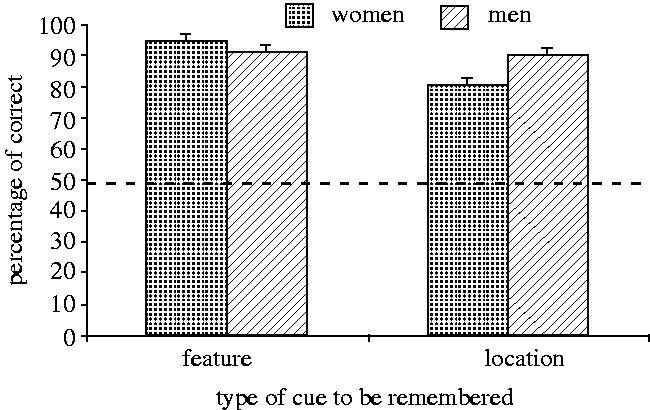
“Although the men tested tended to be older than the women (one-way ANOVA: F1,45=2.94, p=0.09) and the two experimenters tested subjects of significantly different ages (F1,45=9.24, p=0.004; experimenter A’s subjects: mean, 22.44 years; range, 21-24; experimenter B’s subjects: mean, 21.41 years; range, 20-24), age was not correlated with performance on either task (controlling for sex and experimenter; feature: F1,43=1.36, p=0.25; location: F1,43=0.45, p=0.50). Therefore, the observed differences in performance between the men and women on the location task is unlikely to have been due to differences in their ages.”
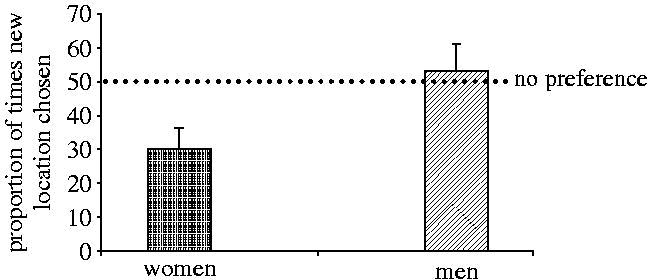
“One-sample t-tests were used to determine whether the number of times that the men and women chose the new location on the probe trials differed from random (i.e. a score of three). The choices of the men did not differ from random (n=20, t=0.42, p=0.68), but those of the women did (n=20, t=-3.33, p=0.004). Women chose the new location significantly less often than would be expected if they were making choices at random.”
Clustrmaps

I’ve signed up for Clustrmaps before, but this weblog gets too many hits so it maxed out. This time I upgraded to the premium service and we shouldn’t overtax it, so it is now there, above frappr.

Vive Lamarck!

A little while back, I mentioned epigenetics, noting that arrays for the detection of methylated sites in the genome are starting to become available. Recently released from The American Journal of Human Genetics is a new article that uses just that type of array to detect epigenetic variation in human sperm. what do they find? Here’s the first paragraph of the discussion:

In this study, we performed an in-depth analysis to address the question of epigenetic variability in the germline. The main conclusions are that (1) the male germline exhibits locus-, cell-, and age-dependent DNA methylation differences and that (2) DNA methylation variation is significant across unrelated individuals, at a level that, by far, exceeds DNA sequence variation.

That is, different people carry different epigenetic information in their germline. The next question is clear– does this information get tranmitted to the next generation?

In general, I had been under the impression that methylation was “cleaned” off the DNA after fertilization, but that’s nothing but a general rule, and exceptions abound. If epigenetic information can be efficiently transmitted from parents to their children, that would be a huge–for the study of disease, for the study of genetic conflict, and for genetics in general. The authors of the article mention that the age of your father is a risk factor for schizophenia, and transgenerational effects on other traits have been seen before. Could this be the mechanism?

This sort of phenomenon could also raise some hairy policy issues– imagine that we know smoking causes specific epigenetic changes that, if transmitted to a child, increase their risk of some disease. Would we then be justified in banning smoking by anyone who is fertile? Or what if smoking decreases the risk of some disease in your offspring? Would the tobacco companies get back all the money they’ve paid out in settlements?

Of course, I’m getting way ahead of myself– no one knows how widespread the transmission of epigenetic variation will be. But this is fascinating stuff, and well worth keeping in mind…

Posted in Uncategorized

DRD4, sex and Jews

I was pointed to this research (via David) that is just out about the correlation between variation on DRD4 and “sexual arousal.” From the press release:

Interestingly, some forms of variants in this gene were shown to have a depressing effect on sexual desire, arousal and function, while other common variant had the opposite effect – an increase in the sexual desire score. The latter is believed to be a relatively new mutation, and it is estimated that it appears in Homo sapiens “only” 50,000 years ago at the time of humankind’s great exodus from Africa. Approximately 30% of many populations carry the heightened arousal mutations, while around 60% carry the depressant mutation.

Read More

"Why sex matters for neuroscience"

Excellent review of the latest findings on sex influences and brain anatomy/functioning by Larry Cahill over at Nature Reviews – Neuroscience [open access]. One comment from Cahill:

A third, also related, misconception holds that the differences within a sex are much more substantial than those between the sexes, the implication being that sex influences can therefore be dismissed as trivial.

Now, where have I heard this (sort of) argument before…?

Posted in Uncategorized

DRD4, sex and Jews

I was pointed to this research (via David) that is just out about the correlation between variation on DRD4 and “sexual arousal.” From the press release:

Interestingly, some forms of variants in this gene were shown to have a depressing effect on sexual desire, arousal and function, while other common variant had the opposite effect – an increase in the sexual desire score. The latter is believed to be a relatively new mutation, and it is estimated that it appears in Homo sapiens “only” 50,000 years ago at the time of humankind’s great exodus from Africa. Approximately 30% of many populations carry the heightened arousal mutations, while around 60% carry the depressant mutation.

In short, it seems like a very sexual orientation is a derived trait, while the ancestral character tends to be more “repressed.” My first thought was that someone should forward this to Geoffrey Miller, his theories relating to sexual selection and cognitive evolution are predicated on weak pair-bonding and operational polyandry as males and females form temporary relationships which dissolve within 5 years after sexual novelty has expired (you need lots of reproductive skew to really ramp up sexual selection, and polygyny is the normal way to go about that). In contrast, other theorists, like pervert-cum-anthropologist Desmond Morris, have posited the importance of pair bonding and monogamy in the natural history of our species. The relatively trivial sexual dimorphism among humans (around 10%) between the sexes in terms of overall size and canine ratio suggests a more monogamous past, while the sperm competition research implies a more “mixed” picture (one problem is that the words do not really map onto to the full distribution well). The short of it is that monogamous species tend to be less “sexy” in many ways because they don’t need to be, whether that be in behavior, display or semen volume (much of this costs resources and so can detract from fitness). The spread of a sexy variant within the last 50,000 years is very interesting, because it is within the last 50,000 years that the cultural explosion has erupted that made us more than just “anatomically modern” humans, that is, behavorially modern. Honestly, I would have guessed that the sexy variant was ancestral, but this data will surely result in new stories being told over the next few years if future research confirms and elaborates on it, because sex + evolution = mucho $$$ in terms of book sales.

The paper to published in Molecular Psychiatry is Polymorphisms in the dopamine D4 receptor gene (DRD4) contribute to individual differences in human sexual behavior: desire, arousal and sexual function. Click through and you will see why Jews are relevant, the study was done in Israel on university students, and found that particular DRD4 variants correlated with questionnaire responses. Is this generalizable to other populations?

Well, DRD4 has shown up elsewhere. For example, DRD4 promoter SNPs and gender effects on Extraversion in African Americans. And of course, there is the Harpending and Cochran review in PNAS, In our genes, which argues that the variation in the allele frequencies between populations is suggestive of their respective evolutionary histories.

I had some issues with figuring out their notation for the mutation, and the fact that I don’t have full access to the journal article in question doesn’t help, but here is a map from Alfred which shows regional variation at the promoter C/T mutation. On visual inspection I really don’t have anything much to say in regards to the map and the allele frequencies (I assume that the C variant is associated with sexiness since it is in the minority). If any readers have access to the article I would suggest you might clear up of the extra-Israeli distributions of these variants as I wouldn’t be surprised if it is mentioned in the discussion.

Addendum: Perhaps sexiness evolved to “spice” up the monogamous pair bond?

Posted in Uncategorized

Another model on human demographic expansion out of Africa

The American Journal of Human Genetics has a paper in its pre-print section titled “A geographically explicit genetic model of worldwide human settlement history.” I quickly skimmed it (and uploaded it into the GNXP forum). I have serious issues some of the inferences made in regards to the “obvious” fit of such coalescence data with a particular demographic history. I am convinced that meta-population dynamics tend to be ignored (in part because they are just another complication) even though they can also explain the data. Nevertheless, this jumped out at me:

We further neglected key events such as spatial and temporal environmental variation. Our results thus suggest that various environmental factors tend to be spatially relatively homogenous for human migration patterns, when considered over a large geographic distance.

As I stated above, meta-population dynamics, local extinctions and recolonizations, are issues that the authors seem to ignore when it comes to ignore their there results, especially given that environmental parameters are likely to be very relevant to marginal groups. They even allude to what seems like an abortive extra-African colonization in the Levant by anatomically modern H. sapiens sapiens which ended in local population extinction. But, the idea that humans are relatively buffered from environmental variation is roughly correct, and I’m talking about “humans” in a very broad sense. Our genus, Homo, broke out of the African continent almost immediately after its genesis. Dmanisi shows that beyond a shadow of a doubt.

Fertility Rate Skepticism

Thought this might be of interest: Brandon Berg, one of my co-conspirators at Catallarchy, wrote a post a while ago sketching out a possible way in which the decline in fertility rates might be overstated in the statistics that are commonly bandied about. The basic idea is that if the mean age of motherhood is increasing each year, the stats are likely to be skewed because of the way they’re calculated (simple summing of the fertility rates for each age group). Now he’s written a short follow-up demonstrating how sensitive the fertility numbers are to this effect. He suggests that the European fertility rates could realistically be understated by about 0.1-0.3, which is not huge but still significant.

Update: Related: Population Fallacies Part 2

Posted in Uncategorized

Race and Prenatal Alcohol Exposure

A new study tracks the effects of alcohol drinking during each trimester of pregnancy for 636 mother-child pairs.

Light to moderate drinking during the second trimester led to the most pronounced cognitive deficits at age 10. The catch is the effect was found only for the African-Americans in the study and not for the white children, suggesting that race differences may make alcohol drinking more harmful for the babies of African-American mothers:

No such association was found for Caucasian children in the study. “This racial difference could not be explained by the amount or pattern of drinking during pregnancy or socioeconomic factors,” [study chief Dr. Jennifer A.] Willford told Reuters Health. This suggests that genetics play a role in these racial differences, the investigators add.

Also:

“Our study also showed that prenatal alcohol exposure was associated with lower IQ for African-American but not Caucasian children, said Willford. “Importantly, we know that this racial difference was not due to differences in the amount or pattern of alcohol use during pregnancy or by differences in socioeconomic status. We cannot say why the racial difference exists, but laboratory animal and human studies show that it may be partly explained by genetic factors.”

Levitt and Fryer type sophism using motor development scales aside, cognitive differences between African American and white children show up very early, and persist in a number of transracial adoption studies (I’m collecting this research into an Ebook that I’ll release here on gnxp when it can be finished). So studies like this are at least getting warmer than “acting white” type mythologies.

Super Glue

The majority of cells in the nervous system are not neurons. They are glia. There are several subtypes of glia, one of which is astrocytes. Glia means glue. In general, people think of glia in their support role in the nervous system. Holding it together, disposing of waste and other menial tasks.

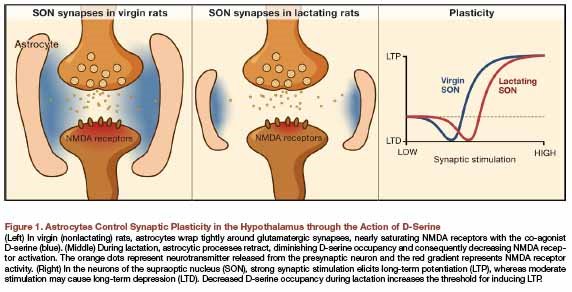
This little commentary here (pdf) in the current Cell describes a change in thinking that is occuring with regard to glia. They are stepping into a more active role. In this case, they modulate the ability of hypothalamic synapses to undergo plasticity. Compared to lactating rats, virgin rats have closer astrocyte encasement of synapses. The astrocytes release a chemical called D-serine into synapses that binds to a co-agonist site on NMDA receptors. NMDA receptor activation is considered the first checkpoint for increases in synaptic strength. More D-serine = more effective NMDA receptor activation.

In the study described, virgin rats have a lower threshold for LTP induction than do lactating rats. This is nicely illustrated below the fold.


So better glia encapsulation of synapses = more D-serine in synapses = more NMDAR activation = easier to undergo synaptic enhancement. This is in the hypothalamus mind you, not usually a major locus for memory studies. I’d like to see what’s going on during these states in the hippocampus. For those of you interested in intelligence and Ashkenazis and all that business, you might note that the major abnormality of Einstein’s brain was an greater glia to neuron ratio. I don’t know what that means either.