I don't smell it

Over at Genetics and Health Hsien-Hsien Lei tells the tale of a friend who can’t smell:

The Anosmia Foundation says that approximately two to five million American adults have disorders of taste and smell, which is a serious problem because they’re not able to smell burning fires, poisonous fumes, leaking gas, or spoiled food. Not being able to taste or smell anything can lead to weight loss (especially in the elderly) and even depression.

Just to show you what a freak I am, I immediately thought that perhaps these individuals would be greats controls to check and see if their partner’s MHC profiles don’t exhibit the same patterns we see in the smelling population. Meanwhile, Churchill posts on olfactory genes.

Slicer structure, piRNAs, and so much more

Nature Chemical Biology has a bunch of free content up in the form of an RNA Focus. There is, for instance, this review of some of the most recent advances in understanding RNA interference.

Small interfering RNAs are cut out of larger precursors by an enzyme called Dicer. From there, they are loaded into the RNA-Induced Silencing Complex (RISC). RISCs silence complementary, target RNAs either by sequestering them in processing bodies (P bodies) or by snipping them in two. This latter activity is carried out by a component of RISC called Argonaute. Since Argonaute can carry out the central “Slicer” activity of RNA interference, there has been much interest in its catalytic mechanism. Crystallization and mutagenesis studies have winnowed the active site down to three central amino acids in a chunk of Argonaute called the PIWI domain. Conservation of these amino acids (“the Slicer catalytic motif is moderately degenerate and should be defined as Asp-Asp-Asp/Glu/His/Lys”) is necessary but not sufficient for the Slicer activity, but Argonautes without them can still perform the other form of translational repression.

I haven’t yet taken the time out to read the literature on Piwi-interacting RNAs (piRNAs), but the review gives a nice concise description. These RNAs are slightly larger than your usual siRNA. They have mainly been studied in mouse testes. There are a ton of them and they don’t match up to known mRNAs so who they should be targeting. The Argonaute associated with piRNAs has the right amino acids and is a Slicer, but we don’t know what it is slicing just yet. There are also sections on the process of handing off newly produced siRNAs from Dicer to Slicer and Slicer function in another form of RNA-induced silencing that happens in the nucleus.

Posted in Uncategorized

ASPM, Microcephalin, and intelligence

One of the papers mentioned before on the lack of association between the derived haplotypes at ASPM and Microcephalin and intelligence is now out. Here’s the abstract:

Recent studies have made great strides towards identifying putative genetic events underlying the evolution of the human brain and its emergent cognitive capacities. One of the most intriguing findings is the recurrent identification of adaptive evolution in genes associated with primary microcephaly, a developmental disorder characterized by severe reduction in brain size and intelligence, reminiscent of the early hominid condition. This has led to the hypothesis that the adaptive evolution of these genes has contributed to the emergence of modern human cognition. As with other candidate loci, however, this hypothesis remains speculative due to the current lack of methodologies for characterizing the evolutionary function of these genes in humans. Two primary microcephaly genes, ASPM and Microcephalin, have been implicated not only in the adaptive evolution of the lineage leading to humans, but in ongoing selective sweeps in modern humans as well. The presence of both the putatively adaptive and neutral alleles at these loci provides a unique opportunity for using normal trait variation within humans to test the hypothesis that the recent selective sweeps are driven by an advantage in cognitive abilities. Here, we report a large-scale association study between the adaptive alleles of these genes and normal variation in several measures of IQ. Five independent samples were used, totaling 2,393 subjects, including both family-based and population-based datasets. Our overall findings do not support a detectable association between the recent adaptive evolution of either ASPM or Microcephalin and changes in IQ. As we enter the post-genomic era, with the number of candidate loci underlying human evolution growing rapidly, our findings highlight the importance of direct experimental validation in elucidating their evolutionary role in shaping the human phenotype.

Neandertal-Modern hybrid skull?

There is news about a skull which is about 40,500 years old found in Europe that exhibits a hybrid Neandertal-Modern morphology:

However, there were some important differences: apparently independent features that are, at best, unusual for a modern human. These included frontal flattening and exceptionally large upper molars with unusual size progression which are found principally among the Neanderthals.

Prof Chris Stringer of the Natural History Museum, London, commented on the PNAS paper’s suggestion of interbreeding: “How often it happened and its importance to the bigger picture of modern human origins are unclear, but my view from the available evidence is that it was probably a rare event. I thus take a different view from colleagues such as Joao Zilhao and Erik Trinkaus who see signs of a significant Neanderthal input in early Cro-Magnons.

Stringer is an Out of Africanist who believes that modern humanity emerged recently from the ancestral continent and replaced other archaic populations. But, as noted by the introgression story, rare breeding events can have salient genetic and evolutionary consequences. The key is to establish interfertility beyond a doubt, and then the genetic logic that positively favored alleles are likely to spread and fix across the subspecies boundary becomes compelling. This is only one skull, and though other “hybrid” finds have been recovered, I suspect that the total number will always remain small. Genetic methods will be essential in filling in the gaps in our knowledge, but these morphological finds are necessary elements in constructing the theoretical superstructure because genetic methods are by their nature conjectural and must be interpreted through particular assumptions.
The paper will be out soon in PNAS.

Race & modern genomics

p-ter has an interesting post where he explores some current findings about human population substructure. He begins:

First, an important preliminary– there are millions of places in the human genome where any two given people could possible differ, either by a single base change, the addition of an entire chunk of DNA, the inversion of a chunk of DNA, or whatever. Keep that in mind: millions and millions of places (for a database of many of the single base changes, see the HapMap). Now, the intuitive argument: after humans arose in Africa, they dispered themselves throughout the world. By both chance and in response to selection due to their new environments, populations in different parts of the world ended up with different frequencies of those millions of DNA variants. Simple enough. Now, below the fold, I will present the evidence that 1. the patterns of genetic variation form clusters on a world-wide scale, 2. genetic clusters coincide with what is commonly called “race”, and 3. genetic variation between clusters is relevant phenotypically.

Jason Rosenhouse has posted on race recently as well. You can find some of my own opinions on the topic here. Ultimately, I think asking questions about race/population substructure is very interesting because I find human evolutionary genetics very interesting. 2 years ago Armand Leroi could plausibly say we didn’t know how skin color was genetically controlled. Today he wouldn’t be able to say that.

Variation in gene expression between Africans and Europeans

Speaking of race, literally on the heels of a separate study (by a separate lab) on variation in gene expression between European and East Asian populations, a new study in the AJHG quantifies within- and between-population variation in gene expression for Africans and Europeans, an open question at the end of Rik’s post on the Euro vs East Asian differences.

We find extensive variation in gene-expression levels and estimate that ~83% of genes are differentially expressed among individuals and that ~17% of genes are differentially expressed among populations.

The latter percentage is smaller than the corresponding estimate from the Euro vs East Asian study, where it was ~26%. Contrary to proclamations (originally stemming from Lewontin’s Fallacy) that such fractions are “small,” imagine you observed that, despite most of the employees at the numerous stores of two corporations being mostly identical (there are mail clerks, receptionists, etc.), some of the actions of certain positions varied from one store to another. Suppose 83% of these variations were idiosyncratic: say, the mail clerks in all stores of corporation X tended to wear their hair in ways different from one another, and likewise for the mail clerks in all stores of corporation Y, with no clear split. But then suppose 17% of the variations were mostly X vs Y differences: some might be boring, like X employees wore blue uniforms while those of Y wore red uniforms. Other differences would not be boring, especially differences in “management style” — who gave what orders to whom. You’d have to dig up lots of data to see how large of an effect these between-group differences had on observable characteristics for each corporation (such as gross revenue, market share, and other finance terms I don’t know the meaning of). But the point is simply that it might “only” require the “small” amount of 17% to make a noticeable difference in such characteristics.

Next, the authors looked up the biological pathways that the differentially expressed genes fell into (using PANTHER). Their Table 1 shows that genes in 2 pathways were expressed differently among individuals, while genes in 11 pathways were expressed differently between Africans and Europeans:

Between-individuals
Inflammation mediated by chemokine and cytokine
T-cell activation

Between-populations
Inflammation mediated by chemokine and cytokine
Histamine H1 receptor-mediated signaling pathway
Toll-receptor signaling pathway
Fibroblast growth factor-signaling pathway
Vascular endothelial growth factor-signaling pathway
T-cell activation
EGF receptor-signaling pathway
B-cell activation
Notch-signaling pathway
Enkephalin release
5HT2 type receptor-mediated signaling pathway

All p-values were less than 0.05, though only the first one listed in “Between-populations” remained significant after a Bonferroni correction. I’m no bioinformaticist, but it seems that “multiple tests” here might not be so multiple if, for example, several differentially expressed genes were all involved in combatting a particular pathogen — then we have 1 hypothesis (different expression to combat a pathogen) which has several facets whose p-values we might add up, on the idea that the facets constitute a partition of the main trait, rather than multiply each p-value by 100 (or however many “tests” we ran). For example, the 4 p-values of the third through sixth entries in the “Between-populations” list add up to 0.0459 — still significant — although here none of their p-values withstands the Bonferroni correction. NB: I don’t claim these 4 pathways are linked to a single purpose; I’m just showing how several typical p-values can add up to less than the standard 0.05 significance level. Obviously, though, the input of professional statisticians is worth more than my wonderings.

Finally, on a molecular bio level (my square brackets:

To better understand the molecular basis for the observed [between-population] difference in expression [for SH2B3], we asked whether the expression level of one allele was different from the other in heterozygous individuals. If so, this provides evidence of cis-regulatory effects.26 There was a significant difference [P = 0.00118] in expression between alleles in heterozygous cDNA versus genomic DNA, strongly suggesting cis-regulatory effects (fig. 5b).

And as for signatures of selection (my square brackets):

Interestingly, these observations coincide with patterns of genetic variation at SH2B3, since there are 13 SNPs with large allele-frequency differences [Fst greater or = 0.45] between the CEU and YRI samples (fig. 5c). Five of these highly differentiated SNPs occur in conserved regions, as determined by alignment of 17 vertebrate genomes, making them strong candidates for future functional studies. We calculated the empirical probability of observing a SNP with a pairwise [Fst greater or = 0.45] between the CEU and YRI samples, on the basis of all autosomal markers contained in Hap-Map release 21, to be ~0.05, and this magnitude of allele frequency difference is consistent with a signature of local adaptation.7,39 SH2B3 also possesses unusually large levels of linkage disequilibrium compared with the rest of the genome,40 which provides additional support for the hypothesis that this locus has been subject to adaptive evolution, although additional studies will be necessary to make more-definitive inferences about its evolutionary history.

Posted in Uncategorized

Race: the current consensus

There has been surprisingly little outrage in the internets over Steve Hsu’s argument that the concept of “race” has a biological basis. But still, it might be worth going over in a bit more detail the evidence supporting him, so that’s what this post will aim to do; it will hopefully be worthwhile to have this all compiled in a single spot.

First, an important preliminary– there are millions of places in the human genome where any two given people could possible differ, either by a single base change, the addition of an entire chunk of DNA, the inversion of a chunk of DNA, or whatever. Keep that in mind: millions and millions of places (for a database of many of the single base changes, see the HapMap). Now, the intuitive argument: after humans arose in Africa, they dispered themselves throughout the world. By both chance and in response to selection due to their new environments, populations in different parts of the world ended up with different frequencies of those millions of DNA variants. Simple enough. Now, below the fold, I will present the evidence that 1. the patterns of genetic variation form clusters on a world-wide scale, 2. genetic clusters coincide with what is commonly called “race”, and 3. genetic variation between clusters is relevant phenotypically.

I. Genetic variation in humans forms clusters that correspond to geography

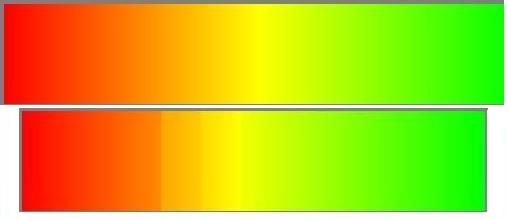
The fact that one can cluster humans together by geography based solely on their genetic information was most convincingly demonstrated in two papers (the second one is open access) by a group out of Stanford. These studies looked at several hundred variable places in the genome in 52 populations scattered across the globe. The hypothesis was as follows– on applying a clustering algorithm to these data, individuals from similar geographic regions would end up together. I’ve put a representation on the right, where colors represent poplations– on top is a pattern of variation that would lead to no clustering (the colors all blend one into the next) while on the bottom is a pattern of variation that would lead to clustering (there are subtle but noticable jumps from yellow to green, for example, though there is much variation within each color). Note that the lack of clustering would not mean that all populations are genetically the same (in the top figure, yellow and orange are not “the same” even though you couldn’t find a fixed boundry between them). But indeed, the researchers found the situation corresponding to the bottom figure– the individuals formed five clusters which represented, in the authors’ words, “Africa, Eurasia (Europe, Middle East, and Central/South Asia), East Asia, Oceania, and the Americas”. Some populations were exceptions, of course (there are always exceptions in biology)– they seemed to be a mix between two clusters, or could even form their own cluster in certain models.

But in general, the second model in the figure is a good fit for human variation based on the spots in the genome used by these researchers– continents correspond to clusters, and geographic barriers like the Himalayas or an ocean correspond to those areas where a “jump” from one cluster to the next occurrs.

II. Clusters and race

The fact that humans cluster together based on genetic information could, in theory, be entirely orthoganal to the concept of race. However, at least in the United State (where this has been explicitly tested), this is not the case. The most important reason for this, in my mind, is that the ancestors of European-Americans and African-Americans were not randomly sampled from the globe (there’s a bias towards points on the globe that are quite distant), and this non-random sampling accentuates the genetic differences between the two groups. But in any case, the reasons for this are irrelevant to the argument; let’s look at the data.

The basis for this assertion comes from a paper (open access) by a different set of researchers at Stanford, who assembled a group of Americans who identified themselves as either African-American, white, East Asian, or Hispanic. They followed a similar protocal as the studies in the first section– they took DNA from all individuals, looked a hundreds of different DNA variants, and applied a clustering algorithm. They then looked to see if their clusters corresponded to self-reported group. And indeed, in 3631 out of 3636 cases (99.85%), the individuals were clustered by the algorithm into the “correct” racial group.

This result is obviously only valid in America, but presumably it could be repeated in other parts of the world (though there is some evidence that skin color and genetic ancestry are becoming independent in Brazil). But it is certainly the case that knowing someone’s race will give you some probabilistic insight into their genetics[1].

III. Genotype and Phenotype

Once one accepts that genetic information clusters people together according to geography and that these clusters sometimes correspond to race, the next question is, do these genetic differences add up to phenotypic differences? The answer to this question is slowly emerging, and in the shadows I see the outline of a “YES”.

All of the studies I will cite are based on the HapMap, a resource with genetic data as well as cell lines for individuals from four populations– one of Western European ancestry, an Nigerian population, a Chinese population, and a Japanese population. Does the Nigerian population represent all populations in the African cluster, or the European population represent all the populations in the Eurasian cluster? Of course not, but analyzing them certainly gives an insight as to what makes one population different from any other.

First, the genetic data from the different populations can be analyzed to search for areas of the genome that have been under recent selection– i.e. that have recently become beneficial for Nigerians, or Chinese, or whichever group. That analysis was done by two groups (both papers are open access), though I will discuss the second one. What they found was that each of the populations (they group the Chinese and Japanese together into a single population) has been under, and probably continues to be under, natural selection. It would be theoretically possible (if remarkable) to find that all humans are undergoing the same selective pressures and responding identically to them, but that is not the case. I’ve posted on the right a Venn diagram from the paper showing that most of the loci identified as under selection are detected in only one of the three groups, indicating that selection is causing people in different parts of the globe to become more distinct. The precise effects of the genetic variation between populations is unclear, but (as it’s under selection) it’s certainly phenotypically relevant. And lest you think the genes under selection are related only to “boring” physiological traits, note that one of the papers found that a number of genes involved in “ne
uronal function” have been under selection.

Even more recently, another group analyzed gene expression in both the Asian HapMap samples and the European HapMap samples and found that around 25% of the genes in the two were differentially expressed, and that this differential expression is due to genetic differences in many cases. The road from genotype to phenotype goes through gene expression, so this is a major step in connecting genetic variation to phenotypic variation.

So it’s clear that populations differ genetically and that these differences are relevant phenotypically and informative about race. So, do genetic differences explain racial differences in any given phenotype? I hope that for phenotypes like eye color and skin color people accept the answer as obviously yes; these sorts of things have been convincingly demonstrated. For other phenotypes like IQ or personality, if you’re inclined to react negatively, I say wait a few years before you get too confident; the study of human genetic variation is in its infancy, and once it hits adolescence it’s going to start becoming a real pain in the ass.

[1]A note on race being a societal construct. To some extent, of course it is–some people that would be called “black” in the US might not be called “black” in France, for example (and not because of the language difference, for all you smartasses. The word “black” in French specifically refers to racial classification). I have enough faith in human intelligence to think that the first person who called race a societal construct did not mean that it had no biological component as well–note that the Wikipedia entry on adolesence refers to it as a “cultural and social phenomenon” but also “the transitional stage of human development in which a juvenile matures into an adult”. People seem to somehow be able to keep the cultural and biological aspects of adolescence in their heads at the same time, as I imagine the first sociologists to study race were able to do (I may, of course, be wrong), yet somehow the fact that biological differences are interpreted through a cultural lens has somehow morphed into the idea that the biological differences don’t exist to begin with (see, e.g. the ASA statement on race). Weird.

The Alevis of Turkey

Ruchira Paul points me to this article about the Alevis of Turkey. CIA factbook says of Turkey: “Muslim 99.8% (mostly Sunni).” The articles suggests that about 20% of Turkish citizens are Alevi (I say “Turkish citizens” because many Alevis are Kurds, not ethnic Turks). It goes on to describe their religion, which is hard to pin down and is assumed to be vaguely Shia (mostly because anything non-Orthodox seems to be thrown into the Shia bag). I’ve noted before that it is likely they have some relationship to the Alawites of Syria, this must remain conjecture since both are operationally crypto-religions. That being said, it doesn’t really matter much…except for the fact that the Middle East matters…because of oil and international politics….

Addendum: My own awareness of Alevis comes from taking a course on ethnic minorities in Germany as an undergraduate. The Alevi-Sunni schism is pretty evident in the Turkish Diaspora as the Alevis no longer have to dissimulate and kow-tow to the Sunni establishment. It is important to know this when an ethnic Turk attempts to represent Turks in Germany, and it turns out they’re Alevi and so have no influence amongst most Turks.