

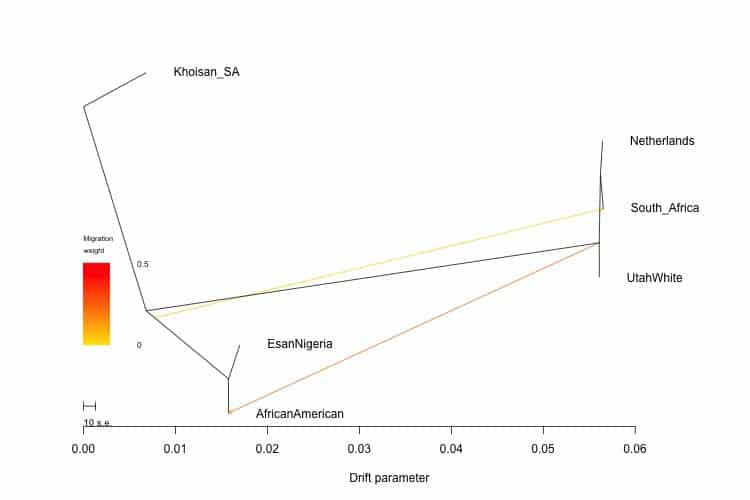
 There’s a new paper in BMC Biology, Patterns of African and Asian admixture in the Afrikaner population of South Africa, which confirms some of what I found years ago with a much smaller data set, The Genetics Of Afrikaners (Again). The PCA above and Treemix to the right I generated from the data in the new paper.
Here are their results:
To investigate the genetic ancestry of the Afrikaner population today (11–13 generations after initial colonization), we genotyped approximately five million genome-wide markers in 77 Afrikaner individuals and compared their genotypes to populations across the world to determine parental source populations and admixture proportions. We found that the majority of Afrikaner ancestry (average 95.3%) came from European populations (specifically northwestern European populations), but that almost all Afrikaners had admixture from non-Europeans. The non-European admixture originated mostly from people who were brought to South Africa as slaves and, to a lesser extent, from local Khoe-San groups. Furthermore, despite a potentially small founding population, there is no sign of a recent bottleneck in the Afrikaner compared to other European populations. Admixture amongst diverse groups from Europe and elsewhere during early colonial times might have counterbalanced the effects of a small founding population.
 Afrikaner ancestry is overwhelmingly Northern European. But as you see in the PCA above they are notably African and Asian shifted when compared to their potential ancestral populations (I used Dutch and German individuals above). For me this is the part that is important, if not surprising:
The individual with the most non-European admixture had 24.9% non-European admixture, and only a single Afrikaner individual (out of 77) had no evidence of non-European admixture…Amongst the 77 Afrikaners investigated, 6.5% had above 10% non-European admixture, 27.3% between 5 and 10%, 59.7% between 1 and 5% and 6.5% below 1%.
So about 87% of Afrikaners in their sample had between 1 to 10 percent non-European ancestry. As suggested by genealogical evidence, genetics indicates this is a relatively recent admixture, occurring during the 17th and 18th-century. The early decades of the Cape Colony. It’s a mix of diverse Asian and African components. In some ways, it seems that the non-European ancestry in modern Afrikaners is just the same phenomenon which gave rise to the Cape Coloured population, which is a mix of European, Asian (Indian and Austronesian) and African (Bantu and Khoisan).
Honestly, I think the individuals with more than 10% non-European ancestry, or 0% non-European ancestry, may have recent non-Afrikaner ancestry, and so are not representative (Hendrik Verweord was Dutch and immigrated to South Africa, so he would not have had non-European ancestry). Arguably, the fact that Afrikaners are only ~5% non-European is rather surprising in light of the conditions of the Cape Colony during its early years.
 But, this result is more interesting in light of how it contrasts with another case. Also in the 17th-century, there emerged another European settler society on the edge of a vast ocean rooted in a deeply Calvinist faith. By this, I mean the colonies of New England. Though New England has been reshaped by later migrations, between 1640 and 1790 30,000 English settlers expanded and grew into a region with 750,000 Americans. In the early 19th-century, New England spilled out over much of the northern swath of the United States of America, in part due to the fact that the fertility of New Englanders was quite high (the early Mormons were fundamentally a New England-derived subculture).
And yet unlike the Afrikaners or the whites of Latin America, the scions of New England have no non-European ancestry. One might argue here that this is due to the lack of opportunity, as the number of slaves in New England was always very low, and there were no native peoples. King Philip’s War falsifies the latter contention. There were numerous native people. At least initially. But the New Englanders were very efficient and effective at marginalizing and exterminating the native peoples of the region. To a far greater extent than occurred in the South.
There was no New England “Trail of Tears,” because New Englanders eliminated most of the local tribes. There are even records New England militias in the 17th-century drowning native children in the Connecticut River as an ultimate solution (to the chagrin and concern of some ministers who wished these children to be baptized and raised as Christians).
 Of course, another distinctive aspect of the New England settlement is that it was the transplantation of a whole English society, men and women, rather than simply men seeking fortune and opportunity. This sex balance from the beginning meant that there was no necessity of looking for partners in the local population, as often occurred in other colonial contexts.
The lack of any local imprint on New England’s genetics, in contrast with almost all other settler and colonial societies, is in keeping with the other peculiarities of the region’s cultures. By the latter portion of the 18th-century New England was unique because it was beginning to see itself as not just a complement of the metropole, but a potential rival.* A potential that would be realized with the intellectual (the emergence of Harvard) and economic (industrialization) developments of the 19th-century.
 Today when talking to Patrick Wyman of Tides of History, I suggested that genetics can only be understood in a broader context, even if it is to answer specific questions. Though European settler societies are all predominantly European, both culturally and biologically, New England’s uniqueness genetically in having almost no native input reflects I think a broader cultural reality of the region’s history: it is peculiarly European without much synthesis with the local substrate.
* The South was a traditional commodity-exporting colony. The Mid-Atlantic, focused on New York City, was the center of mercantile activity that operated as a transaction hub of a global trade system.


 kan
kan


